
Quick Insight
The rise of smart contracts—self-executing digital agreements written in code—is redefining how financial systems operate. These contracts automate trust, executing transactions only when programmed conditions are met. But as financial logic shifts from human interpretation to digital automation, a deeper question emerges: What happens when code itself enforces the law?
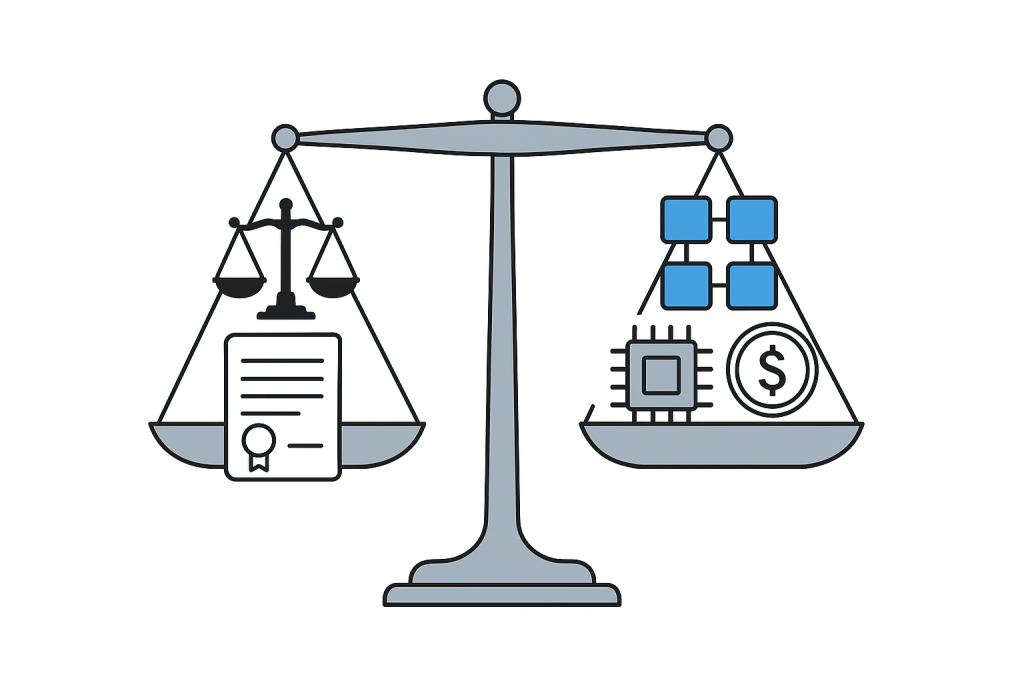
This convergence of technology, law, and ethics is forming the new governance layer of smart finance. “Programmable law” challenges traditional systems of regulation and accountability, demanding that we rethink how fairness and compliance function in an autonomous, global economy.
Why This Matters
Financial systems have always been governed by a mix of human judgment and institutional oversight—laws, contracts, regulators, and courts ensuring fairness and responsibility. Smart contracts replace much of that structure with algorithmic precision. A transaction only executes if the code allows it, leaving little room for interpretation.
That shift introduces both power and risk. Automation removes human bias, but it also removes human empathy. Once a smart contract is deployed, it cannot easily be altered or overridden. If the code contains an error—or if unforeseen circumstances arise—the system may act lawfully in logic, but not ethically in context.
For educators, parents, and civic leaders, understanding this tension is essential. As digital economies grow, future generations will inherit a world where governance is increasingly embedded not in institutions, but in algorithms. The question is no longer if code will shape law—it’s how we ensure it reflects shared human values.
Here’s How We Think Through This
- Define the Boundary Between Legal Intent and Code Execution
Traditional contracts rely on interpretation—judges and lawyers consider the “spirit” of the law. Smart contracts, by contrast, follow their code precisely. The challenge is translating human intention into digital logic without losing nuance. - Understand the Concept of Programmable Law
Programmable law isn’t just about automating contracts—it’s about creating systems where compliance, taxation, and even dispute resolution can be built into the infrastructure. This could make global finance more efficient but also more rigid if governance mechanisms are poorly designed. - Evaluate Accountability and Error Management
In the physical world, disputes can be mediated; in the digital one, execution is often irreversible. Effective smart finance systems must include fallback mechanisms—what’s sometimes called “human-in-the-loop” oversight—to prevent unintended consequences. - Map the Role of Regulators and Institutions
Regulators are adapting by building “RegTech” frameworks that monitor smart contract systems in real time. Governments are experimenting with blockchain auditing tools and compliance oracles that blend automation with legal enforcement. - Forecast Ethical and Educational Implications
As financial literacy evolves into digital governance literacy, the next generation must learn to read both contracts and code. Understanding how rules are embedded into algorithms will be key to maintaining fairness in automated economies.
What Is Often Seen as a Future Trend — Real-World Insight
We’re already seeing the early forms of programmable law emerge:
- Estonia and Singapore are developing national digital governance systems that integrate legal frameworks directly into blockchain-based registries.
- Switzerland’s “Crypto Valley” has established legal recognition for blockchain governance models, blending digital and traditional oversight.
- The EU’s MiCA regulation (Markets in Crypto-Assets) is introducing compliance standards for automated systems that operate across borders.
These examples reveal a gradual fusion of law and code. The “governance layer” of finance is no longer confined to legal documents—it’s embedded in algorithms, infrastructure, and digital institutions.
The next evolution of finance won’t just be about decentralization—it will be about designing digital systems that balance efficiency with empathy, automation with accountability, and precision with justice.