
Quick Insight
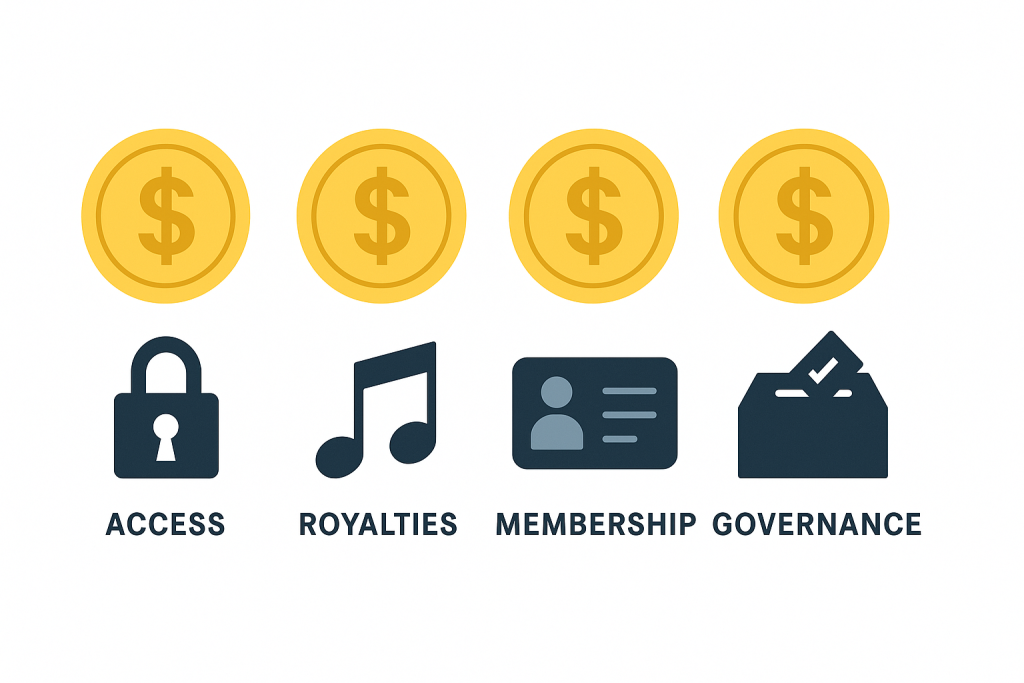
Tokens are often described as digital money, but their real power emerges when they represent rights rather than currency. A token can grant access, distribute royalties, provide voting power, or signal membership. For young people growing up in digital ecosystems, understanding these rights-based tokens is essential to navigating future economic, creative, and civic environments.
Why This Matters
The next generation will interact with systems where ownership is only one part of the story—participation, access, and influence matter just as much.
In physical life, rights are usually separate from money: a ticket grants access, a membership confers status, a vote determines governance, and royalties reward creators. Tokenized rights bring all of these functions into one programmable layer, making them portable, transparent, and sometimes tradeable.
This shift matters because:
- Students may participate in digital communities governed by tokens.
- Creators increasingly rely on automated royalties tied to digital assets.
- Membership and access may be verified through tokenized passes rather than accounts or subscriptions.
- Decision-making in online spaces is increasingly collective and token-powered.
For parents and educators, it’s no longer enough to teach “how money works.” We must also help young learners understand how rights are represented, distributed, and protected in tokenized systems.
Here’s How We Think Through This
Grounded steps to explain rights-based tokens clearly, safely, and without hype.
1. Separate tokens-as-value from tokens-as-rights
Start by drawing a clear distinction:
- Value tokens behave like digital currency.
- Rights tokens represent what someone can do or access.
This helps students see that not all tokens should be evaluated through price alone.
2. Explain the four core categories of tokenized rights
Access rights
Tokens can act like digital keys or passes:
- Course enrollment
- Event tickets
- Subscription alternatives
Students quickly grasp this because it mirrors everyday experiences.
Membership rights
Tokens can function as digital ID cards for communities:
- Clubs
- Learning groups
- Online organizations
Membership tokens can unlock spaces or privileges normally hidden behind sign-ups.
Governance rights
Some tokens allow holders to vote on decisions:
- Rules of a community
- Allocation of resources
- Future project direction
These tokens teach real lessons about shared responsibility and civic participation.
Royalty or revenue rights
Tokenized royalties allow creators to receive automated income streams when their work is used or resold. This modernizes concepts like licensing and intellectual property.
3. Connect rights to real-world analogies
Educators can map tokenized rights to familiar equivalents:
- A festival wristband as an access token
- A library card as a membership token
- A student council ballot as governance power
- Book royalties as revenue rights
This keeps explanations grounded and relatable.
4. Introduce programmability without leaning on technical jargon
The key difference with tokens is programmability:
- Access can be time-limited
- Royalties can be distributed instantly
- Governance votes can be weighted based on contribution
Students don’t need code—just the understanding that rules can be automated.
5. Discuss responsibility and risk
Rights can be lost if:
- A wallet is compromised
- A token is accidentally transferred
- A platform hosting the rights fails
Students need to understand the importance of secure storage and thoughtful participation.
6. Use simulations or classroom-made tokens
Educators can build simple systems where:
- Tokens grant access to classroom activities
- Students vote on group decisions
- “Royalties” are given based on contribution to a project
These experiences create memorable, low-risk lessons about digital rights.
What Is Often Seen as a Future Trend — Real-World Insight
Tokenized rights often sound futuristic, but many young people already use systems that resemble them—learning portals, digital passes, game memberships, creator platforms, and loyalty apps.
The real insight is that tokenization doesn’t introduce new rights.
It digitizes existing ones in ways that are:
- Portable
- Verifiable
- Shareable
- Programmable
This means the next generation will interact with rights more directly and with greater visibility into how they’re allocated or exercised.
Rights-based tokens teach young people how communities function, how decisions are made, and how value is shared. Instead of being passive users inside digital systems, they can become active participants who understand the mechanics shaping their digital and physical lives.
When we help them understand tokenized rights today, we prepare them for a world where economic participation and community participation increasingly overlap—and where digital rights will matter just as much as digital money.