
Quick Insight
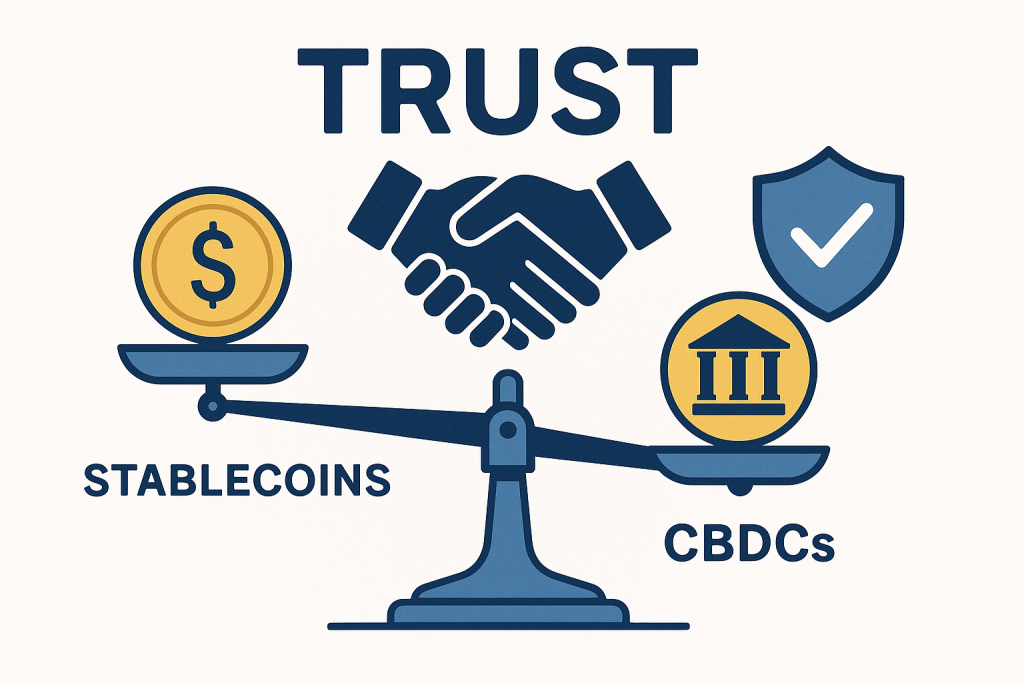
In the emerging landscape of digital money, the defining factor isn’t code—it’s confidence. As stablecoins (privately issued, blockchain-based currencies) and central bank digital currencies (CBDCs) vie for relevance, the future of commerce hinges not on technological capability, but on who people trust to issue, hold, and manage value.
Stablecoins promise flexibility, speed, and innovation. CBDCs offer state-backed reliability and policy control. Yet both face the same underlying question: Can they earn—and sustain—trust in a world where digital money is only as strong as the system behind it?
Why This Matters
Money is no longer just paper or numbers on a screen—it’s becoming a programmable asset. In this transition, trust becomes the new currency standard.
- For consumers, it’s about assurance—knowing their digital funds will retain value and privacy.
- For governments, it’s about sovereignty—ensuring the state remains central to monetary stability.
- For businesses, it’s about interoperability—balancing efficiency and regulatory compliance.
As digital currencies blur the line between public and private finance, the future of money will be determined by which system earns deeper societal legitimacy. The question isn’t just “Which is safer?” but “Which is fairer, more transparent, and more resilient?”
Here’s How We Think Through This
Step 1: Separate the Technology from the Trust
Both CBDCs and stablecoins run on digital ledgers, but trust derives from who governs the ledger, not just how it functions. Central banks rely on policy credibility; stablecoins depend on the perceived stability of their reserves and governance. The technical layer only matters if the social layer is credible.
Step 2: Understand the Incentive Architecture
CBDCs are designed for policy alignment—enabling better financial oversight and inclusion. Stablecoins are built for efficiency and innovation—enabling borderless commerce. Each system builds trust differently: one through centralization and accountability, the other through decentralization and market proof.
Step 3: Map Transparency Against Risk
In stablecoin systems, transparency comes from open ledgers and third-party audits; in CBDCs, it comes from government regulation and institutional reputation. The challenge for both lies in balance—too much control erodes freedom; too little invites volatility.
Step 4: Track the Public Mood
Adoption depends as much on sentiment as on infrastructure. People trust what they understand and what reflects their values. A well-governed stablecoin may outpace a CBDC in one market, while in another, citizens may prefer the reassurance of state-issued currency. Trust is local before it becomes global.
Step 5: Focus on the Human Interface
Whether wallet, app, or policy portal, the point of interaction defines perception. Design trust into the user experience—clarity of value, simplicity of use, and ethical data handling will determine which currency gains traction in daily life.
What Is Often Seen as a “Future Trend” — Real-World Insight
While this competition may seem theoretical, it’s already unfolding:
- China’s digital yuan demonstrates how state-backed systems can scale rapidly—but also how control can limit privacy and autonomy.
- U.S. dollar-backed stablecoins like USDC have shown resilience in cross-border commerce, but rely on private transparency and regulatory goodwill.
- The EU and emerging economies are experimenting with hybrid models—regulated stablecoins operating within CBDC frameworks—to merge innovation with oversight.
The trajectory is clear: trust, not technology, will define the winners. The world’s next monetary system will succeed not because it’s faster or cheaper, but because it feels reliable, fair, and human-centered.
The future of money isn’t about replacing what we trust—it’s about rebuilding that trust for a digital era.