
Quick Insight
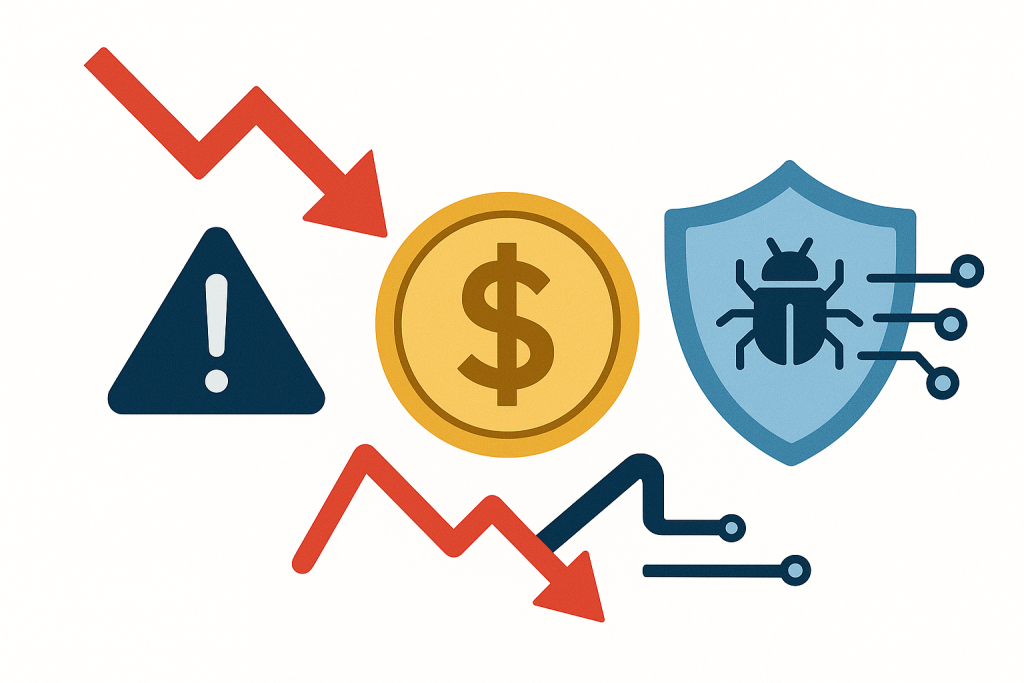
Tokenized assets introduce risks that differ from traditional financial systems. These include rapid price volatility, code-based vulnerabilities, and behavioral traps that emerge in fast-moving digital environments. Teaching young people how these risks work—and how to respond to them—builds financial resilience for a future where digital value is embedded in everyday life.
Why This Matters
Young people are already operating in digital economies without fully understanding the risks beneath them.
In conventional finance, risk is often slow to appear and heavily mediated—banks provide fraud protection, credit card companies absorb errors, and institutions handle security in the background. Tokenized systems shift much of that responsibility to individuals. Assets can fluctuate in seconds, and smart contracts operate as automated agreements with no customer service line when something goes wrong.
For parents and educators, the goal isn’t to discourage participation. It is to give young people the tools to navigate digital value systems safely.
This means helping them understand how technical risks, economic dynamics, and human behavior intersect in token environments. When these concepts are explained clearly, young people gain the ability to evaluate opportunities and avoid unnecessary exposure.
Here’s How We Think Through This
Grounded steps for understanding risk in token-based systems.
1. Start with volatility as a feature, not a flaw
Token markets react instantly to demand, speculation, and network activity.
Young people should understand:
- Prices can move quickly, up or down
- Small communities can create large swings
- Long-term value depends on fundamentals, not temporary hype
This is the digital equivalent of teaching that investments can go both ways.
2. Introduce technical risk through smart contract basics
A smart contract is code that executes automatically. It can:
- Facilitate trades
- Distribute rewards
- Enforce rules in digital ecosystems
But it can also contain bugs or be exploited. Young people should know that code-based systems require audits, testing, and ongoing maintenance—and that “trustless” does not mean “riskless.”
3. Explain custody and security risks
Unlike traditional accounts, tokenized assets often rely on self-custody. This creates new responsibilities:
- Private keys must be protected
- Recovery phrases must be stored safely
- Device security becomes financial security
Young people must learn that losing access isn’t a minor inconvenience—it can mean permanent loss of assets.
4. Highlight network and platform risks
Even well-designed tokens depend on:
- Platform stability
- Network activity
- Developer support
If a platform shuts down or a network becomes congested, access to assets can become delayed or disrupted. This teaches the importance of evaluating the reliability of the systems that surround a token—not just the token itself.
5. Address behavioral risk
Digital environments heighten emotional responses.
Examples include:
- Fear of missing out during sudden price spikes
- Following influencers instead of evidence
- Underestimating loss because assets feel abstract
Teaching young people to pause, verify, and evaluate before acting builds long-term financial discipline.
6. Use controlled scenarios to practice safe habits
Educators can simulate:
- Volatility events
- Smart contract bugs
- Liquidity drops
- Risk assessments for hypothetical platforms
This allows young people to explore risk safely before encountering it in the real world.
What Is Often Seen as a Future Trend — Real-World Insight
Many adults treat token risk as something distant or highly technical, but young people face token-like environments every day. In games, creator platforms, and digital ecosystems, they experience fluctuating digital value, platform changes, and evolving rules—mirroring the dynamics of real tokenized systems.
What appears to be a futuristic concern is already shaping how they interact with digital value.
The real point is not whether young people will use tokenized assets.
They already are.
The question is whether they understand the risks:
- Volatility teaches that value can change quickly.
- Smart contracts reveal that code can be powerful—and fallible.
- Self-custody highlights the responsibility of digital ownership.
- Behavioral patterns show how emotion can override judgment.
Building literacy around these concepts prepares young people not just to avoid mistakes, but to recognize well-designed systems, evaluate risks logically, and participate confidently in a tokenized world.