
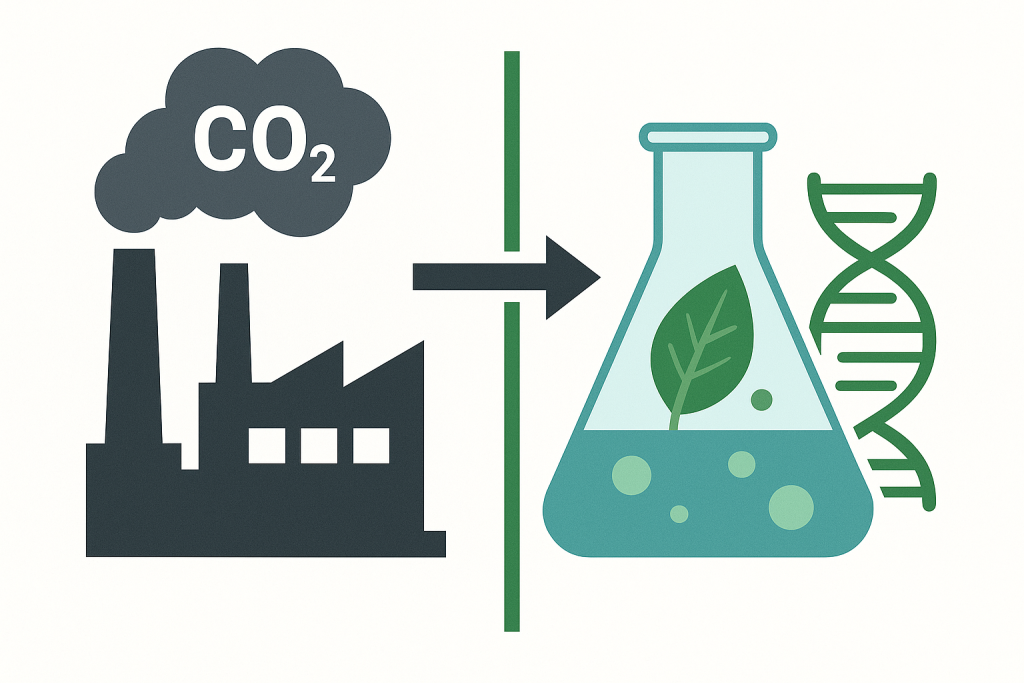
When factories learn to grow instead of burn, climate math changes forever.
The Industrial Problem
For two centuries, the global economy has relied on extraction and combustion. From petrochemical plants to steel mills, the industrial model runs on fossil fuels, releasing massive amounts of carbon dioxide (CO₂) into the atmosphere.
Today, manufacturing accounts for roughly one-third of global emissions, with much of that embedded in supply chains that depend on mining, refining, and long-distance transport. Even “green” production often hides upstream costs—energy-intensive inputs, chemical waste, and logistics footprints that are invisible to the end consumer.
To achieve true decarbonization, it’s not enough to power old systems with renewables. We must rebuild the systems themselves, replacing extraction-based manufacturing with regenerative biological processes.
That’s where programmable biology—the ability to engineer life with tools like CRISPR—enters the equation.
The Shift: From Petrochemistry to Biomanufacturing
Programmable biology is transforming production by using living systems—microbes, algae, and engineered enzymes—to manufacture materials, fuels, and chemicals.
Unlike industrial chemistry, biological manufacturing operates at room temperature and atmospheric pressure. It uses CO₂, sunlight, and renewable feedstocks instead of petroleum or coal. The result: drastically lower energy use and near-zero emissions.
Think of it as replacing factories with bioreactors—systems that “grow” materials rather than assemble them.
Traditional manufacturing: extract → refine → burn → emit.
Programmable biology: design → grow → recycle → sequester.
The difference is not incremental—it’s systemic.
CRISPR: The Engine of Biological Precision
CRISPR enables scientists to edit and reprogram DNA with precision, turning microbes into programmable factories. Through gene editing, microbes can be taught to:
- Capture carbon dioxide from the air or industrial waste streams.
- Convert CO₂ into valuable products like biofuels, plastics, or textiles.
- Self-regulate energy use for optimal efficiency.
This makes CRISPR not just a medical breakthrough—but a climate technology. Instead of simply offsetting carbon, CRISPR-based systems can reverse emissions by embedding carbon capture directly into production cycles.
The Climate Math: Why Biology Wins
Comparing the carbon footprint of programmable biology with traditional industry reveals a fundamental inversion in energy use and waste generation.
| Process | Energy Source | Emissions Profile | Byproducts |
|---|---|---|---|
| Petrochemical Manufacturing | Fossil fuels | CO₂ emitted during production | Waste, pollution, heat |
| Programmable Biomanufacturing | Biomass, CO₂, sunlight | Carbon-neutral or negative | Oxygen, biodegradable outputs |
A single CRISPR-engineered microbe can produce the same compounds as a refinery—but without pipelines, combustion, or toxic residue.
For example:
- Biofuels made by engineered algae emit up to 80% less CO₂ than petroleum fuels.
- Bioplastics from microbial fermentation break down naturally instead of persisting as waste.
- Biofoundries, powered by automation and AI, can produce locally, eliminating thousands of miles of shipping emissions.
When scaled, these differences amount to gigatons of avoided or sequestered carbon every year.
Local Production, Global Impact
Programmable biology decentralizes manufacturing. Rather than massive plants exporting goods worldwide, localized bioprocessing hubs can produce materials close to where they’re needed.
This shift shortens supply chains, lowers transport emissions, and creates regional resilience. It also reduces reliance on politically and environmentally unstable resource markets—turning biological literacy into a form of climate security.
Imagine: a city where clothing fibers, construction materials, and fuels are grown locally using engineered cells. This is not speculative science—it’s an emerging economic model.
The Sustainability Multiplier
The climate advantage of programmable biology extends beyond emissions. Biological systems are inherently circular—they regenerate resources and align with ecological cycles.
- Waste-to-Value: Microbes can turn industrial CO₂ into building materials or fuels.
- Energy Efficiency: Bioreactors run at ambient conditions, reducing energy use by up to 90%.
- Renewability: Feedstocks come from plants, waste streams, or captured carbon—not fossil reserves.
Every step of biological manufacturing compounds sustainability rather than depleting it.
Education and the New Climate Literacy
For educators and parents, programmable biology offers a new lens for climate education. The story of decarbonization is no longer just about energy—it’s about systems thinking: how biology, technology, and design interconnect to rebuild industry sustainably.
Students can learn how gene editing translates into materials science, how circular systems mimic ecosystems, and how innovation itself can become regenerative.
Preparing young people for a bio-based economy means teaching them not only how to code software—but how to code life.
Ethics and Oversight
As we turn biology into infrastructure, new ethical questions arise:
- How do we ensure genetically engineered organisms are safely contained?
- Who owns the genetic blueprints of essential materials?
- How do we balance innovation with biodiversity protection?
Responsible governance must evolve alongside capability. As with any transformative technology, the goal is not control—but stewardship.
The Next Industrial Model: Living Systems
Programmable biology flips the industrial paradigm from consumption to creation. It transforms carbon from a pollutant into a resource and redefines manufacturing as a biological process that regenerates instead of depletes.
In this new model:
- Factories become living systems.
- Supply chains become ecosystems.
- Emissions become inputs for the next cycle.
The carbon code of the future isn’t written in smoke or steel. It’s written in DNA.