
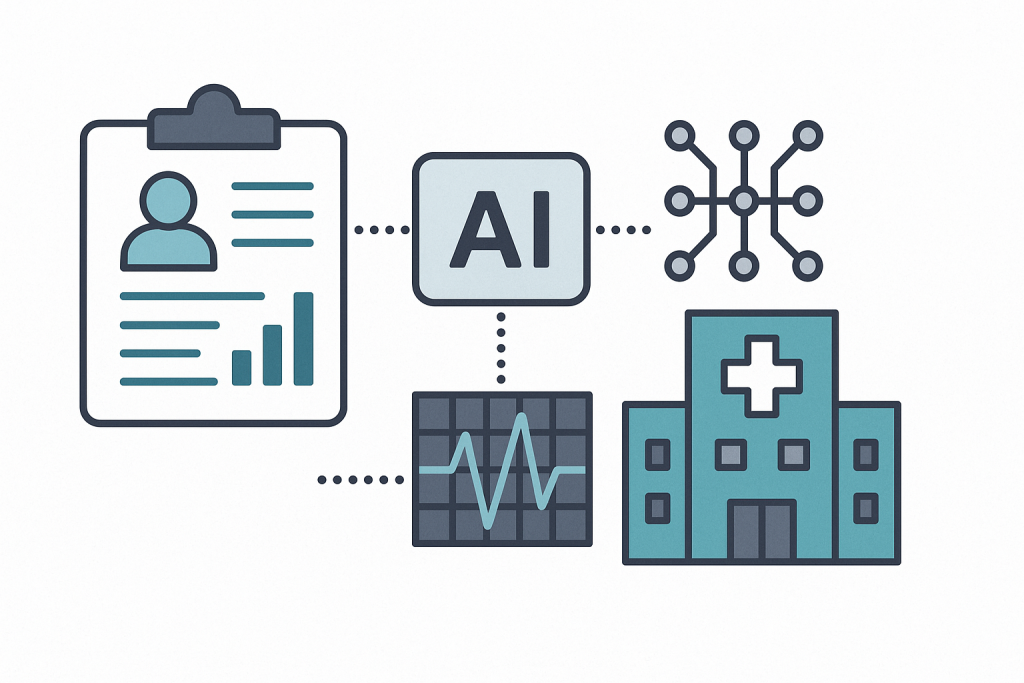
Healthcare AI needs data that is both rich and deeply sensitive. Synthetic medical data offers a practical bridge: it can preserve the statistical patterns that matter for model training and evaluation—without containing records tied to real people. When done responsibly, synthetic patients and outbreak simulations let health systems build safer, faster, and more collaborative AI, while avoiding the exposure risks that come with sharing real patient data.
Light italic subheading What “synthetic patients” really are
Synthetic patients are not copied charts with names removed. They are newly generated records that resemble the population-level behavior of real datasets: the same distributions of age, diagnoses, lab results, treatment sequences, and outcomes—but without any one person’s traceable footprint.
Why This Matters
In healthcare and public health, AI is often blocked by a single tension: the best models need large, detailed datasets, yet the most detailed datasets are the hardest to share ethically and legally. Synthetic data changes that tension in three important ways.
Light italic subheading 1) It unlocks training data without widening privacy risk
Real patient data, even anonymized, can sometimes be re-identified—especially when paired with external information. Synthetic data reduces that risk because it aims to avoid one-to-one correspondence with real individuals. This makes it possible to train or pre-train models with far less chance of exposing sensitive histories.
Light italic subheading 2) It accelerates research and cross-institution collaboration
Hospitals and public health agencies frequently want to collaborate, but face long delays around data-sharing agreements. Synthetic datasets allow teams to share realistic data for development and testing while leaving real data behind locked governance walls.
Light italic subheading 3) It builds readiness for rare events and system shocks
Public health depends on preparedness. Outbreak simulations and synthetic cohorts for rare diseases expand the “training universe” so models can learn patterns that real datasets don’t capture in sufficient quantity.
For families and communities, this matters because better healthcare AI should not require sacrificing confidentiality. Synthetic data helps move us toward that balance.
Here’s How We Think Through This (steps, grounded)
Light italic subheading Step 1: Start with clinical or public-health decisions, not data volume
We define the purpose first. Examples:
- Predicting sepsis risk earlier
- Optimizing readmission reduction pathways
- Detecting imaging anomalies
- Forecasting outbreak spread and resource needs
Synthetic data is only useful relative to a decision it supports.
Light italic subheading Step 2: Identify the “signal relationships” AI must learn
Healthcare data is full of correlations that look meaningful but aren’t. We select the relationships that matter clinically:
- Time-dependent disease progression
- Medication–lab response patterns
- Co-morbidity clusters
- Realistic care pathways and delays
We want to protect the signal, not merely reproduce surface similarity.
Light italic subheading Step 3: Build a minimal, representative real seed dataset
Synthetic data still needs a foundation. The seed should be:
- Minimal: excluding unnecessary identifiers and proxies
- Governed: strict access inside the institution
- Representative: capturing demographic and clinical diversity
If the seed is biased or thin, the synthetic output will mirror those weaknesses.
Light italic subheading Step 4: Generate synthetic cohorts matched to the use case
Different problems require different synthetic approaches:
- Tabular synthetic records for EHR/model development
- Time-series synthetic data for vitals, wearables, ICU dynamics
- Synthetic imaging/text for radiology notes, pathology, triage summaries
Key principle: preserve cross-variable logic (what tends to happen together and in what sequence).
Light italic subheading Step 5: Validate utility and privacy as two separate gates
Utility validation asks:
- Do key distributions and clinical correlations match?
- Do trained models generalize similarly to real-data models?
- Are edge cases present at realistic rates?
Privacy validation asks:
- Are any synthetic records too close to real ones?
- Can membership or attribute inference reveal who was in seed data?
- Are rare-case fingerprints generalized enough?
A synthetic dataset is not acceptable unless both gates pass.
Light italic subheading Step 6: Use synthetic data as the default sandbox
Once validated, synthetic datasets can support:
- Vendor evaluation without exporting real charts
- Rapid prototyping across teams
- Clinical model pre-training before fine-tuning
- Workforce training and simulation
- Public health tabletop exercises with realistic data streams
Real data becomes the controlled “final exam,” used sparingly for calibration and monitoring.
Light italic subheading Step 7: Maintain real-world anchoring over time
Healthcare changes: new variants, new treatments, new patient populations. We keep synthetic systems aligned by:
- Refreshing seed data periodically
- Monitoring performance drift
- Retesting privacy and bias at each release
Synthetic patients help you move faster—but only if you keep them tethered to today’s reality.
What is Often Seen as a Future Trend — Real-World Insight
Light italic subheading Trend people talk about: “Synthetic data will replace real patient data.”
Light italic subheading Reality we see: Synthetic data reshapes the pipeline, but real data remains the anchor.
Here’s what’s true on the ground right now:
Light italic subheading Where synthetic data is already driving real progress
- Multi-hospital model development
Teams use synthetic cohorts to collaborate on model design and benchmarking without transferring real EHRs. This speeds research while keeping patient data inside local governance. - Rare disease and pediatrics
Real datasets are often too small to train robust models for rare conditions. Synthetic generation expands sample size while preserving rarity patterns, enabling safer experimentation. - Outbreak and surge readiness
Synthetic outbreak simulations help public health agencies test forecasting, resource allocation, and triage tools before crises hit—without requiring exposure of real patient-level surveillance data.
Light italic subheading Where real data still matters deeply
- Ground-truth outcomes
Synthetic outcomes are only credible if they match real-world validation. Final deployment always needs “real-world checkpoints.” - Unexpected complexity
Healthcare doesn’t follow neat rules. Social factors, staffing shifts, and local care norms can be hard to simulate. Synthetic data must be continuously tested against reality to avoid drift. - Equity guarantees
If the seed data underrepresents certain communities, the synthetic output can preserve that imbalance invisibly. Equity validation must be explicit.
Light italic subheading The strategic takeaway
Synthetic patients offer a privacy-first way to scale learning and preparedness. But the highest-value systems will be hybrid: synthetic data for safe speed and collaboration, real data for truth and accountability.