
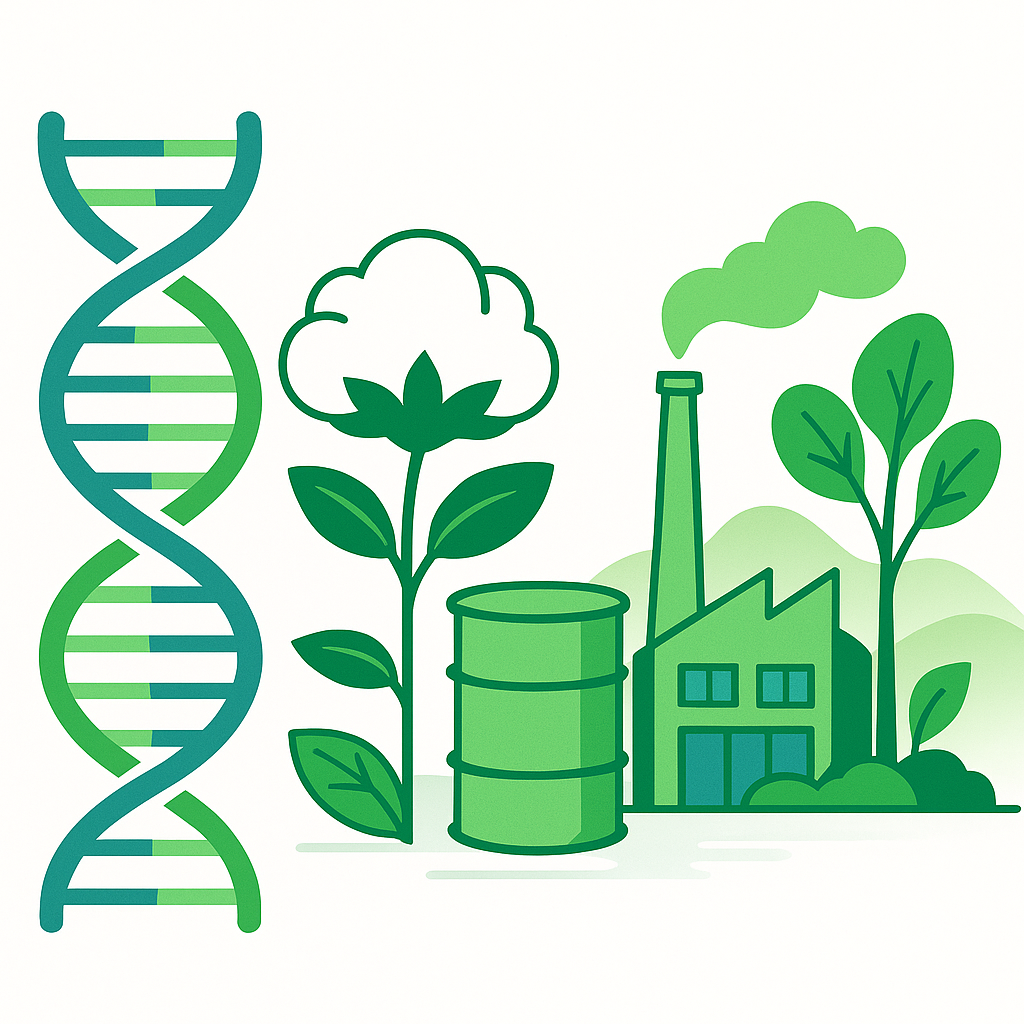
The future of sustainability isn’t mined, manufactured, or shipped—it’s coded.
From Extraction to Design
For centuries, our economy has depended on extraction—mining minerals, pumping oil, and harvesting natural resources faster than ecosystems can regenerate. Sustainability has often meant reducing harm, but rarely redesigning systems.
Now, a new form of production is emerging—one that doesn’t rely on raw materials, but on genetic information. Using programmable biology, scientists can encode instructions directly into DNA, allowing living cells to grow materials, fuels, and chemicals that once required industrial extraction.
In this model, biology itself becomes the supply chain.
Programmable Biology 101
Programmable biology is the ability to design and modify organisms at the genetic level to perform specific functions. With tools like CRISPR gene editing and synthetic DNA design, researchers can “program” microbes, yeast, or plants to produce complex molecules—just as a computer runs a line of code.
For example:
- Yeast cells can be programmed to produce spider silk proteins stronger than steel.
- Bacteria can synthesize biodegradable plastics or jet fuel from CO₂.
- Algae can generate pigments and food additives with zero chemical waste.
Each of these processes replaces an industrial factory with a biological one, powered by sunlight, sugar, and microbial metabolism rather than fossil fuels.
The New Supply Chain Is Alive
In a biological supply chain, DNA replaces blueprints. Instead of mining, refining, and transporting materials across the globe, we can share genetic code digitally and grow materials locally.
Here’s how it works:
- Scientists design a DNA sequence that encodes a desired product—like a polymer, dye, or enzyme.
- The sequence is sent to a bioreactor facility, where microbes use it as a recipe.
- Within days, those microbes produce the material naturally.
What once required global shipping, refineries, and heavy industry can now happen in a lab the size of a classroom.
This shift transforms sustainability from a matter of efficiency to one of architecture—rebuilding production from the genetic level up.
The Carbon Advantage
The environmental impact of programmable biology is not just incremental—it’s exponential.
| Process | Traditional Manufacturing | Programmable Biology |
|---|---|---|
| Energy Use | High heat, fossil fuels | Ambient temperature, renewable feedstocks |
| Carbon Impact | Emissions-intensive | Carbon-neutral or negative |
| Resource Inputs | Non-renewable | CO₂, sugar, plant biomass |
| Waste | Persistent and toxic | Biodegradable or recyclable |
By shifting from extraction to growth, biological systems achieve carbon inversion—turning emissions into resources rather than pollutants. For instance, engineered microbes can use CO₂ as a feedstock, effectively converting greenhouse gases into valuable materials.
In lifecycle analyses, this model reduces total emissions by 50–80% compared to traditional manufacturing methods.
Digital Meets Biological
One of the most revolutionary aspects of this transformation is its scalability. DNA sequences—the “recipes” for production—can be transmitted digitally, just like software.
Imagine a future where a biotech startup in Nairobi can download the same genetic code as one in Boston and locally grow biodegradable plastics, fertilizers, or building materials using regionally available resources.
This digitally distributed biology democratizes production and reduces reliance on global supply chains prone to disruption, shipping emissions, and waste.
It’s sustainability by design, not afterthought.
Education for a Bio-Based Economy
For educators and parents, this new industrial paradigm changes what it means to prepare students for the future.
The next generation of environmental innovators won’t just study ecology or engineering—they’ll study genetic design. The skills of tomorrow’s workforce will include:
- Systems biology: Understanding how living systems interact with resources.
- Synthetic design: Writing DNA as a language of innovation.
- Ethical stewardship: Balancing biotechnology with ecological integrity.
This shift calls for a new kind of literacy—biological fluency—where sustainability and science merge into one discipline.
Ethics and Oversight
As biology becomes programmable, ethical considerations must scale alongside the technology.
- How do we ensure safety in the release of engineered organisms?
- Who controls access to genetic intellectual property?
- How do we prevent biological innovation from becoming a new form of inequality?
Just as digital technology reshaped privacy and labor, biotechnology will reshape environmental policy and ethics. Educators and policymakers must embed responsibility into innovation to ensure this new economy serves both people and the planet.
From Code to Carbon Capture
The most promising vision of programmable biology isn’t just cleaner manufacturing—it’s regenerative manufacturing. By embedding carbon capture and circularity into biological systems, we can design production that actively restores the environment.
Materials will be made from carbon pulled from the air.
Factories will become living systems that heal ecosystems.
And sustainability will move beyond reduction—toward regeneration.
This is the ultimate rewrite of the supply chain: one where DNA becomes the operating system of sustainability.