
Quick Insight
The speed of the global economy depends on how fast value can move—money, goods, and data. Yet, even in a hyper-connected world, many financial and trade systems still rely on manual processing, intermediaries, and paperwork. Smart contracts are changing that foundation.
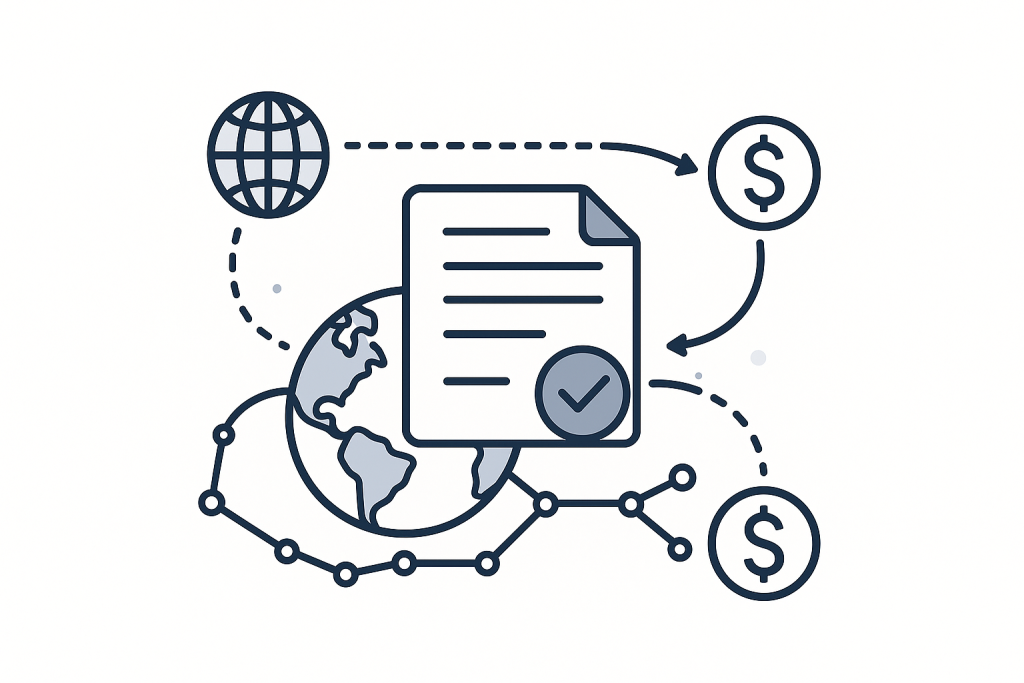
By embedding trust, verification, and execution directly into code, these self-running agreements automate transactions across borders. Whether it’s paying suppliers, settling trades, or triggering insurance claims, smart contracts execute instantly when conditions are met. The result: faster capital movement, reduced friction, and an emerging layer of programmable global finance.
Why This Matters
Every delay in global trade and finance has a cost. Waiting days for settlement, relying on multiple intermediaries, and reconciling data across disconnected systems slows growth—especially for developing markets.
Smart contracts eliminate much of this lag. They enable real-time transactions verified on decentralized ledgers, accessible anywhere in the world. For families, educators, and students, this shift isn’t just about technology—it’s about economic inclusivity. When financial systems become programmable, participation expands beyond institutions to individuals, entrepreneurs, and small enterprises.
Automation isn’t removing trust—it’s accelerating it. It’s creating a world where financial systems move at the speed of the internet, not the speed of paperwork.
Here’s How We Think Through This
- Start with the Core Mechanism: Self-Execution
A smart contract is a piece of code that automatically carries out an agreement when conditions are met. For example, in global trade, payment can be released the moment delivery data confirms a shipment’s arrival—no bank or broker required. - Understand the Global Implications: Instant Settlement
Traditional cross-border payments can take 2–5 days due to intermediary banks and regulatory checks. Smart contracts streamline this to seconds by verifying compliance and clearing directly on the blockchain. This creates a new standard for liquidity and responsiveness. - Apply It to Real Systems: Supply Chains and Beyond
In supply chains, smart contracts connect IoT sensors and logistics data to trigger automated actions—payments, insurance releases, or customs processing. This makes global trade less reactive and more predictive. - Assess the Economic Impact: Liquidity and Access
Faster transactions mean capital circulates more efficiently. Small and medium enterprises (SMEs) can join global markets without needing large banking relationships. Liquidity, once concentrated in institutional pipelines, becomes distributed across programmable networks. - Consider the Governance Layer: Regulation and Reliability
Automation doesn’t mean deregulation. Governments and central banks are developing frameworks for “compliant smart contracts” that integrate with Know Your Customer (KYC) and Anti-Money Laundering (AML) systems. The next phase of growth will depend on how effectively law and code coexist.
What Is Often Seen as a Future Trend — Real-World Insight
This transformation is already unfolding:
- Trade finance platforms like Contour and Marco Polo are using smart contracts to automate letters of credit and reduce transaction times from weeks to hours.
- Insurance companies such as AXA have piloted blockchain-based claims processing where payouts trigger automatically from verified events (e.g., flight delays).
- Central banks and regulators in Singapore, Switzerland, and the EU are exploring digital currencies that integrate smart contracts for programmable payments and cross-border efficiency.
These experiments point to a future where financial automation is not an option—it’s the operating standard. The same technology that powers cryptocurrencies is now being reengineered to accelerate the world’s most traditional systems of value exchange.
For future generations, understanding this shift isn’t about learning blockchain jargon—it’s about recognizing how code becomes an economic force. Smart contracts are turning financial infrastructure into living systems—adaptive, fast, and borderless.