
Quick Insight
The music industry’s revenue system has long been a patchwork of publishers, distributors, collection agencies, and regional licensing bodies. Payments often take months to reach artists, and transparency remains elusive. Now, smart contracts—self-executing agreements coded onto blockchains—are emerging as a powerful solution.
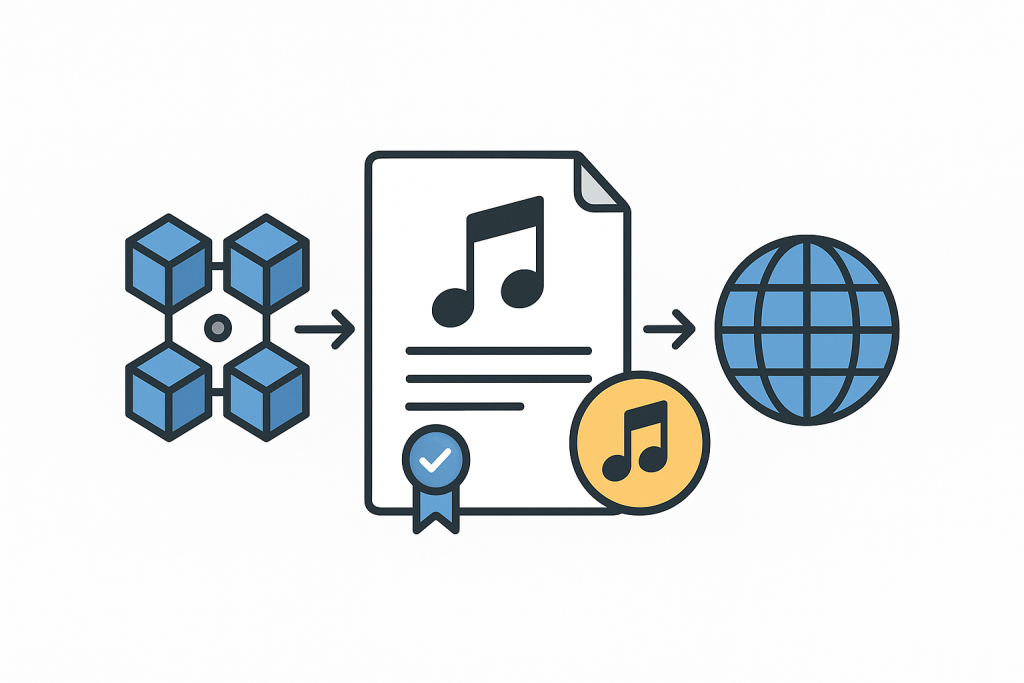
These programmable contracts can automatically calculate and distribute royalties, handle cross-border payments, and track performances in real time. In essence, the Smart Contract Studio is becoming the new backbone of global music publishing—turning what was once administrative complexity into digital precision.
Why This Matters
Behind every song lies a web of rights: writers, performers, producers, and publishers, each entitled to their share. Traditional systems manage these relationships through centralized databases and intermediaries. This introduces friction, cost, and delay.
Smart contracts replace that infrastructure with transparent, rule-based automation. Here’s what that means for the industry:
- Instant, accurate payments: Royalties are split and distributed automatically the moment a stream or download occurs.
- Global interoperability: Blockchain’s borderless nature eliminates exchange rate and jurisdictional hurdles.
- Transparency by design: Every transaction and attribution is recorded immutably, reducing disputes and errors.
For artists and educators alike, this represents more than just technology—it’s the foundation for a fairer, data-driven creative economy.
Here’s How We Think Through This
(A grounded framework for understanding automated royalties in the digital age)
- Map the existing ecosystem.
The traditional royalty chain spans collection agencies, publishers, PROs (Performance Rights Organizations), and digital platforms. The first step is identifying which points in this chain can be automated safely without losing oversight or legal compliance. - Define the data model.
A smart contract is only as accurate as the data it contains. That means ensuring song metadata—writers, percentages, rights holders—is verified and standardized. Many current royalty issues stem not from payment failures, but from inconsistent data entry. - Automate the logic, not just the transaction.
Smart contracts do more than move money; they encode logic. For example: “If a track is streamed in Japan, pay the producer 5% after tax conversion in yen.” This granular automation is what makes them transformative for cross-border transactions. - Design for scalability and governance.
Global music publishing requires interoperability across thousands of systems. Smart contract platforms must align with existing music registries and maintain shared governance models, ensuring creators, platforms, and regulators trust the same data. - Educate creators early.
For young musicians, understanding smart contracts is as critical as understanding chords or composition. Educators can introduce the basics of digital rights, tokenized royalties, and on-chain attribution as part of modern creative literacy.
What Is Often Seen as a “Future Trend” (and the Real-World Insight)
Many perceive smart contract royalties as a far-off innovation, but several industry experiments are already in motion. Platforms like Opulous, Ujo Music, and Revelator are using blockchain-based systems to pay collaborators instantly and transparently. Some major publishers are exploring hybrid systems to bridge legacy databases with blockchain registries.
The real-world insight: This isn’t about replacing the industry’s infrastructure—it’s about streamlining it for global scale. As music consumption becomes increasingly decentralized—spanning social media, metaverse platforms, and AI-driven remixing—real-time, programmable royalties will be essential. The Smart Contract Studio marks a new era: where every creative contribution is recognized, measured, and rewarded the moment it’s heard.