
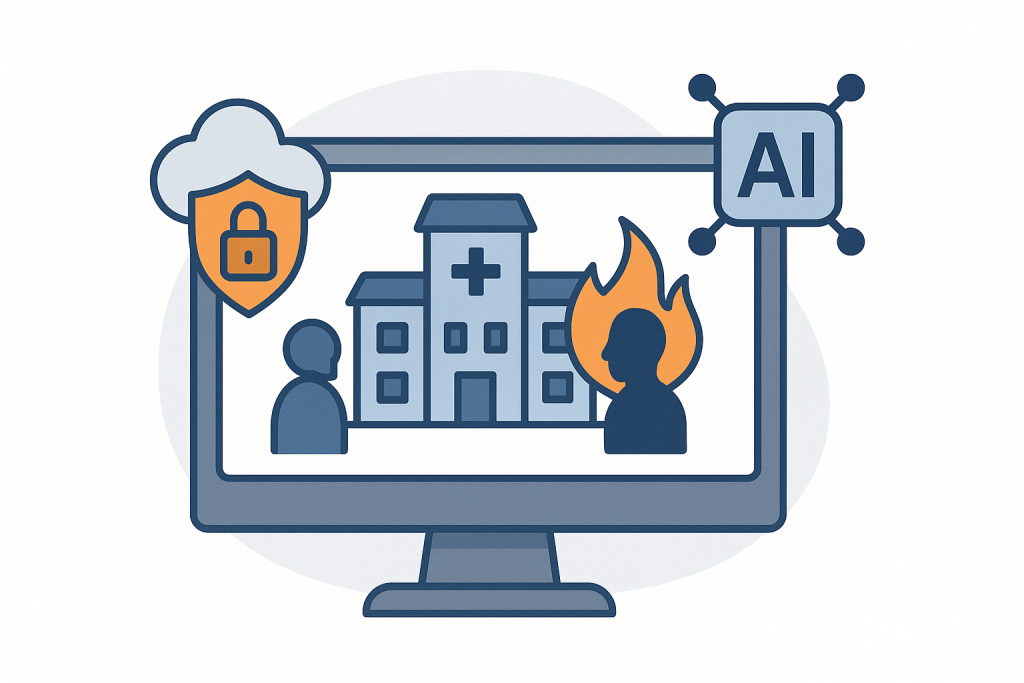
High-stakes systems—schools, hospitals, utilities, governments, enterprises—need AI that performs well in rare, sensitive, or dangerous scenarios. The problem is that real data from these moments is scarce, ethically fraught, or too risky to collect. Synthetic environments solve this by creating “practice worlds”: simulations that reproduce the dynamics of crisis situations without placing real people, infrastructure, or confidential systems in harm’s way. These environments produce training data and evaluation conditions that are safer than collecting more real-world incident data, and often more realistic than waiting for the next disaster to learn from.
Light italic subheading A simple analogy
We don’t teach pilots by crashing real planes. We teach them in flight simulators that include storms, engine failures, and mid-air emergencies. Synthetic practice worlds do the same for AI in high-stakes settings.
Why This Matters
The next decade will see AI embedded deeper into decisions with real consequences: student safety, hospital triage, cybersecurity response, wildfire management, industrial processes, and public-service continuity. That increases a quiet pressure: models must be ready for the rare cases, not just the average day.
Light italic subheading 1) Real incident data is the wrong place to “learn by doing”
Some scenarios are too costly to generate, too dangerous to study in live settings, or too sensitive to share. Examples include school safety failures, cyber breaches, medical near-miss events, or critical infrastructure outages. Collecting “more data” here often means tolerating more harm or more surveillance. Practice worlds let us learn without repeating the risk.
Light italic subheading 2) Rare events are exactly where AI tends to fail
Most datasets are dominated by routine cases. That means models can look accurate overall while failing in the situations that matter most—such as a fast-moving ransomware attack or a sudden patient deterioration. Simulation allows us to oversample rare events so models learn robust response patterns.
Light italic subheading 3) Parents and educators benefit from safer experimentation
In education, high-stakes events include bullying escalations, mental-health crises, or safety incidents. We should not use students as a testing ground for new detection or support systems. Synthetic practice worlds allow tools to be tested and stress-checked before they touch real classrooms.
Light italic subheading 4) It improves preparedness without broadening surveillance
A common but problematic fairness or safety strategy is “collect more signals from everyone.” Practice worlds reduce that temptation. They enable readiness by simulating realistic conditions rather than monitoring more of real life.
Here’s How We Think Through This (steps, grounded)
Light italic subheading Step 1: Define the high-stakes decisions the AI will support
We anchor on decisions with consequences, not abstract model performance.
Examples:
- “When should a hospital escalate to rapid response?”
- “How should a district triage threats without over-flagging students?”
- “Which cyber alerts require immediate containment?”
The scenario set must map to real interventions.
Light italic subheading Step 2: Identify the rare and sensitive events worth simulating
We list events that are:
- Rare but high-impact
- Hard or unethical to capture in real data
- Systemically evolving (new attack types, changing crisis patterns)
We include both “known threats” and plausible emergent ones.
Light italic subheading Step 3: Build the environment from real-world anchors
Good simulations are not fantasy. We base them on:
- Historical incident patterns
- Expert domain rules
- Real operational constraints (staffing limits, network topology, resource lag)
This keeps practice worlds grounded in reality.
Light italic subheading Step 4: Generate synthetic data within the environment
Instead of generating standalone synthetic records, we generate interactions over time.
That allows models to learn:
- Early warning signals
- Cascading failure paths
- Human response effects
- Feedback loops (e.g., panic behavior, network contagion, supply shortages)
Light italic subheading Step 5: Validate utility and safety separately
Utility checks:
- Does simulation reproduce key dynamics and edge behaviors?
- Do trained models transfer to real validation data?
- Are outcomes stable across many simulated runs?
Safety and ethics checks:
- Does the environment prevent embedding real identifiers or proprietary configurations?
- Are vulnerable groups protected from being “modeled as threats”?
- Are outputs framed to support care and safety, not punishment?
Light italic subheading Step 6: Stress-test models against adversarial and worst-case variants
We intentionally push beyond the average scenario:
- Multiple simultaneous failures
- “Novel” attack or crisis patterns
- Resource scarcity
- Conflicting signals
This finds brittleness before deployment.
Light italic subheading Step 7: Combine synthetic readiness with real-world monitoring
Practice worlds are for training and pre-deployment evaluation. In production we still need:
- Real-world performance tracking
- Periodic recalibration from governed real data
- Human override pathways
Simulation reduces risk; real anchoring keeps models honest.
What is Often Seen as a Future Trend — Real-World Insight
Light italic subheading Trend people talk about: “Simulations will replace real data.”
Light italic subheading Reality we see: Simulations will become the readiness layer, not the whole system.
Here’s what’s playing out in practice:
Light italic subheading 1) Crisis-ready AI is shifting from reactive to rehearsed
Organizations used to improve AI after incidents. Now, synthetic practice worlds allow rehearsal before incidents. This mirrors how modern safety engineering works: pre-mortems, drills, tabletop exercises—except now AI systems participate too.
Light italic subheading 2) Cybersecurity has become the proving ground
Enterprises increasingly train detection and response systems in simulated attack environments. These setups model attacker tactics, lateral movement, and containment decisions. The lesson is transferable to public safety and health: safety-critical AI needs rehearsal, not just historical logs.
Light italic subheading 3) Education and health are quietly adopting “low-harm pilots”
We’re seeing early use of synthetic environments to test wellbeing and safety tools without running experiments on real students or patients. The big unlock is confidence: schools and hospitals can trial AI support systems in a practice world first, then proceed with measured real-world rollout.
Light italic subheading The strategic takeaway
Practice worlds for privacy are becoming a responsible default for high-stakes AI. They let us model the storms without creating them, and they reduce the ethical cost of learning. The organizations that lead will be those who treat simulation as a core capability—paired with careful real-world anchoring—so readiness doesn’t depend on waiting for harm to happen.