
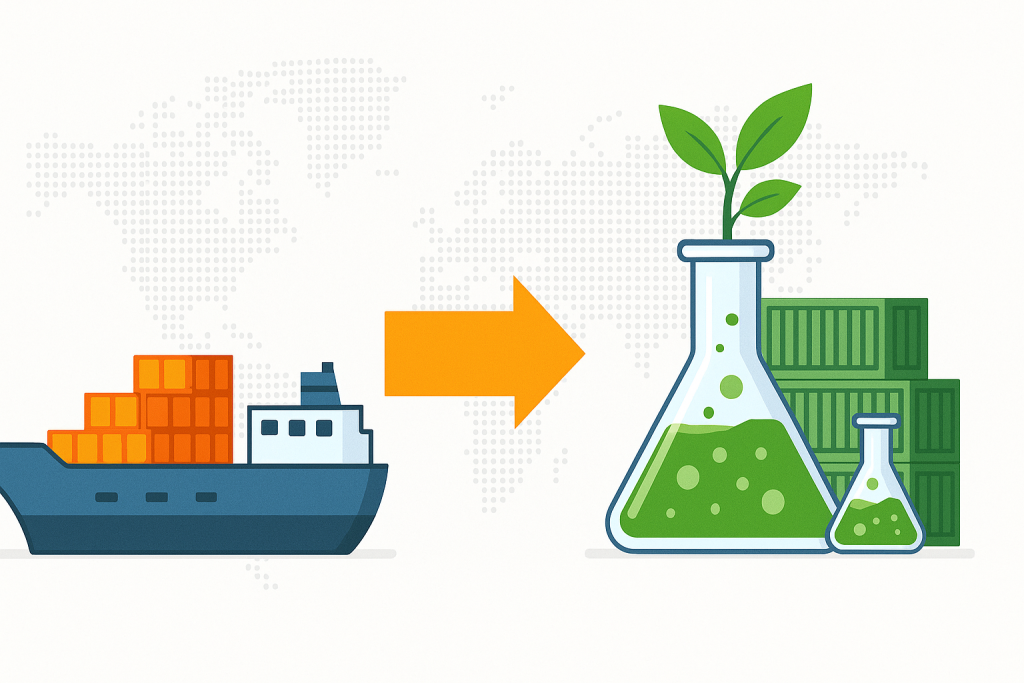
The future of global trade may not move across oceans—it may grow in place.
The Hidden Cost of Global Manufacturing
The global supply chain is one of the most carbon-intensive systems on Earth. The ships, trucks, and planes that move materials and products across continents account for nearly 3% of global greenhouse gas emissions—more than the aviation industry alone.
Add to that the emissions from manufacturing, storage, and waste from overproduction, and the total climbs even higher. Despite advances in efficiency, the core problem remains: our economic infrastructure depends on moving matter, not managing it intelligently.
The emerging alternative is not another transport revolution. It’s a manufacturing revolution—powered by biology.
The Rise of Localized Bio-Production
Localized bio-production uses engineered organisms—like bacteria, yeast, or algae—to produce materials, fuels, and goods on site, using renewable feedstocks such as CO₂, plant matter, or waste.
Instead of extracting and shipping raw materials across the globe, programmable biology makes it possible to “grow” what’s needed where it’s needed. This model transforms supply chains from centralized, high-emission networks into distributed, low-carbon ecosystems.
Think of it as replacing the shipping container with the cell: a production system that is small, efficient, and local.
The Climate Trade-Off: What the Numbers Suggest
The environmental advantage of local bioproduction is measurable. Several recent lifecycle studies and pilot projects show that shifting to biological manufacturing can cut total supply chain emissions by 40–70%, depending on the sector.
| Climate Metric | Traditional Supply Chains | Localized Bio-Production |
|---|---|---|
| Freight Emissions | High (global shipping, trucking, air freight) | Minimal (local or on-site production) |
| Energy Use | Fossil-based, high-temperature processes | Low energy, biological reactions |
| Waste Generation | Significant (overproduction, packaging) | Minimal (on-demand, biodegradable) |
| Resource Efficiency | Linear (extract–use–discard) | Circular (reuse, regenerate) |
For example, a biofactory producing plastics or fibers from waste biomass in one region can eliminate thousands of kilometers of shipping emissions tied to oil extraction, polymer processing, and textile production abroad.
In the aggregate, the global impact is profound—a supply network that no longer burns fuel just to move goods.
Energy Shifts: From Transport to Transformation
While conventional supply chains depend on burning energy to transport goods, bio-production invests energy in transforming local inputs into high-value materials.
This change does more than cut emissions—it changes the physics of commerce. Instead of global flows of material, we see distributed flows of information. Genetic blueprints and production recipes can be sent digitally and replicated biologically anywhere in the world, just as software is copied between computers.
This is the biological equivalent of the digital revolution—manufacturing becomes downloadable.
Reducing Waste and Overproduction
Traditional industrial systems rely on mass production, which inevitably leads to surplus and waste. Biological manufacturing is modular and scalable, allowing for precise, on-demand production that aligns with local demand and resource availability.
This adaptability reduces overproduction and inventory waste, while the use of biodegradable or recyclable feedstocks ensures that materials re-enter the ecosystem rather than polluting it.
A garment grown from lab-engineered yeast, for instance, doesn’t just reduce shipping—it eliminates dye runoff, plastic microfibers, and landfill waste.
In this sense, biology replaces both the factory and the landfill.
Local Resilience, Global Stability
Localized production is not only more sustainable—it’s more resilient. Global crises like the COVID-19 pandemic exposed the fragility of centralized supply chains. When borders close and ships stall, production halts.
In contrast, decentralized bio-manufacturing systems can operate independently. Each region can produce essential goods—from food ingredients to medical materials—without waiting for global logistics to catch up.
This is not a retreat from globalization, but a biological rebalancing of it—turning production into a network of living nodes instead of a single linear chain.
Education and the Skills Gap
For parents and educators, this shift signals a new direction for workforce development. The future supply chain won’t be managed by logisticians moving containers—it will be designed by bioengineers, data scientists, and systems thinkers managing living infrastructure.
Students entering this world will need literacy in:
- Synthetic biology: how to program cells to produce materials.
- Circular design: how to engineer systems that regenerate rather than deplete.
- Digital fabrication: how biological data travels and scales.
This is the foundation of a bioeconomy that links local action with global impact.
The Ethical Equation
As with any powerful technology, programmable biology raises ethical questions:
- How do we ensure fair access to bio-production tools globally?
- What are the ecological risks of deploying engineered organisms outside the lab?
- Could localized production destabilize developing economies reliant on exports?
These considerations must evolve alongside the technology. The transition to living supply chains must balance innovation with inclusion—a biological economy that benefits everyone, not just those with lab access.
From Cargo Ships to Code: The Future of Trade
Replacing freight with biology redefines what “global trade” means. In this new model, genes, data, and knowledge move across borders—not tons of cargo.
A future circular economy might see nations exchanging biodesign templates rather than raw resources, drastically reducing emissions while expanding creative and scientific collaboration.
The climate trade-off isn’t simply about efficiency—it’s about redesigning the global system to mirror natural ecosystems: distributed, regenerative, and self-balancing.
The next era of trade won’t be measured in miles traveled.
It will be measured in carbon saved and ecosystems sustained.