
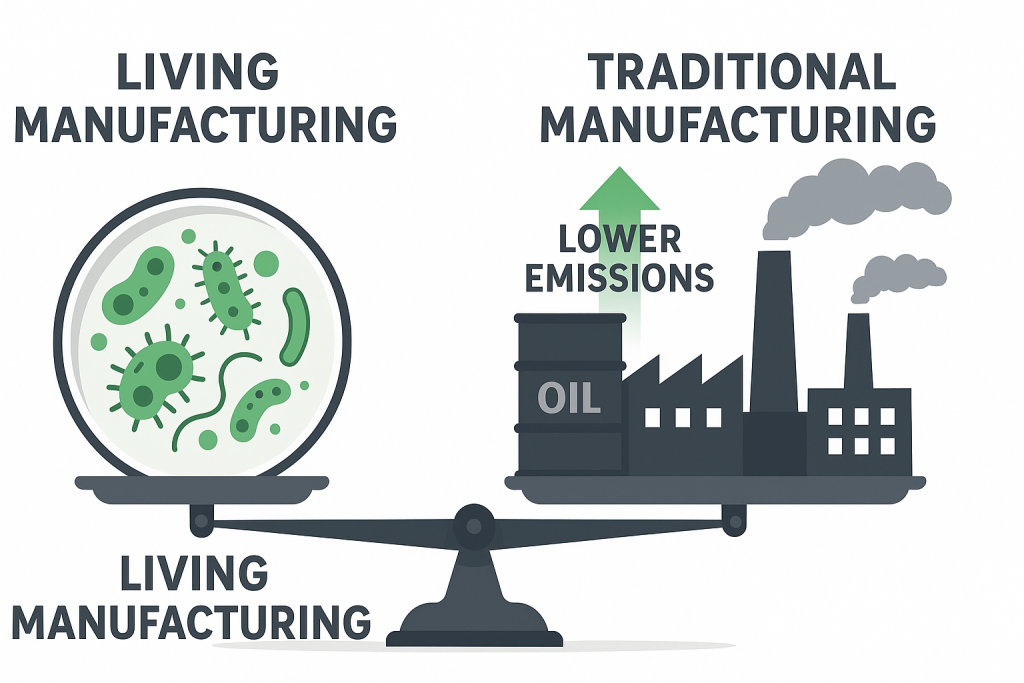
When factories begin to grow instead of burn, sustainability turns from an equation into a system.
Rewriting the Math of Production
Modern industry has always been defined by energy, extraction, and waste. From petrochemicals to textiles, our materials are forged through high heat, long transport, and irreversible emissions. Even in a world shifting toward renewables, traditional manufacturing remains carbon-heavy by design—built to consume, not regenerate.
Enter living manufacturing: the use of bioengineered organisms—microbes, algae, and cells—to produce materials and fuels. Through tools like CRISPR gene editing and synthetic biology, these systems replace combustion with metabolism, turning carbon emissions and waste into raw material.
To understand the climate potential of this transformation, we need to look beyond slogans—and run the actual math.
Lifecycle Analysis: Biology vs. Industry
A lifecycle analysis (LCA) measures the environmental impact of a product from start to finish: raw materials, manufacturing, use, and disposal.
Here’s how the equation shifts when production moves from industrial chemistry to biology:
| Factor | Traditional Manufacturing | Bioengineered Manufacturing |
|---|---|---|
| Primary Energy Source | Fossil fuels, mining, high heat | Sunlight, sugars, CO₂ |
| Operating Temperature | 200–1000°C | 20–40°C |
| Feedstock Origin | Extractive (petroleum, metal ores) | Renewable (plants, waste, air) |
| Emissions Profile | CO₂-intensive | Carbon-neutral or negative |
| End-of-Life | Persistent waste | Biodegradable or recyclable |
In nearly every category—energy input, emissions, and waste management—bio-based production dramatically reduces environmental load. The key difference lies in how energy and carbon flow through the system: biology recycles, while chemistry consumes.
Case Study: Microbial Plastics vs. Petroplastics
Take the example of microbial plastics—materials like PHA (polyhydroxyalkanoates) or PLA (polylactic acid) produced by genetically engineered bacteria.
- Energy use: Microbial plastics require roughly 40–60% less energy than conventional plastics, since microbes operate at ambient conditions.
- Carbon footprint: For every ton of PHA produced, roughly 1.8 tons of CO₂ can be captured rather than emitted.
- End-of-life: Unlike petroplastics that persist for centuries, microbial plastics naturally degrade into organic matter.
In lifecycle terms, this means a shift from carbon emitter to carbon sink. Factories no longer contribute to atmospheric load—they become part of the carbon cycle itself.
Case Study: Lab-Grown Textiles vs. Traditional Fabric
The textile industry is one of the most polluting sectors globally, responsible for up to 10% of global emissions and immense water waste from dyeing and finishing processes.
Lab-grown textiles—created from engineered yeast, fungi, or plant cells—radically change that profile.
- Water use: Reduced by up to 90%, since microbial dyeing eliminates chemical runoff.
- Waste: On-demand biofabrication allows for closed-loop production, minimizing overproduction.
- Energy: Low-temperature cultivation slashes total energy input per kilogram of material.
The result is a supply chain that acts like an ecosystem—where every output can become an input again.
Circularity: The Built-In Advantage
Traditional industry tries to retrofit circularity through recycling. Biology, however, is circular by default. Every organism naturally participates in a closed loop of resource flow: energy from sunlight, nutrients from waste, and regeneration through growth.
CRISPR and bioengineering extend this principle to manufacturing by programming cells to create molecules that degrade, recycle, or self-renew.
This means materials designed from the start to fit within planetary boundaries—a concept impossible for most extractive industries.
Energy Efficiency in the Climate Equation
From an energy systems perspective, living manufacturing achieves a step-change improvement in thermodynamic efficiency.
Traditional chemistry requires breaking molecular bonds using heat and pressure—an inherently energy-intensive process. In contrast, biological production leverages enzymes, which perform the same transformations at room temperature using minimal energy.
Even when powered by renewable electricity, bio-manufacturing’s total energy demand is lower, meaning less infrastructure, fewer emissions, and greater scalability.
Economic and Educational Implications
For educators and parents, these shifts redefine what it means to prepare for a sustainable economy. Tomorrow’s industries won’t only be powered by technology—they’ll be grown by it.
Future professionals will need literacy in:
- Systems biology and data science to model living processes.
- Lifecycle thinking to understand sustainability beyond compliance.
- Ethics of engineering life, balancing innovation with ecological responsibility.
Schools that merge environmental science, coding, and biotechnology are training students for the bio-industrial era—where sustainability isn’t an add-on, but the operating system.
The Climate Dividend of Biology
According to preliminary LCAs from emerging biotech firms and academic studies:
- Living manufacturing can reduce industrial emissions by 40–70%, depending on product type.
- Waste output drops by up to 90%, since byproducts are often reusable or biodegradable.
- Feedstock flexibility—using CO₂, organic waste, or renewable biomass—creates resilience against raw material scarcity.
In climate terms, these efficiencies scale exponentially. Each biofoundry or microbial production hub removes both emissions and waste from the system simultaneously—a climate double dividend.
From Extraction to Regeneration
The transition from industrial to biological manufacturing isn’t just technological—it’s philosophical. It replaces a worldview of extraction and depletion with one of regeneration and reciprocity.
In living manufacturing, factories become ecosystems. Products are designed for reintegration, not disposal. And growth—biological, economic, and social—can finally align with planetary health.
As we refine the math behind this transformation, one conclusion becomes clear:
The most powerful climate technology isn’t synthetic.
It’s alive.