
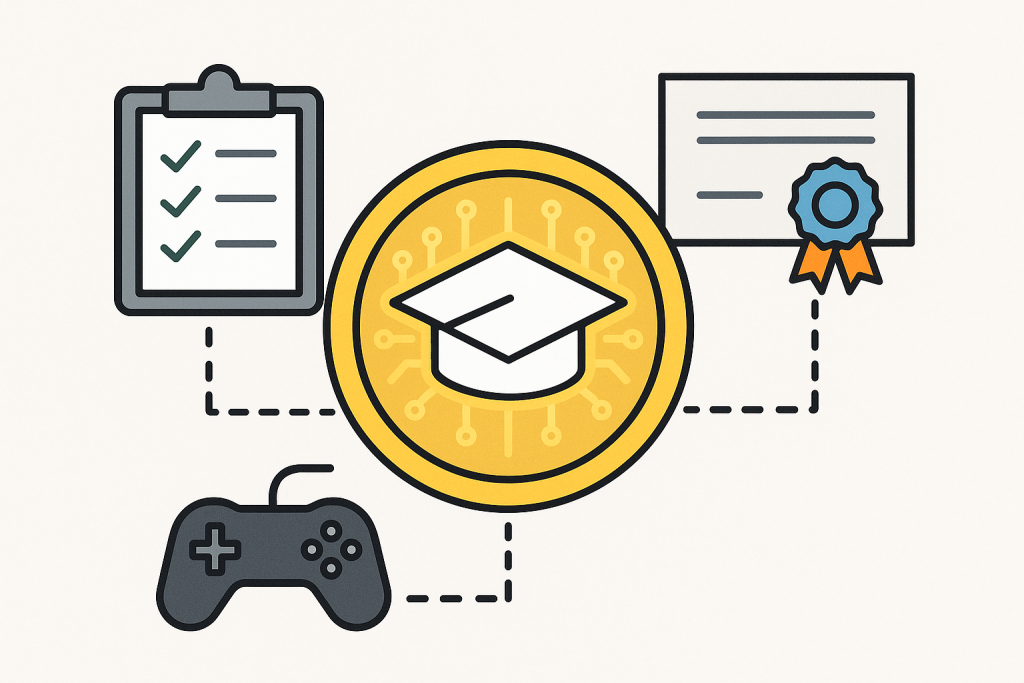
Quick Insight
The way we motivate learners is evolving. Traditional systems—grades, certificates, rankings—are being reimagined through tokenized economies that reward consistent effort, creativity, and contribution. Instead of learning being measured by static outcomes, token systems make progress visible and participatory.
These systems, used in both education and gaming, enable learners to “earn” through engagement: completing challenges, collaborating with peers, or contributing to shared goals. The result is a more balanced form of motivation—where recognition, reward, and responsibility converge in a self-sustaining ecosystem.
Why This Matters
Motivation is the engine of learning. For decades, education has leaned on extrinsic rewards—grades, trophies, rankings—that often disengage learners once the incentive disappears. In parallel, the gaming world has demonstrated that when designed correctly, digital incentives can keep players deeply engaged for hours, even years.
Tokenized systems bridge these two worlds. By introducing blockchain-verified tokens or digital credits into learning environments, educators and developers can reward behaviors that reflect genuine growth—like curiosity, collaboration, and consistency.
For parents and educators, this shift represents a profound pedagogical change: learning becomes a participatory economy rather than a one-way transaction. Students are no longer passive recipients of knowledge—they become active participants in value creation.
Here’s How We Think Through This
1. Define What’s Being Rewarded.
Tokens shouldn’t replace learning goals—they should reinforce them. The first step is to align token rewards with meaningful actions: mastering new skills, mentoring peers, or contributing to group projects. This ensures the system values quality and persistence, not just activity.
2. Build Trust and Transparency into the System.
The success of token economies relies on fairness. Using blockchain or verifiable tracking ensures that every achievement is recorded transparently and can’t be manipulated. This helps learners trust that their effort is genuinely recognized.
3. Encourage Intrinsic Motivation Through Feedback Loops.
Tokens are not just about accumulation—they’re feedback mechanisms. When tied to milestones, they help learners visualize progress. Over time, the focus shifts from “earning tokens” to “achieving mastery,” creating a natural bridge between extrinsic and intrinsic motivation.
4. Integrate Learning with Real-World Value.
Tokens can represent more than digital points—they can unlock mentorship sessions, access to advanced courses, or real-world certifications. This integration gives learning tangible meaning beyond the classroom or app.
5. Govern the Economy Collectively.
The best tokenized systems evolve through community governance. Allowing students or players to vote on new rewards, milestones, or causes ensures that the economy remains relevant, ethical, and educationally sound.
What Is Often Seen as a Future Trend
Many assume token economies are confined to crypto speculation or gaming—but real-world implementations are already taking root in education. Platforms like Learn-to-Earn initiatives, decentralized study groups, and skill-based games are rewarding learners for time, creativity, and impact.
In gaming, this model is well established. Players earn in-game tokens for contributing to ecosystems that thrive on collaboration and persistence. In education, this same logic translates into micro-economies of learning—where effort and curiosity hold measurable value.
The broader insight is this: tokenized systems shift motivation from achievement-as-status to achievement-as-contribution. In this new model, the goal isn’t just to “win,” but to participate, sustain, and grow alongside others.
For educators, it opens a pathway toward more inclusive and equitable systems—where every learner, regardless of starting point, can see progress, earn recognition, and belong to a shared learning economy.