
Quick Insight
In the traditional world, infrastructure is something that’s built for us—roads, networks, grids, and systems managed by governments or corporations. But a new model is emerging. Decentralized Physical Infrastructure Networks (DePIN) are transforming infrastructure from a static utility into a living ecosystem—one where citizens are not just consumers, but contributors, operators, and stakeholders.
DePIN uses blockchain coordination and token-based incentives to enable people to collectively build, maintain, and benefit from the systems that power daily life. From wireless connectivity to energy distribution, infrastructure is evolving into something dynamic, participatory, and adaptive—a network that grows through the very people who use it.
Why This Matters
Most of the infrastructure we rely on today is invisible, centralized, and often inaccessible to the public. Its governance and profits are typically concentrated in the hands of a few. This creates fragility—single points of failure, high costs, and limited accountability.
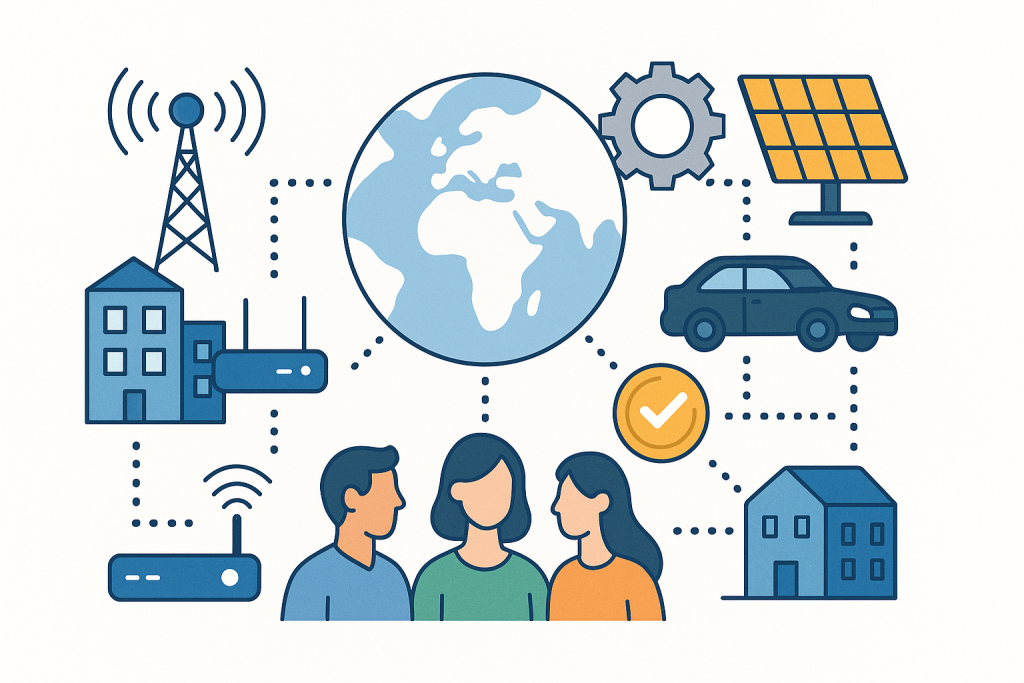
DePIN introduces a new model of ownership and trust. By turning participation into contribution, it blurs the traditional boundary between user and operator. A family hosting a wireless hotspot becomes part of a city’s network backbone. A community sharing local solar energy contributes to the grid. A neighborhood running air-quality sensors helps generate public data for civic use.
This is not just a technological shift—it’s a civic one. For educators and parents, it offers a profound opportunity to teach future generations about cooperation, economics, and responsibility in the digital age. The next generation won’t just live in cities—they’ll co-create the systems that keep those cities running.
Here’s How We Think Through This
1. Identify the System That Can Be Shared.
Not every part of infrastructure benefits from decentralization. The key is identifying systems where distributed participation adds efficiency or resilience—such as broadband access, storage capacity, or sensor data collection.
2. Define How Participants Contribute.
DePIN models reward citizens who contribute real-world resources—bandwidth, computing power, data, or even physical assets like electric vehicle chargers. Blockchain systems track and verify each contribution transparently.
3. Create Economic Alignment Through Tokens.
Instead of top-down control, DePIN networks use token-based economies to align incentives. Participants earn tokens for their verified contributions, and these tokens can represent value, access, or governance rights.
4. Build Governance Around Participation.
As networks mature, contributors gain a voice in how they evolve. Governance mechanisms—often decentralized autonomous organizations (DAOs)—let citizens collectively make decisions on maintenance, pricing, or expansion.
5. Integrate with Public Systems.
The future lies in hybrid cooperation: community networks complementing existing public infrastructure. This co-ownership model enhances resilience and can lower costs for municipalities while promoting civic engagement.
What Is Often Seen as a Future Trend
DePIN is already emerging in the real world. Helium’s global wireless network is built by citizens who deploy hotspots. Energy Web enables decentralized energy coordination among producers and consumers. WeatherXM lets individuals host weather stations that feed real-time data into predictive models.
The deeper insight is this: infrastructure is no longer something that happens to us—it’s something that happens with us. By combining transparent technology with participatory economics, DePIN turns infrastructure into an evolving ecosystem—one that grows stronger with every node, every sensor, and every citizen who joins.
The line between public service and personal participation is dissolving. The future infrastructure isn’t built—it’s cultivated.