
Quick Insight
For decades, fractional ownership in real estate meant buying into a Real Estate Investment Trust (REIT) — a managed fund pooling investor money into large property portfolios. That model democratized access to property markets but still left investors at a distance from the actual assets.
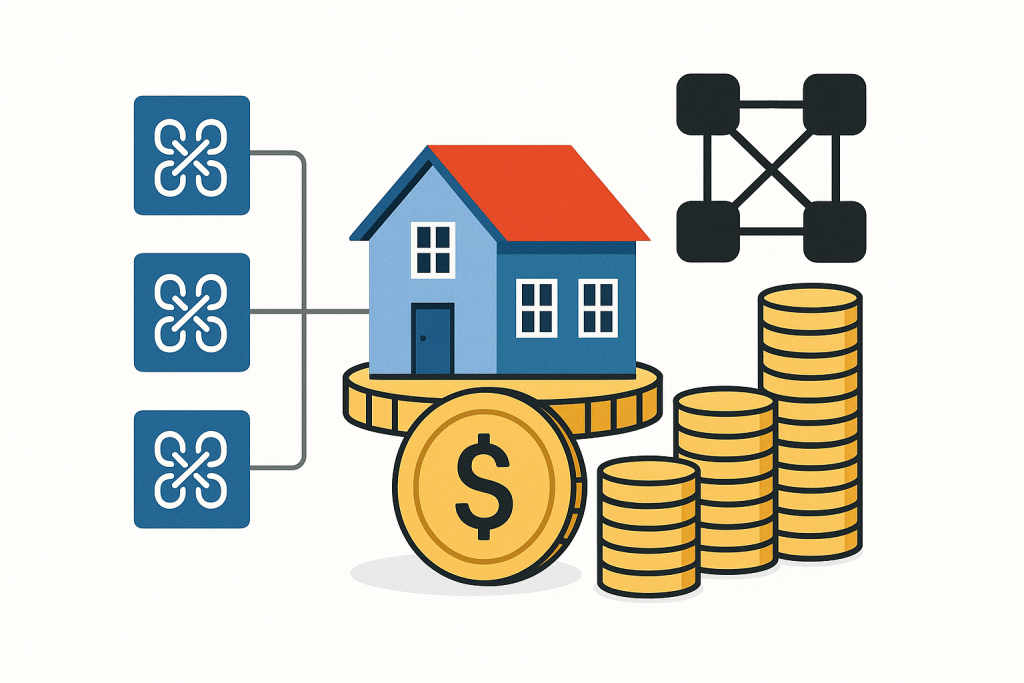
Now, blockchain-based fractional ownership is reshaping this system. Through tokenization, property shares are recorded on secure, transparent digital ledgers. Each token represents a verified fraction of a real-world asset, tradeable with the same ease as digital currency. This evolution blends the reliability of property investment with the accessibility of digital finance — creating what we call Fractional Ownership 2.0.
Why This Matters
Fractional ownership 2.0 lowers the barrier to entry for property investment, giving individuals — not just institutions — the ability to participate in global real estate markets.
For families, educators, and emerging investors, this means that property literacy is no longer limited to those with large portfolios or institutional ties. Students learning about financial systems today will enter a world where buying a share of an apartment complex may be as simple as buying a digital stock.
But accessibility is just one side. Blockchain also introduces radical transparency — each transaction and ownership record is verifiable and permanent. This helps reduce fraud, streamline compliance, and strengthen global investor confidence.
In short, the shift from REITs to real estate tokenization isn’t just a technology upgrade; it’s a redefinition of ownership itself.
Here’s How We Think Through This
- Start with the Legacy Model: REITs
Traditional REITs offered liquidity and diversification but came with limited visibility into specific properties. Investors owned shares in a trust, not in the real asset. - Identify the Blockchain Shift
Tokenization introduces a distributed ledger where ownership shares are recorded as digital tokens. These tokens can represent exact fractions of a specific property or a diversified pool of assets — securely, transparently, and with real-time verification. - Assess Accessibility and Regulation
Compliance remains key. In most markets, property tokens are treated as securities, subject to KYC (Know Your Customer) and AML (Anti-Money Laundering) regulations. The benefit: smaller investors can now participate legally and confidently within structured digital frameworks. - Examine Market Impact
Tokenized properties can be traded across borders, opening global investment flows. A user in London could invest in fractional ownership of housing in São Paulo or Singapore — without intermediaries or long settlement periods. - Understand the Emerging Infrastructure
The supporting ecosystem — from digital custody providers to token exchanges — is growing quickly. As standards mature, these systems will underpin the next generation of investment products, blending traditional finance with decentralized trust.
What Is Often Seen as a Future Trend — Real-World Insight
Many see tokenized fractional ownership as futuristic, but it’s already being implemented.
- Lofty AI allows fractional investments in tokenized U.S. rental properties with blockchain-managed ownership records.
- RealT distributes rental income automatically to investors via digital tokens.
- Switzerland and Singapore are approving compliant frameworks for tokenized real estate exchanges.
These early ecosystems demonstrate how real estate tokenization is more than a speculative idea — it’s a working, evolving market mechanism.
The challenge for educators and parents is to help the next generation understand not only how to invest but how digital systems of trust redefine ownership and participation.