
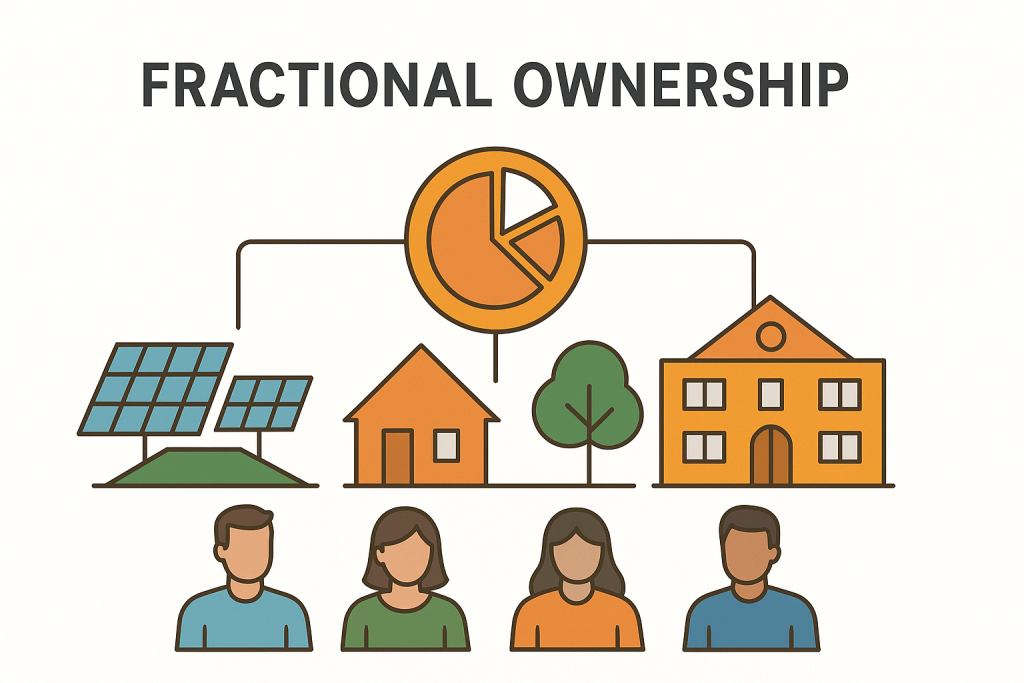
“Fractional everything” is the shift from all-or-nothing ownership to shared participation. Tokenization makes this practical by letting real-world assets be represented in precise digital shares. That means people can co-own and co-govern things that used to be locked behind high price tags or complex paperwork—like solar arrays, community buildings, school equipment, local farms, or even neighborhood emergency resources. The key idea isn’t speculative trading. It’s a new social infrastructure for pooling resources, sharing benefits, and distributing responsibility.
Why This Matters
Fractional ownership sounds financial, but its biggest impact is social. It changes how families, schools, and communities can build stability and opportunity together.
Families can share assets more fairly and flexibly.
Many families already “fractionalize” informally—siblings share inherited property, relatives pool funds for land, parents co-buy educational tools. Tokenization makes these arrangements clearer and easier to manage across years, locations, and generations. Rights can be encoded: who can use the asset, who can sell their share, how income is distributed, how guardianship works for minors, and how inheritance is triggered.
Schools can access high-value resources without buying alone.
Think of expensive lab equipment, maker-space tools, sports facilities, or learning technologies. Fractional models allow schools to co-own, lease-to-own, or community-fund these assets with transparent usage and maintenance rules. Ownership becomes a shared civic project rather than a budget cliff.
Communities can finance local infrastructure in smaller, safer increments.
Local real estate, solar microgrids, water systems, shared mobility, or cultural spaces often fail because funding is “too big” for individuals and “too slow” for institutions. Fractional participation enables community-sized investments with visible accountability: people can see what they own, how it performs, and what decisions are being made.
Education gets a real-world lens on economics and governance.
Students don’t just learn about money. They learn about systems: how shared ownership works, how rules are set, how benefits and risks are distributed, and how consensus is built. Fractional assets create hands-on civic literacy—one of the most future-relevant skills we can teach.
Here’s How We Think Through This (steps, grounded)
Step 1: Identify the asset and the community purpose.
We begin with a simple question: What shared need does this asset serve?
Examples:
- a neighborhood solar grid that lowers energy costs
- a community farm that stabilizes local food access
- a school robotics lab shared across districts
- a local building that supports childcare, tutoring, and events
If the purpose isn’t clear, fractional ownership becomes complexity without benefit.
Step 2: Define the rights bundle, not just the shares.
Fractional ownership only works if rights are explicit. We map:
- usage rights (who can use, when, and how)
- governance rights (who votes on upgrades, maintenance, or sale)
- economic rights (who receives revenue or savings)
- exit rights (how someone sells or transfers a fraction)
This prevents the most common failure mode: unclear expectations.
Step 3: Anchor the digital shares to real legal structures.
Tokens need enforceable linkage to the physical asset. We typically see:
- cooperative or trust models
- special purpose vehicles (SPVs)
- municipally recognized community ownership frameworks
- school district agreements
The token should represent a legal claim, not a symbolic one.
Step 4: Build a trustworthy “reality pipeline.”
Shared ownership depends on shared facts. We decide how the asset’s condition and performance are verified:
- inspections and maintenance logs
- sensor data for energy output or equipment use
- audited financial tracking
This ensures people are co-owning something real, not a story.
Step 5: Design governance for real human life.
We bake in social realities: disagreements, life changes, and uneven participation.
Mechanisms might include:
- tiered voting for big decisions
- multi-party approvals for sales
- mediation pathways for disputes
- protective rules for vulnerable members
Governance is where fractional ownership succeeds or fails.
Step 6: Ensure inclusion is intentional, not accidental.
Fractional models can widen access—or reinforce exclusion. We look at:
- minimum share sizes
- on-ramps for non-technical users
- community education and support
- safeguards against predatory accumulation
Access is a design choice.
Step 7: Measure outcomes in social value, not just ROI.
We track:
- affordability improvements
- resilience gains (energy, food, facilities)
- learning outcomes for students
- participation depth and fairness
The goal is community strength, not just tradability.
What is Often Seen as a Future Trend — Real-World Insight
Fractional ownership is often sold as “everyone can invest in everything.” That framing misses the deeper shift: fractionalization is becoming a new coordination tool for shared life.
Here’s what’s emerging in practice:
The most durable models are tied to local utility, not global speculation.
Projects that last are grounded in everyday value—lower power bills, shared facilities, stable housing options, or community services. They don’t need hype because they solve visible problems.
Fractional ownership is a governance experiment as much as a finance one.
Communities are learning that shared assets require shared rules. Tokenization makes those rules transparent and auditable, which is why co-ops, municipalities, and school networks are exploring it quietly.
Schools are a natural proving ground.
Education systems already operate on shared resources and shared benefits. Fractional models can modernize PTA fundraising, district collaborations, and community-school partnerships—especially for capital-intensive programs like labs or sustainability projects.
Families will use fractional tools for intergenerational clarity.
As families become more geographically distributed, fractional digital ownership provides a clearer, lower-conflict way to manage shared property or pooled savings. The benefit isn’t “tech.” It’s reducing ambiguity.
The takeaway: fractional everything is less about slicing assets for trade and more about enabling participation at the scale real communities can afford. It’s a new ownership language for collective resilience.