
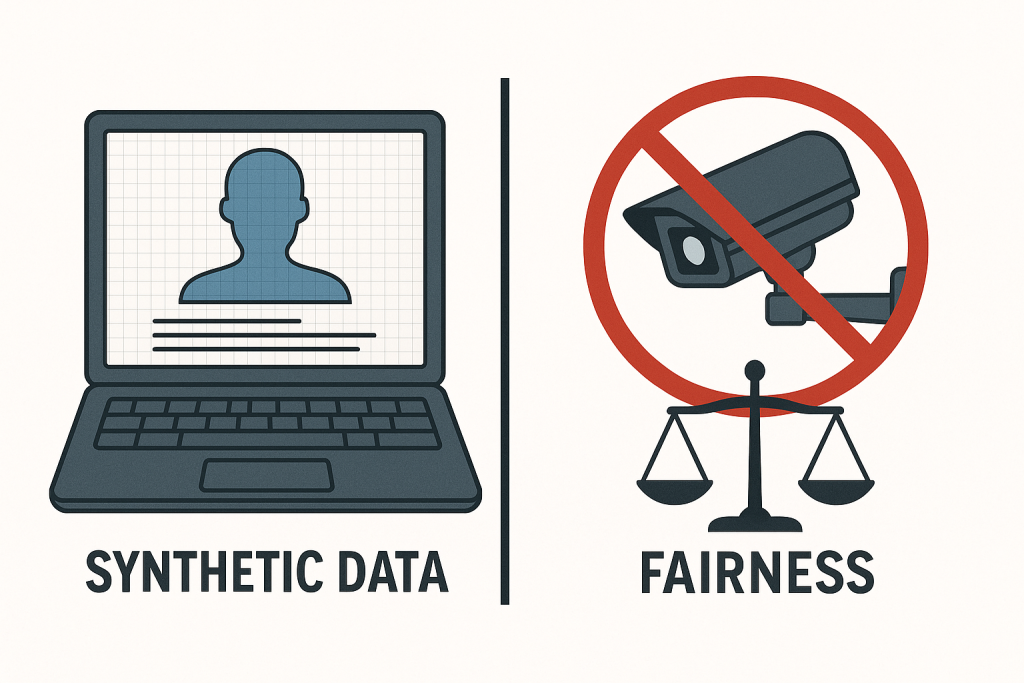
Fixing bias in AI has often defaulted to a blunt solution: collect more real data on underrepresented groups. In sensitive domains, that can slide into more surveillance—especially of children, patients, and communities already over-measured. Synthetic data offers a different path. By generating balanced and counterfactual datasets that preserve real-world relationships without tracking more individuals, teams can reduce bias while shrinking privacy risk. The core shift is from “observe more people” to “simulate responsibly.”
Light italic subheading Plain-language version
Instead of asking more people to share more personal details so AI becomes fairer, we can create privacy-safe “what-if” versions of the data that help models learn to treat people more equitably.
Why This Matters
Bias in AI is not just a technical issue—it’s a trust issue. And in education, health, and public services, trust is earned by how systems learn, not just what they predict.
Light italic subheading 1) “More data” can mean “more exposure”
When a district tries to reduce bias in a learning model by collecting more data from multilingual students, neurodiverse students, or low-income families, those groups bear the added scrutiny. The fairness goal is good; the method can be ethically costly.
Synthetic balancing lets us improve representation without expanding the footprint of real data collection.
Light italic subheading 2) Counterfactual data tackles bias at its root
Bias often lives in gaps: missing outcomes, small sample sizes, or skewed histories. Counterfactual synthetic data creates realistic alternate cases—e.g., similar students with different supports, or similar patients with different care pathways—so models learn fairness-relevant patterns that real data alone can’t easily provide.
Light italic subheading 3) It reduces the “fairness tax” on teachers, parents, and clinicians
Today, fairness improvement often requires lengthy data agreements, extra consent processes, and repeated data pulls. Synthetic-first debiasing allows faster iteration with fewer real-world burdens on families and frontline professionals.
Here’s How We Think Through This (steps, grounded)
Light italic subheading Step 1: Define the fairness problem in outcome terms
We ask: What unfair behavior are we trying to prevent?
Examples:
- An AI tutor that performs worse for students with limited internet access
- A health risk model that under-predicts risk for women
- A hiring screen that filters out older applicants prematurely
This clarity matters because different harms require different synthetic strategies.
Light italic subheading Step 2: Audit current bias using real governance-safe data
We start with a controlled real dataset to measure baseline gaps:
- Performance differences across groups
- Error rates and false positives/negatives
- Drift over time
If the fairness gap isn’t measurable, it can’t be fixed.
Light italic subheading Step 3: Identify which gaps come from data scarcity vs structural patterns*
Some bias is due to underrepresentation (too few examples).
Some bias is due to historical patterns (e.g., uneven support resources).
Synthetic data helps both, but in different ways:
- Scarcity gaps → balanced synthetic augmentation
- Structural gaps → counterfactual synthetic scenarios
Light italic subheading Step 4: Generate balanced synthetic cohorts
We create synthetic records that increase representation without copying individuals.
Key safeguards:
- Preserve core correlations that reflect learning/clinical reality
- Avoid generating “idealized” data that erases real hardship
- Ensure rare but important cases are present
Balanced does not mean “smoothed into sameness.” It means statistical visibility without individual exposure.
Light italic subheading Step 5: Generate counterfactual synthetic data for fairness learning
This is where synthetic data becomes uniquely powerful. We simulate plausible alternatives such as:
- Students with similar starting skills but different classroom supports
- Patients with similar profiles but different care access
- Applicants with matched experience but different demographic markers
The point isn’t to rewrite history. It’s to teach the model which variables should not determine outcomes.
Light italic subheading Step 6: Retrain and re-evaluate models with rigorous validation
Two tests must pass:
Utility validation:
- Model should remain accurate overall
- Improvements should be real, not artifacts
Fairness validation:
- Reduced gaps in error rates and outcomes
- No new harms introduced elsewhere
- Stability across time and settings
Light italic subheading Step 7: Lock in governance to prevent “fairness washing”
Synthetic debiasing isn’t ethical unless it’s transparent. We recommend:
- Documenting how synthetic data was generated
- Publishing fairness metrics before and after
- Independent review in high-stakes settings
- Clear limits on any use of real sensitive attributes
What is Often Seen as a Future Trend — Real-World Insight
Light italic subheading Trend people talk about: “Synthetic data will automatically make AI fair.”
Light italic subheading Reality we see: It creates room to make AI fair—if designed carefully.
Three practical insights are emerging:
Light italic subheading 1) Surveillance is a fairness strategy of last resort
In education and health, we see growing agreement that collecting more sensitive real data should be the exception, not the default. Synthetic augmentation offers a middle route that is often enough to close gaps without broadening surveillance.
Light italic subheading 2) Counterfactuals outperform simple reweighting
Traditional bias fixes (like reweighting data) help, but can’t teach models about unrealized possibilities. Counterfactual synthetic scenarios improve fairness in a more causal, human-aligned way by showing models: “Here’s what should happen under equal conditions.”
Light italic subheading 3) The biggest danger is unrealistic synthetic “fairness worlds”
If synthetic data is generated without domain grounding, it can create a fake reality where inequities vanish too neatly. That trains models to expect fairness that doesn’t exist yet. The right approach preserves real constraints while preventing them from being mistaken as destiny.
Light italic subheading The strategic takeaway
Fairness without surveillance is possible when we treat synthetic data as a privacy-preserving fairness lab. We don’t need to watch more people to respect them better. We need to simulate responsibly, validate rigorously, and keep real-world anchors in the loop.