
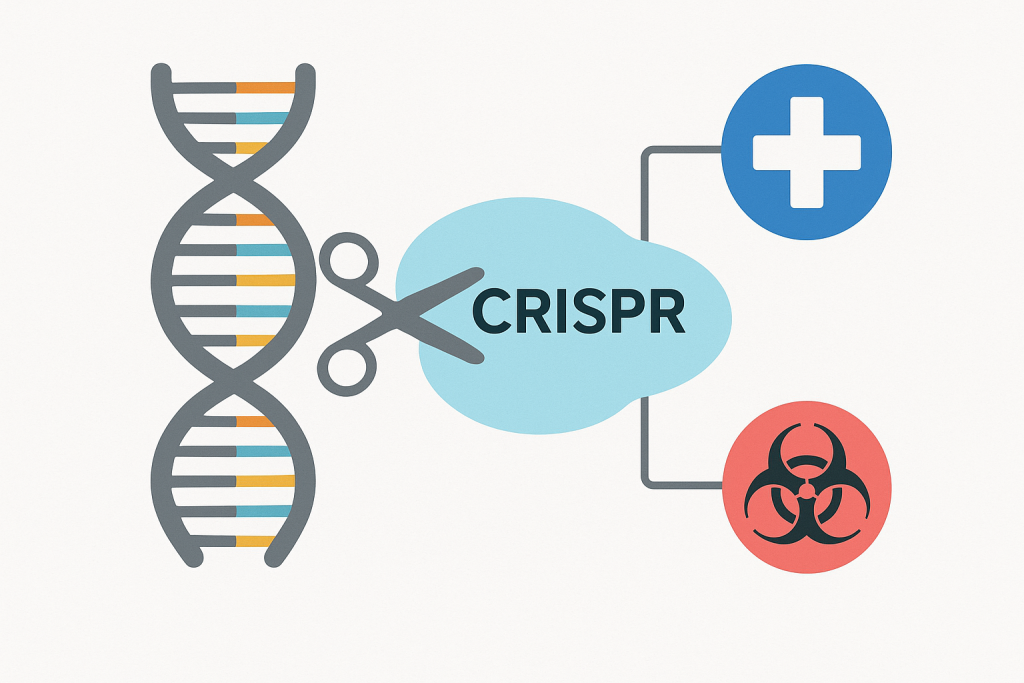
When the tools that cure can also destroy, oversight becomes as critical as innovation.
Biology’s Double Edge
Every powerful tool has two uses: one for progress, one for peril.
Synthetic biology and CRISPR gene-editing have unlocked extraordinary capabilities—treating genetic diseases, growing sustainable materials, and even editing food crops for resilience. But these same technologies also carry a profound risk: the ability to create, modify, or amplify biological threats.
This paradox is known as the dual-use dilemma—where the same scientific knowledge can serve both human welfare and harm. In biology, the stakes are existential.
From Medical Breakthrough to Potential Weapon
CRISPR was designed to heal. It can also be programmed to harm.
Gene-editing tools like CRISPR make it possible to alter organisms with precision once unimaginable. That precision can be used to delete a mutation in a child—or insert one in a pathogen.
Synthetic biology, which allows scientists to design genetic code from scratch, amplifies this risk. In theory, anyone with access to the right tools and data could recreate known viruses, modify bacterial toxins, or design novel biological agents with unpredictable effects.
These are not speculative fears. In 2002, researchers synthesized the poliovirus from published sequences. In 2018, a lab reconstructed horsepox, a close relative of smallpox, as a proof of concept. The line between research and risk is now razor-thin.
The Nature of Dual-Use Risk
The danger isn’t intent—it’s capability.
Most researchers in synthetic biology pursue legitimate and beneficial work. But because biology is programmable, the same data, materials, and methods that advance medicine can also be redirected.
Three layers of risk define dual-use bioengineering:
- Knowledge risk – Research papers or open genetic databases can provide blueprints for misuse.
- Technology risk – Readily available lab tools (DNA printers, CRISPR kits) reduce the barrier to experimentation.
- Access risk – Globalized supply chains make it easier to acquire biological materials without oversight.
This convergence makes biosecurity not just a government concern—but a shared global responsibility.
Existing Frameworks—and Their Gaps
International oversight exists, but it’s fragmented and slow.
Several agreements aim to prevent biological misuse:
- The Biological Weapons Convention (BWC) bans the development and stockpiling of biological weapons.
- The World Health Organization (WHO) provides guidance on dual-use research of concern (DURC).
- National biosafety agencies regulate access to pathogens and genetic materials.
Yet these frameworks were designed for a different era—when dangerous research required institutional infrastructure. Today, biological capability has become distributed. Startups, universities, and even community labs have the tools once reserved for state actors.
No global mechanism yet exists to track or verify how synthetic biology research is being applied.
The Oversight Challenge: Speed vs. Safety
Science moves faster than policy.
Regulatory systems struggle to keep pace with the velocity of biotechnological progress. Oversight processes—grant reviews, export controls, ethics boards—operate on timelines that lag months or years behind innovation cycles.
Meanwhile, AI-driven bioinformatics platforms can now design genetic constructs in hours. As biological software becomes integrated with artificial intelligence, the dual-use dilemma expands into bio-digital convergence—where code and life blur beyond jurisdictional boundaries.
Building a Global Safety Net
The solution isn’t restriction—it’s responsibility.
Effective management of dual-use biology depends on embedding ethics, traceability, and transparency at every level of research. Key measures include:
- Standardized screening: DNA synthesis companies must verify orders against pathogen databases.
- Ethical training: All biology education should include biosecurity awareness and dual-use ethics.
- AI-integrated monitoring: Algorithms can flag suspicious gene sequences or anomalous lab data.
- International cooperation: Nations must update the Biological Weapons Convention to reflect programmable biology realities.
Regulation alone won’t stop misuse. Culture and accountability—rooted in scientific ethics—will.
Why This Matters for the Next Generation
Students entering biology today aren’t just learning science—they’re inheriting power.
Educators and parents must help frame biotechnology not only as a tool for innovation but as a system of responsibility. As programmable life becomes the new frontier, literacy in ethics, safety, and security is as vital as literacy in code.
The next century of biology will be written not just in DNA, but in decisions. Whether CRISPR heals or harms will depend on how we govern the hands that wield it.
Conclusion: Power Demands Stewardship
Biology has entered its nuclear age—capable of both extraordinary creation and irreversible damage. The dual-use dilemma isn’t a hypothetical threat; it’s a reminder that every advancement carries an ethical echo.
The challenge is not to slow innovation, but to design a culture of safety that grows as fast as the science itself.
Because in programmable biology, the real breakthrough isn’t what we can do—it’s how responsibly we choose to do it.