
Factories of the future won’t forge steel—they’ll grow it.
From Machines to Molecules
For over a century, manufacturing has meant assembling parts: metal, plastic, and electricity combined by human design. But as we enter the next industrial revolution, the blueprint is no longer mechanical—it’s biological.
CRISPR, the precise gene-editing tool once known for rewriting DNA in medicine, is now shaping a new kind of manufacturing platform. Instead of machines producing materials, cells will.
This shift—often called synthetic biology manufacturing—marks the emergence of a world where factories are alive.
What Is a Genetic Foundry?
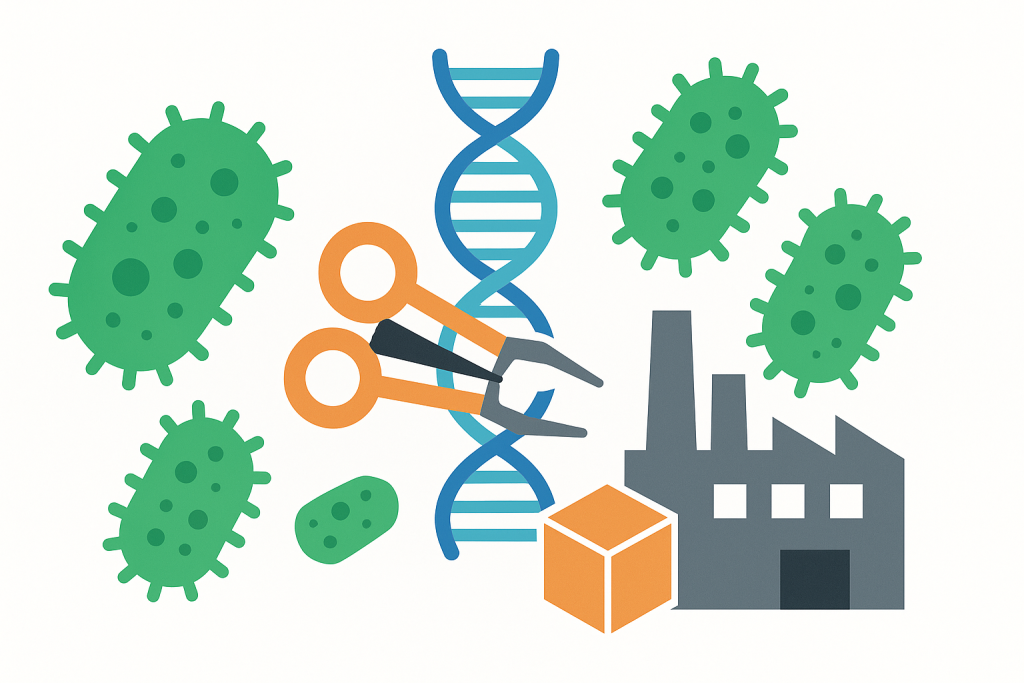
A genetic foundry is a bioengineering environment where DNA functions as the design language for production. Using CRISPR and other genetic tools, scientists can program living cells to create specific molecules, fibers, or even entire materials—just as a 3D printer produces objects from digital code.
The process looks like this:
- Code: Define the material’s properties at the genetic level (for example, elasticity or strength).
- Edit: Use CRISPR to insert or modify genes in microbes, plants, or cell cultures to express those traits.
- Grow: Let the edited organism produce the target material through natural processes like fermentation or protein synthesis.
The result? A material grown instead of manufactured—precise, renewable, and programmable.
From DNA to Material Science
This fusion of biology and industry is already reshaping material science. Researchers are using CRISPR to:
- Produce spider-silk proteins stronger than steel for textiles and aerospace.
- Engineer microbes that secrete bioplastics or adhesives on demand.
- Create cells that produce pigments, sensors, or electronic components.
These are not laboratory curiosities. Some are already being scaled by startups partnering with automotive and construction firms. The vision is clear: factories that operate at the speed and efficiency of nature.
Programmable Living Factories
In a traditional factory, materials flow through machines. In a biological one, information flows through genes. Each cell becomes a production unit—a biological robot capable of sensing, computing, and manufacturing simultaneously.
CRISPR enables this by giving engineers fine control over cell behavior. By editing metabolic pathways, scientists can reroute how energy and resources are used, optimizing yield and reducing waste.
Imagine yeast that produces jet fuel instead of alcohol, or bacteria that synthesize concrete-strength proteins from CO₂. This is not theoretical—it’s already underway.
Advantages Over Traditional Manufacturing
The appeal of CRISPR-based bio-manufacturing lies in its scalability and sustainability:
- Energy Efficiency: Processes occur at room temperature and low pressure, reducing fossil fuel use.
- Zero Waste: Byproducts are biodegradable or recyclable.
- Customization: DNA can be rewritten for each use case, allowing local or on-demand production.
This makes the biological factory not only cleaner but smarter—able to adapt as conditions, markets, or environmental priorities change.
Education and Workforce Implications
For educators and parents, this revolution reframes what it means to “make things.” The next generation of engineers will design living systems, not just mechanical ones.
Students will need fluency across biology, coding, and systems thinking. Courses in biodesign, bioinformatics, and ethical biotechnology will become as foundational as physics or computer science.
In essence, “shop class” is being replaced by cell class—where students learn to design, test, and optimize biological processes.
Ethical and Ecological Considerations
As biology becomes programmable, ethical questions grow equally complex.
- Who owns the genetic code of a cell used for manufacturing?
- How do we ensure engineered organisms remain contained and safe?
- What happens when living materials enter natural ecosystems?
Educators and policymakers must integrate these discussions early—equipping young people not just with technical literacy but with moral literacy in the stewardship of life-based technologies.
A New Definition of Manufacturing
The genetic foundry isn’t science fiction—it’s an evolving ecosystem where DNA replaces blueprints and cells replace machines. CRISPR makes this possible by transforming biology into a modular, editable framework for innovation.
This new model of manufacturing isn’t about building with nature—it’s about building as nature.
When the world’s factories become living systems, sustainability won’t be an afterthought. It will be the operating principle.