
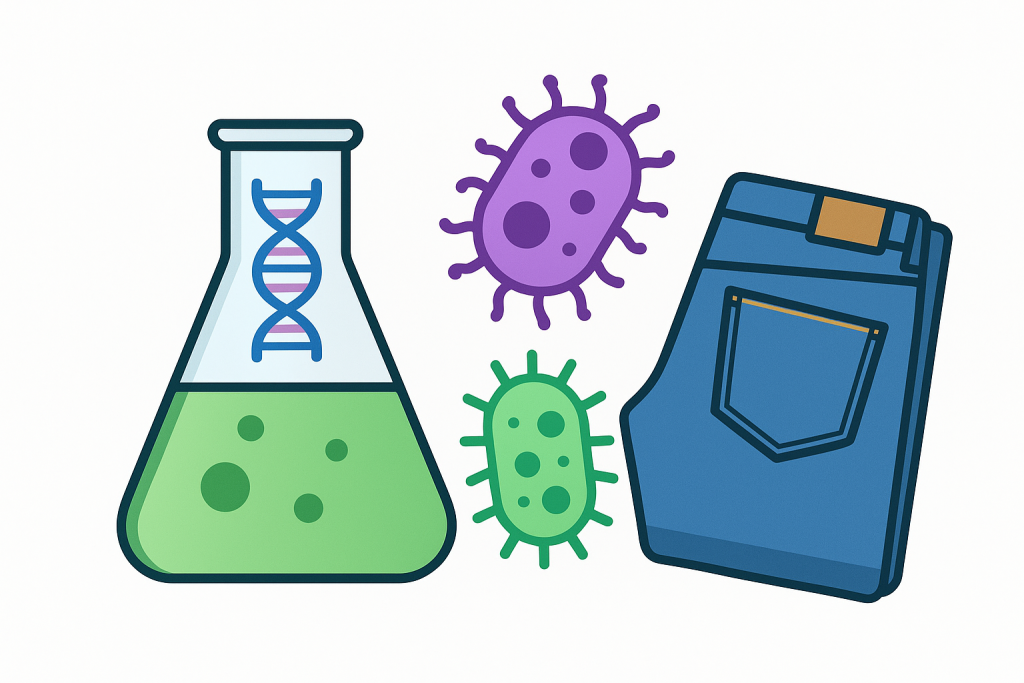
The future of sustainable fashion might not start in a factory—it might start in a lab.
The Problem with Fashion’s Chemistry
Fashion is one of the most resource-intensive industries on Earth. Textile dyeing alone consumes billions of liters of water each year and releases toxic chemicals into rivers and soil. The traditional supply chain depends on petrochemical dyes, harsh finishes, and energy-heavy processing—a legacy system that’s increasingly unsustainable in both environmental and economic terms.
Now, a new class of innovators is turning to biology instead of chemistry. Using CRISPR, scientists are reprogramming microbes to produce colors, fibers, and coatings naturally—marking the rise of biofashion.
How CRISPR Is Changing the Fabric of Fashion
CRISPR, the precise gene-editing tool that allows scientists to modify DNA with surgical accuracy, is transforming how we make materials. Instead of extracting dyes or polymers from petroleum, researchers can now engineer bacteria, yeast, and algae to produce the same molecules organically.
For example:
- Bacteria can be programmed to produce indigo pigment—the dye that gives denim its iconic blue—without toxic byproducts.
- Engineered yeast can secrete silk-like proteins for textiles, replacing water-intensive sericulture.
- Microbes can create biofinishes that add water resistance or stretch to fabrics without synthetic coatings.
These processes don’t just mimic nature—they enhance it. By redesigning microbial metabolism, CRISPR allows production that’s cleaner, faster, and infinitely renewable.
The Rise of Bio-Dyeing and Living Color
Traditional dyeing uses vast amounts of water and chemicals to fix color to fabric. CRISPR-engineered microbes solve this by producing dyes directly from fermentation.
Take Bio Indigo, developed by startups using gene-edited bacteria. Instead of polluting waterways with leftover dye, these microbes grow the pigment inside a controlled bioreactor, producing color with minimal waste.
Beyond blue, scientists are now programming microbes to express new pigments—reds, purples, and greens—by tweaking genetic pathways that control natural color production. This means living color palettes, not chemical ones, opening the door to eco-conscious design without compromise.
Reinventing the Fabric Itself
CRISPR isn’t just creating color—it’s redesigning fibers from the molecular level up.
By editing genes in yeast and bacteria, researchers are producing materials that blend the softness of cotton, the strength of nylon, and the stretch of spandex, all without fossil fuels or factory waste.
One example is lab-grown spider silk, made by microbes that have been programmed to spin silk proteins identical to those of spiders. The result is a biodegradable, high-performance fabric already being tested by sportswear and luxury brands.
Environmental and Economic Advantages
CRISPR-based fashion offers several transformative benefits:
- Water conservation: Bio-dyeing reduces water usage by up to 90%.
- Chemical elimination: No heavy metals, formaldehyde, or solvents required.
- Localized production: Biofactories can produce dyes or fibers near the point of use, cutting transport emissions.
- Circularity: Because these materials are organic, they can biodegrade naturally or be recycled as feedstock for new production.
The shift isn’t just about sustainability—it’s about redefining efficiency. Biology does what chemistry can’t: build complex materials at room temperature, powered by sunlight or sugar.
Fashion’s New Supply Chain: The Bioreactor
In the near future, the most important part of a clothing factory may be a bioreactor, not a loom. These contained environments can culture billions of engineered microbes that produce pigment or fiber proteins continuously.
Once harvested, the output can be purified, woven, and finished just like traditional textiles. The difference? No waste streams, no toxins, no fossil feedstocks.
This is a new kind of industrial infrastructure—living manufacturing—where biology replaces the smokestack.
Educating the Next Generation of Bio-Designers
For educators and parents, this shift offers a glimpse of where art and science will converge. The designers of the future won’t just sketch garments—they’ll code them. Understanding DNA as a creative medium will become as important as understanding pattern-making or materials science.
Schools and universities are already developing programs in biodesign, materials biology, and synthetic fashion, preparing students to work at the intersection of sustainability, aesthetics, and technology.
Ethics and Accessibility in Biofashion
With biology entering the supply chain, ethical questions follow.
- Who owns the genetic code of a color or fiber?
- How do we ensure fair access to biotech innovations in developing countries?
- Can engineered organisms be safely contained outside the lab?
Teaching these issues alongside the technology itself will help ensure the industry grows responsibly—protecting both creativity and the planet.
A Future Woven from Code
CRISPR is giving fashion a new material language—one written in DNA, not chemistry. It allows us to design fibers and colors that are alive, adaptable, and aligned with ecological limits.
The phrase “from DNA to denim” isn’t just poetic—it’s literal. The next generation of jeans, dresses, and shoes may be grown in labs, not stitched from extracted resources.
The future of style is coded, cultivated, and sustainable by design.