
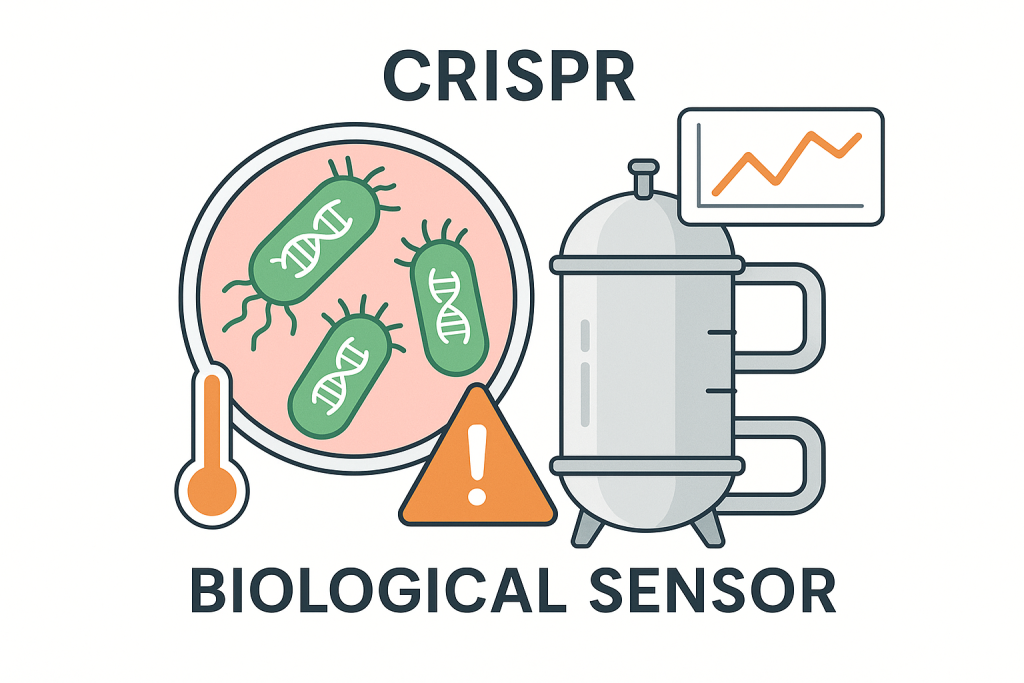
The next generation of sensors won’t be made of silicon—they’ll be alive.
From Microbes to Machines
For over a century, industries have relied on mechanical sensors to monitor temperature, pressure, and chemical conditions. But as production systems grow more complex—and more biological—traditional hardware is reaching its limits.
Now, thanks to CRISPR, scientists are creating living sensors: bacteria that can detect toxins, signal contamination, and regulate industrial processes from the inside out. These “smart microbes” don’t just observe their environment—they respond to it.
How CRISPR Turns Cells into Sensors
CRISPR gives researchers precise control over microbial DNA, allowing them to program bacteria to recognize and react to specific molecular cues.
Here’s how it works in principle:
- Detection: Scientists engineer microbes with genetic circuits that “turn on” when they encounter a target molecule—like a toxin, heavy metal, or temperature change.
- Response: Once triggered, the cell produces a measurable signal—such as fluorescence, color change, or chemical release.
- Feedback: The signal can then be used to adjust conditions, trigger alerts, or even activate another biological process.
In short, CRISPR transforms microbes from passive organisms into programmable, self-reporting systems.
Applications in Bioprocessing and Manufacturing
The first wave of CRISPR-based microbial sensors is emerging in industrial biotechnology—where precision and safety are paramount.
- Fermentation Optimization: Engineered bacteria can sense when oxygen or nutrient levels fall outside the ideal range and automatically adjust metabolic activity, improving yield and efficiency.
- Contamination Detection: Microbes can identify viral or chemical contaminants early in the process, signaling through visible color shifts or data-linked biosensors.
- Waste Monitoring: In water treatment and recycling systems, CRISPR-modified bacteria detect heavy metals, ammonia, or organic pollutants and record their presence.
These systems reduce the need for manual sampling, lab testing, and complex sensor arrays. The living sensor is the process.
Environmental and Safety Benefits
Unlike traditional monitoring systems that require energy-intensive instruments, biological sensors are self-powered and biodegradable. Once their job is done, they naturally degrade, leaving no waste behind.
Moreover, these systems can operate in extreme environments—deep in fermentation tanks, wastewater channels, or remote locations where electronics fail. Because microbes can self-replicate, they offer a sustainable, scalable solution to continuous monitoring.
Smart Microbes in Action
Examples of real-world breakthroughs include:
- E. coli-based sensors that detect arsenic in groundwater with visible color change, providing low-cost environmental testing.
- Yeast strains that measure alcohol content and pH in fermentation processes for the brewing and biofuel industries.
- Marine bacteria designed to sense oil leaks, producing fluorescent signals that guide cleanup operations.
Each innovation demonstrates a shift from static measurement to living feedback—a continuous, adaptive flow of information.
The Rise of Self-Monitoring Bioprocesses
In industrial biomanufacturing, where precision control over living systems is critical, CRISPR is enabling a new model: self-monitoring production.
Imagine a bioreactor where microbes grow, sense, and adjust their own environment in real time. The system would detect nutrient depletion, adjust gene expression to stabilize output, and even alert operators before a problem occurs.
These processes combine biotechnology with automation—creating cyber-biological systems that learn from their own data.
It’s biology meeting control engineering.
Implications for Education and Workforce
For educators and parents, smart microbes provide a powerful teaching bridge between biology, coding, and engineering. They illustrate how life can be designed to perform computational functions—detect, respond, and adapt.
Students studying synthetic biology today aren’t just learning about cells; they’re learning about systems thinking—how living processes can become programmable tools for sustainability, health, and manufacturing.
This is where biology becomes both the subject and the software.
Ethical and Safety Considerations
As with any powerful technology, the deployment of CRISPR-engineered microbes requires oversight and responsibility.
- How do we ensure these organisms remain contained in industrial settings?
- Should biological sensors report only to humans, or also trigger automated actions?
- Who owns the data they produce?
Embedding bioethics into science and engineering education ensures that innovation aligns with ecological and social priorities—not just industrial efficiency.
The Future of Living Technology
Smart microbes represent the next phase of industrial evolution. They merge life’s adaptability with human precision, enabling systems that are autonomous, efficient, and environmentally conscious.
As industries transition to bio-based economies, these living sensors will act as the connective tissue between biology and technology—continuously sensing, adapting, and improving.
In the future, our smartest machines may not be built.
They’ll be grown.