
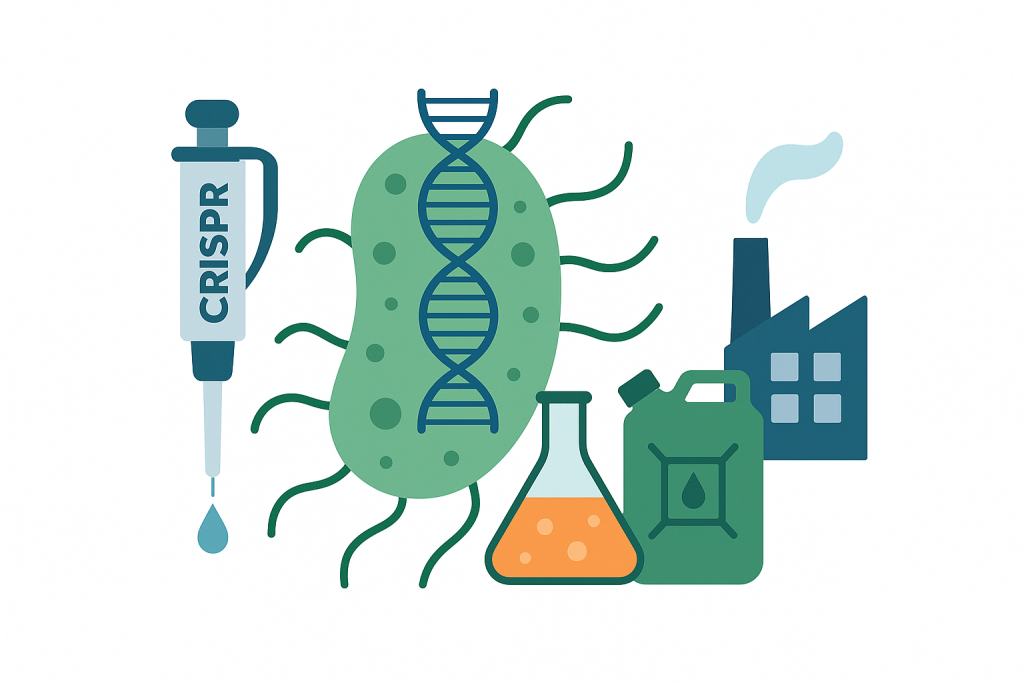
The next generation of factories won’t be made of metal—they’ll be made of microbes.
The Industrial Revolution, Rewritten in DNA
For more than a century, industrial manufacturing has relied on heat, pressure, and chemistry to produce the world’s fuels and materials. But these systems are energy-intensive, carbon-heavy, and often toxic to the planet.
Today, a new model is emerging—biological manufacturing, where living cells replace smokestacks. At the heart of this revolution is CRISPR, the gene-editing tool that lets scientists precisely reprogram microbial DNA to turn cells into efficient, sustainable mini-factories.
From Fermentation to Precision Bioengineering
Microbes have been industrial partners for centuries—brewing beer, making cheese, and fermenting antibiotics. What’s new is the level of control. With CRISPR, scientists can directly modify a microbe’s genetic code to optimize how it consumes resources, produces molecules, and tolerates environmental conditions.
Instead of relying on trial and error, researchers can now fine-tune biological systems with surgical precision. The result: faster development cycles, higher yields, and cleaner chemistry.
Think of it as shifting from farming microbes to engineering them.
Reprogramming Microbes for Energy and Fuel
One of the most transformative uses of CRISPR is in biofuel production. By editing the genomes of algae or bacteria, scientists can increase their ability to convert CO₂ into ethanol, hydrogen, or even jet fuel.
For example, certain strains of cyanobacteria are being redesigned to use sunlight more efficiently and secrete energy-rich hydrocarbons directly. Unlike traditional biofuels that rely on large-scale crops, these microbial systems operate in compact reactors and recycle carbon instead of emitting it.
This could make renewable fuels cost-competitive—and carbon-negative.
Bio-Based Chemicals: Rethinking the Supply Chain
Chemical manufacturing is another industry being quietly rewritten by CRISPR. By reprogramming microbial metabolism, companies are producing bio-based alternatives to industrial chemicals like acetone, lactic acid, and even nylon precursors.
For instance, CRISPR-edited E. coli can now synthesize bioplastics from plant sugars instead of petroleum. Similarly, engineered yeast are generating aromatic compounds used in detergents and fragrances, with significantly lower emissions.
These new production lines can run continuously, at room temperature, and without the toxic byproducts of traditional chemical plants.
Building Climate-Friendly Factories
Traditional factories emit carbon dioxide as a waste product. CRISPR-designed microbes can flip that equation by consuming carbon. Certain species are now engineered to feed on industrial exhaust or agricultural waste, converting it into valuable materials.
This approach—known as carbon upcycling—could transform emissions into feedstocks. Imagine steel mills or cement plants where waste gases fuel microbial reactors producing renewable materials.
The combination of CRISPR precision and microbial metabolism is redefining what “industrial efficiency” means.
Why It Matters for the Next Generation
For educators and parents, these developments signal a major shift in career pathways. The “factory worker” of the future may not wear a hard hat but a lab coat—or manage automation systems that run living production lines.
Fields like synthetic biology, bioprocess engineering, and systems design are rapidly becoming the foundation of sustainable manufacturing. Students who understand both code and biology will shape industries that merge computing, genetics, and environmental science.
Classrooms teaching this intersection—where life itself becomes programmable—will be training the architects of a new industrial age.
Ethics and Ecological Balance
As with all technologies that reprogram life, CRISPR’s industrial applications raise key ethical questions:
- How do we ensure engineered microbes don’t disrupt ecosystems?
- Who regulates the release or containment of these new life forms?
- How can developing nations access bio-manufacturing equitably?
Responsible design, safety standards, and transparent governance must evolve alongside the technology. Teaching bioethics as part of future STEM education is no longer optional—it’s essential.
The New Factory Model
The traditional factory consumes resources and releases waste. The biological factory—powered by CRISPR—does the opposite: it repurposes waste and generates renewable products with minimal impact.
This isn’t just innovation—it’s inversion.
- From combustion to cultivation.
- From extraction to regeneration.
- From chemistry to biology.
CRISPR doesn’t just edit genes; it edits the logic of industry itself.
Conclusion: The Living Machines of Tomorrow
As we move into an age where biology becomes technology, CRISPR is turning microbes into collaborators in solving global challenges—from decarbonization to supply chain resilience.
The future factory will hum quietly—not with engines, but with engineered cells, working in harmony with the planet.
In that world, we won’t just build with materials.
We’ll build with life.