
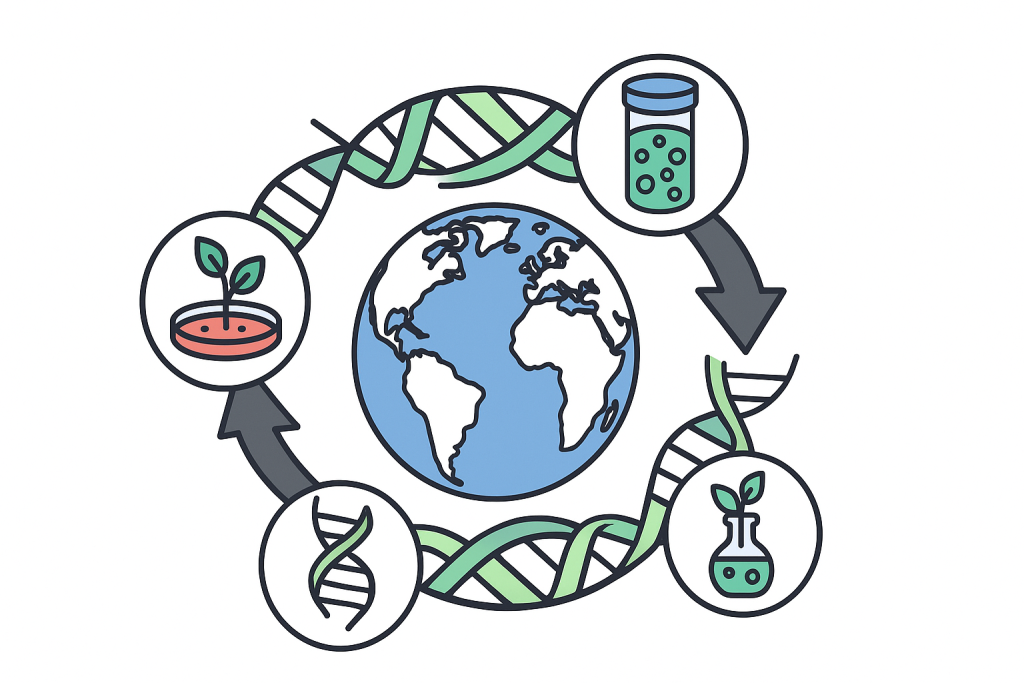
The next phase of global logistics may not run on oil or data—it may run on life.
Rethinking the Engine of the Global Economy
Modern supply chains are the invisible infrastructure of civilization. They deliver everything—from energy to medicine to clothing—but at a tremendous cost. Transport networks fueled by fossil energy, globalized production, and just-in-time logistics account for over half of industrial carbon emissions worldwide.
The solution isn’t simply electrification or efficiency—it’s reimagining the system itself. Enter programmable biology, where cells, enzymes, and organisms become living components of a new, adaptive, and low-carbon supply network.
From Industrial Chains to Living Systems
Traditional supply chains are linear: extract, manufacture, ship, consume, discard. Each step is energy-intensive and geographically dispersed.
Biological supply chains, by contrast, operate circularly and locally. Using tools like CRISPR and synthetic biology, scientists can program organisms—microbes, algae, fungi—to produce materials, fuels, or nutrients anywhere, using renewable feedstocks such as sunlight, CO₂, or waste biomass.
Instead of shipping crude oil across oceans, imagine cultivating engineered algae in coastal biofactories that generate the same chemical building blocks locally. Instead of centralized textile production, think of microbial bioreactors growing natural dyes and fabrics on demand.
This is biology not as a lab discipline—but as infrastructure.
How Programmable Biology Rebuilds the Logistics Model
Programmable biology turns genetic code into a design tool for production. Once an organism is engineered for a specific purpose, its “recipe” can be sent digitally anywhere in the world and replicated using local biological inputs.
This eliminates much of what makes today’s logistics environmentally costly:
- Reduced transport: Genetic data travels instantly; physical goods don’t have to.
- Localized manufacturing: Materials are grown near their point of use, cutting emissions and delays.
- Adaptive resilience: Biological systems can self-adjust to temperature, nutrient, or environmental shifts, ensuring continuity even during disruptions.
The result is a distributed, decentralized manufacturing ecosystem that mirrors nature’s efficiency—responsive, regenerative, and resilient.
Case Studies in the Emerging Bio-Supply Network
- Food Systems: Gene-edited microbes are creating proteins identical to those in meat or dairy, but made locally in small-scale bioreactors. This reduces both transport emissions and land use.
- Textiles and Dyes: CRISPR-modified bacteria are producing indigo pigment and biodegradable fibers, replacing water-intensive, toxic dyeing processes.
- Biofuels and Materials: Engineered algae can turn industrial CO₂ emissions into jet fuel, plastics, or construction materials—literally converting waste into supply.
Each example represents a carbon-negative node in what could become a living, regenerative global network.
The Climate Infrastructure of the Future
Biological supply chains do more than replace industrial systems—they reverse the flow of carbon. Traditional logistics consume energy and emit CO₂. Programmable biology captures and reuses it.
In a world facing climate instability, this biological infrastructure offers three key advantages:
- Carbon sequestration: Many engineered organisms absorb CO₂ as a feedstock.
- Energy efficiency: Biological reactions run at ambient temperature and pressure, reducing energy demand by up to 90%.
- Dynamic adaptability: Living systems evolve—improving themselves without requiring total replacement.
In essence, we’re replacing steel and concrete with cells and code.
Education and the Future Workforce
For educators and parents, the biological supply chain revolution represents a new direction for STEM education. Future logistics managers may not study mechanical engineering—they’ll study bioprocess engineering.
Students will need literacy in both digital and biological systems: how DNA becomes design, how metabolism can replace machinery, and how ecosystems can inform logistics.
Schools that integrate biology, sustainability, and data analytics will prepare students for careers in what could be called bioeconomics—a field where growth and regeneration coexist.
Ethics and Governance in Living Infrastructure
As supply chains become biological, so do their ethical implications.
- How do we regulate living production systems released into open environments?
- Who owns the genetic “recipes” for essential goods?
- How do we ensure equitable access to biological manufacturing technologies globally?
Embedding bioethics and governance into innovation is critical. The promise of programmable biology must balance innovation with safety, sovereignty, and environmental responsibility.
From Logistics to Life Systems
We stand at the edge of a fundamental redesign of the global economy. The industrial supply chain, once defined by fossil fuel and friction, is evolving into a living ecosystem of distributed biological production.
Programmable organisms—powered by CRISPR, AI, and synthetic design—can grow what factories once forged, turning emissions into materials and logistics into regeneration.
The supply chain of the future will not just move products.
It will grow them, adaptively, sustainably, and intelligently—because life itself will be part of the infrastructure.