
The next great industrial revolution isn’t mechanical—it’s biological.
What Is a Biofoundry?
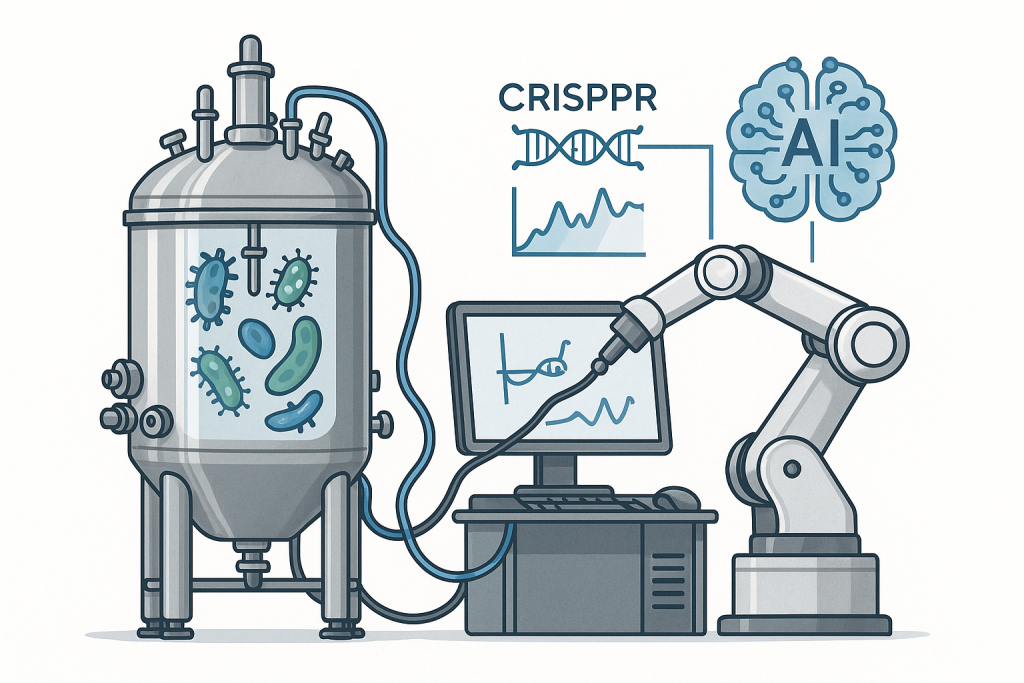
A biofoundry is a fully automated facility where biology is designed, tested, and optimized like software. Instead of assembling cars or electronics, biofoundries engineer living systems—microbes, enzymes, and biomaterials—using robotics, AI, and CRISPR gene editing.
In essence, they are factories for evolution, where machines and algorithms accelerate what used to take nature millennia.
These facilities are redefining research and development across sectors, from medicine to manufacturing to agriculture.
The Automation of Evolution
Traditional biology relied on slow, manual experimentation—scientists pipetting solutions one at a time. Biofoundries replace that process with automated, high-throughput systems that can test thousands of genetic variations simultaneously.
CRISPR provides the precision: it edits DNA to introduce specific changes. AI provides the direction: it analyzes outcomes, learns from data, and suggests the next round of edits. Robotics provides the speed: it executes these edits continuously, without human fatigue.
Together, these systems create a closed-loop cycle of biological innovation:
- Design: AI models predict which DNA sequences might yield useful traits.
- Build: Robotic CRISPR systems synthesize and insert those sequences into living cells.
- Test: Automated analytics evaluate performance—growth rate, yield, resistance, or other metrics.
- Learn: Machine learning algorithms analyze the results and feed insights back into the next design.
This loop repeats 24/7, effectively allowing biology to evolve under supervision.
Why It Matters for Industry
Biofoundries transform biology from an unpredictable science into a scalable engineering discipline. Companies can now prototype and optimize living systems as quickly as software firms develop apps.
This acceleration is already reshaping multiple industries:
- Energy: Engineered microbes produce clean biofuels from waste.
- Materials: CRISPR-edited organisms create bioplastics, spider silk, and carbon-neutral concrete.
- Pharmaceuticals: AI-guided microbial platforms generate drugs and vaccines faster than ever before.
- Agriculture: Rapid evolution tools design crops that resist drought or disease.
Instead of waiting years for lab breakthroughs, industries can now iterate biology in weeks.
The Biofoundry Model: R&D on Autopilot
A modern biofoundry looks less like a wet lab and more like a tech startup’s data center. Stainless steel robots handle liquids, cloud-connected servers process genomic data, and AI systems manage workflows in real time.
Human researchers act as designers and strategists, defining goals and interpreting results. The tedious steps of experimentation—mixing, measuring, waiting—are handled by autonomous platforms.
This “always-on” system enables continuous discovery and optimization, building a feedback loop between digital simulation and living matter. The result is not just faster science, but evolution as a service.
The Role of CRISPR
CRISPR is the cornerstone of biofoundry innovation. Its precision allows for rapid, predictable genetic changes that can be systematically tested.
In a biofoundry, CRISPR isn’t used for one-off edits—it’s used in parallel, enabling thousands of variations to be generated and analyzed at once. This creates a real-time map of how genes affect function, making biological design increasingly data-driven and predictive.
As CRISPR tools become more versatile—capable of editing multiple genes or even entire pathways simultaneously—the potential to design complex traits and new materials will expand exponentially.
AI as the Evolution Engine
While CRISPR does the editing, AI decides what to edit next. Machine learning models trained on biological data predict which genetic combinations will yield the best outcomes, reducing randomness and waste.
This synergy between CRISPR and AI mirrors how autonomous vehicles learn to navigate roads: the system improves with every iteration. In biofoundries, that means faster optimization and greater control over biological processes.
It’s not evolution by chance—it’s evolution by computation.
Educational and Workforce Implications
For parents and educators, biofoundries represent a pivotal shift in what “biotech” means for the next generation.
Tomorrow’s biologists will also need to be data scientists, coders, and systems engineers. Students should understand not only cell biology but also automation, programming, and ethics in biotechnology.
Schools and universities are beginning to develop biofoundry-inspired curricula—teaching how design, robotics, and genetics converge in sustainable industry. These programs are cultivating the next generation of “bioengineers” who will manage evolution as a programmable process.
Ethical and Governance Questions
As evolution becomes automated, ethical stewardship becomes critical.
- Who decides what organisms are created or modified?
- How do we prevent misuse or ecological disruption?
- Should biological design be patentable?
These are not theoretical concerns—they are pressing realities. Educating young thinkers in bioethics and governance ensures that as we automate life, we also preserve its integrity.
From Nature’s Lab to the Factory Floor
Biofoundries are the next step in humanity’s partnership with biology. They merge the speed of computation with the adaptability of life, creating factories that learn, evolve, and improve.
If the 20th century belonged to steel and silicon, the 21st belongs to cells and code.
The automation of evolution isn’t about replacing nature—it’s about learning to collaborate with it at industrial scale.