
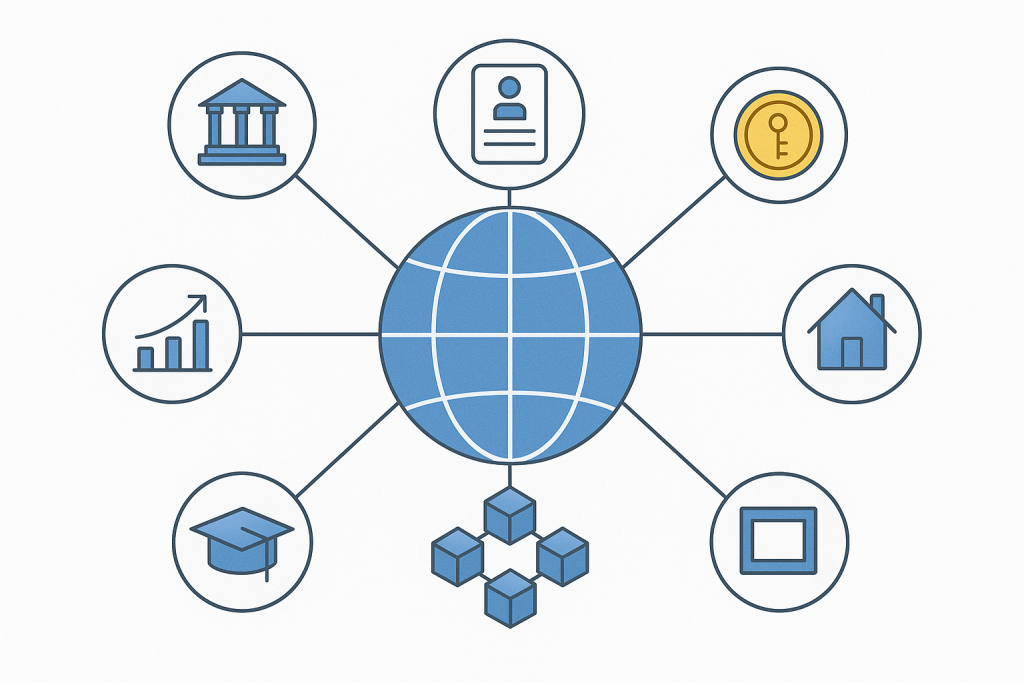
Think of the “asset web” as a new global layer for value movement, similar to how the internet became a global layer for information. Blockchain makes this possible by providing a shared, tamper-resistant record of ownership plus programmable rules for how assets can move. In this world, homes, equipment, savings, royalties, carbon credits, learning credentials, and digital goods can all travel through a common value layer—settling quickly, crossing borders more easily, and carrying built-in rights and compliance. The real breakthrough isn’t any single token or platform. It’s the emergence of a universal infrastructure where ownership becomes portable, programmable, and interoperable.
Why This Matters
This is a big-picture shift, but it will be felt in everyday systems that families, schools, and communities rely on.
Ownership becomes something you can “carry,” not something you chase.
Today, proving and moving ownership depends on a patchwork of registries, banks, platforms, and paper processes. The asset web pulls value into a consistent digital layer so people can hold rights in wallets and present proof when needed—without rebuilding trust each time.
Settlement moves from weeks to near-real time.
Whether it’s property transfers, insurance claims, cross-border remittances, or community fundraising, delays are often caused by reconciliation between institutions. A shared ledger reduces this “ownership lag,” making transactions faster and less dispute-prone.
Cross-border participation becomes more practical.
Families with ties across countries, diaspora investors supporting local projects, or schools partnering globally all face friction in today’s markets. A common value layer lowers operational barriers—if governance and compliance are designed well.
Programmability creates new social and civic models.
Assets can carry rules: shared ownership, revenue splitting, usage rights, or community voting. This isn’t about replacing human judgment. It’s about making agreements explicit and verifiable, reducing ambiguity in how shared assets are managed.
Governance becomes the defining challenge.
A global value layer raises hard questions: Who sets the rules? Who is protected? Who can reverse mistakes? How do we prevent exclusion or capture? If these aren’t addressed, the asset web risks becoming fast but unfair.
Here’s How We Think Through This (steps, grounded)
Step 1: Start from the value flow, not the technology.
We map what people are trying to do:
- transfer ownership
- borrow against assets
- share revenue or access
- verify origin or impact
The asset web only matters where it reduces real friction or risk.
Step 2: Define the asset’s rights bundle clearly.
Every asset needs explicit rights mapping:
- ownership title
- usage permissions
- economic benefits
- governance/voting authority
A token without enforceable rights is not a real node in the asset web.
Step 3: Anchor digital ownership to authoritative registries.
For physical assets, legal truth still matters. We design hybrid linkages:
- land and vehicle registries
- regulated custodians
- audited issuers
The asset web grows by synchronizing with institutions, not bypassing them.
Step 4: Standardize token formats and metadata.
Universal value movement requires shared language:
- consistent token structures
- interoperable metadata (provenance, status, valuation)
- compliance fields and disclosure rules
Without standards, the “web” fragments into incompatible islands.
Step 5: Build credible reality pipelines.
A global ledger can secure data, but it can’t verify the physical world.
We design bridges such as:
- inspections and audits
- IoT sensor logs
- certified attestations
Credible input is what makes the asset web trustworthy.
Step 6: Design compliance as native infrastructure.
Cross-border markets require built-in safeguards:
- verifiable credentials for eligibility
- AML/sanctions checks through regulated gateways
- jurisdiction-aware transfer rules
This is how participation scales safely.
Step 7: Put governance first, speed second.
We specify:
- who can upgrade smart contracts
- how disputes are handled
- what emergency pauses or reversals exist
- how minority or vulnerable stakeholders are protected
The asset web succeeds when governance is explicit and legitimate.
Step 8: Measure success in trust and inclusion, not token volume.
We look for:
- fewer ownership disputes
- lower transaction costs
- faster settlement without higher fraud
- broader participation from non-experts
If only insiders benefit, the infrastructure hasn’t matured.
What is Often Seen as a Future Trend — Real-World Insight
The asset web is often described as a futuristic “everything on blockchain” scenario. In practice, it’s emerging unevenly—starting where the trust costs are already high.
What we’re seeing:
The asset web grows through “quiet rails,” not loud headlines.
Supply chains, carbon markets, trade finance, and institutional settlement are early layers because they gain the most from shared records and automated reconciliation. Consumer-facing change tends to come later, once the rails are stable.
Hybrid systems will dominate for a long time.
A global value layer doesn’t replace registries overnight. Instead, expect synchronization: legacy registries remain authoritative while on-chain layers automate movement, proof, and compliance. The transition is infrastructural, not theatrical.
Programmable ownership will show up in community use cases first.
Shared solar, cooperative property, school resource pooling, and local investment models are natural fits because they need clear rules and trust across many participants. These are not speculative markets; they are governance markets.
Governance is where real differentiation happens.
Two asset-web systems can use the same blockchain and still produce very different outcomes depending on their rules for participation, dispute resolution, and upgrades. The “code layer” is only half the story; the “social layer” decides legitimacy.
The takeaway: the asset web is not a single product or platform. It’s a global direction of travel—toward a common layer where value moves like information does today. The question for society isn’t whether this layer arrives, but whether we design it to be trustworthy, inclusive, and governable.