
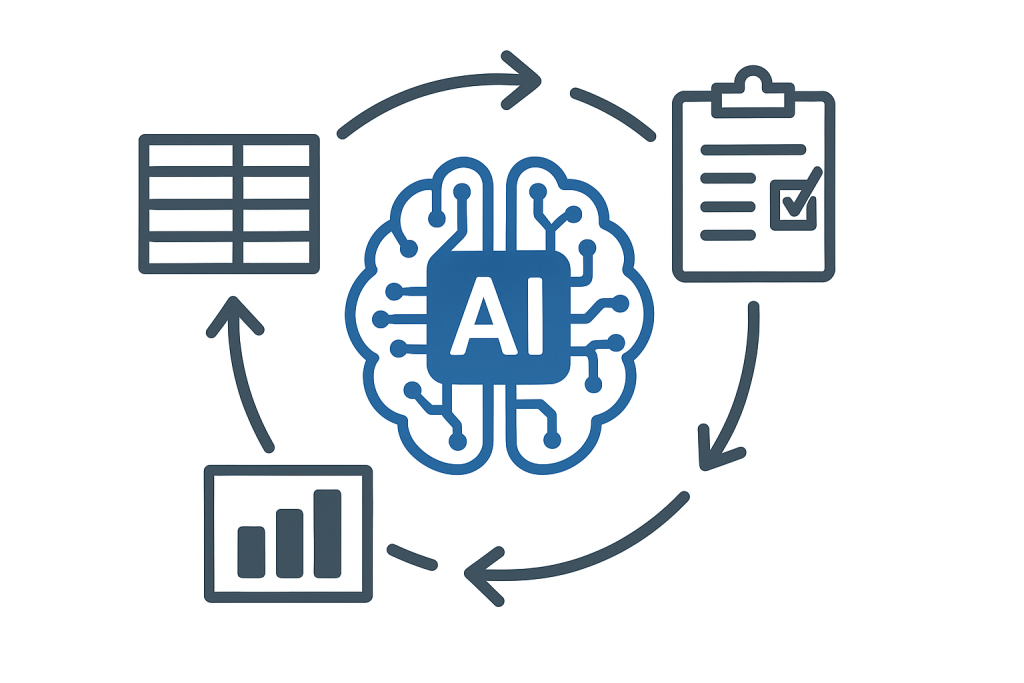
A new kind of AI progress is emerging: models that help create their own training worlds. Instead of relying only on human-collected datasets, advanced systems can generate synthetic problems, attempt solutions, critique their own work, and refine future training rounds. This creates a “data flywheel” where learning accelerates through structured practice—much like how humans improve using mock exams, coaching, and deliberate repetition. The key shift is that training becomes an active, self-improving process rather than a one-time ingestion of past data.
Why This Matters
AI has been powered by a simple equation for a decade: more real data plus bigger models equals better performance. That equation is now hitting limits.
First, real data is not infinite.
The internet is large but uneven, repetitive, and already heavily used. Many valuable skills—scientific reasoning, rare medical decisions, advanced math problem-solving, high-stakes safety judgments—are thinly represented online. Waiting for the world to generate more examples is slow.
Second, humans can’t label everything we need.
High-quality labeling is expensive and scarce. For some domains (children’s learning data, proprietary enterprise processes, sensitive clinical cases), large-scale labeling is also risky or ethically constrained.
Third, the future won’t look like the past.
If AI is going to support emerging jobs, new science workflows, climate adaptation, or next-generation classrooms, we need training that anticipates those environments—not just mirrors yesterday’s patterns.
For parents and educators, this matters because self-improving data flywheels are likely to shape the next wave of learning tools. A tutoring model that can generate fresh practice sets aligned to a child’s exact misconceptions, then test itself on those sets and improve, will evolve faster than a model that waits for new classroom data to appear. The promise is not “AI replaces teachers.” It’s “AI becomes a more adaptive practice partner,” improving in ways that are closer to how real learning works.
Here’s How We Think Through This (steps, grounded)
Step 1: Define what “self-improvement” is allowed to change.
Before letting any model generate training worlds, we decide what must stay fixed. In education, standards and developmental appropriateness are non-negotiable. In enterprise, policy constraints and factual accuracy are fixed rails. Self-improvement without boundaries can drift into unhelpful or unsafe behavior.
Step 2: Build a reliable problem generator.
A flywheel starts with high-quality synthetic prompts. We design generators that produce:
- Problems at varied difficulty levels.
- Long-tail and edge-case scenarios.
- Domain-faithful tasks (aligned with curriculum, regulations, or physical laws).
This is the equivalent of writing a well-designed practice exam.
Step 3: Pair generation with solution attempts.
The model (or a set of models) tries to solve what it generated. This matters because the system learns from the gap between intent and performance. The focus is not just “get the answer,” but “show the reasoning path.”
Step 4: Add critique and verification layers.
Self-generated data only helps if “wrong practice” doesn’t get reinforced. So we add critics:
- A second model that checks logic and consistency.
- Rule-based validators for strict domains (math, code, safety procedures).
- Human review for high-stakes areas (education, medicine, public services).
Critique turns practice into learning.
Step 5: Curate what goes back into training.
Not everything generated should be recycled. We select synthetic examples that:
- Expose real weaknesses.
- Improve generalization to new tasks.
- Represent under-covered scenarios.
This curation step is where quality beats volume.
Step 6: Measure transfer to real-world outcomes.
A flywheel is only valuable if it improves real performance. We check:
- Does the model handle real user queries better afterward?
- Are rare/complex cases improving without new bias?
- Is confidence better calibrated?
If transfer is weak, the synthetic world needs redesign.
Step 7: Keep the flywheel aligned with human goals.
Over time, self-improving systems can optimize for internal metrics that don’t match human needs. We prevent that by maintaining:
- Transparent evaluation rubrics.
- Regular “grounding” with real data.
- Ongoing human oversight, especially in child- or safety-facing tools.
What is Often Seen as a Future Trend Real-World Insight
A common future narrative says: “Models will just train themselves endlessly and surpass humans.” The real-world insight is more practical and more hopeful:
Self-generated training worlds will be powerful when they are treated like a well-designed learning program, not an uncontrolled feedback loop.
Humans don’t learn by repeating random exercises forever. We improve through deliberate practice: targeted drills, feedback, and escalating difficulty. AI flywheels work the same way. The best systems will:
- Generate practice that targets known gaps.
- Use critics and validators to prevent error reinforcement.
- Stay anchored to real-world standards and values.
In education, this could look like AI tutors that continuously refine their understanding of how students learn—creating better explanations, more precise practice sequences, and fairer support across diverse learners. In enterprise and science, it could mean models that rehearse new workflows before they’re widely adopted, helping teams move faster without increasing risk.
The bottom line: the next AI leap is less about scraping more of the world, and more about building better practice worlds—and letting models learn inside them with the kind of structure humans rely on.