
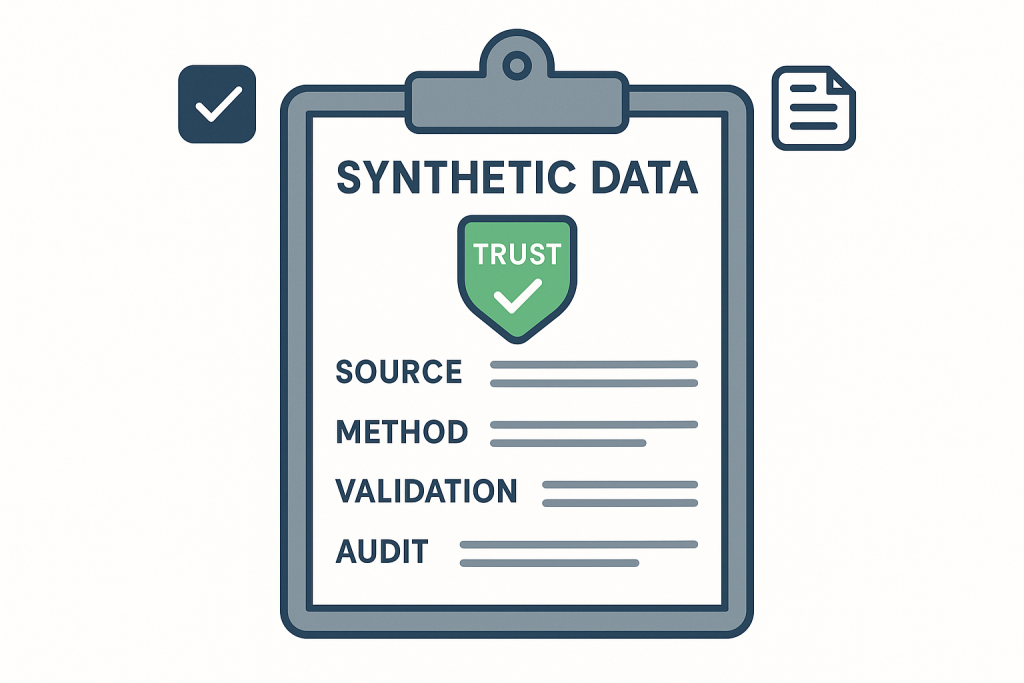
Synthetic data is moving from a niche technical method to a mainstream foundation for AI in schools, hospitals, and public systems. As that happens, a new expectation is emerging: synthetic data should come with trust labels—clear, standardized disclosures about where it came from, how it was generated, what risks were tested, and what it is safe (and not safe) to do with it. In short, synthetic-first innovation will only scale when synthetic-first governance does too.
Light italic subheading Why “trust labels” are the right metaphor
Just as food labels tell you ingredients and allergens, trust labels for synthetic data will tell institutions, families, and regulators what’s inside the dataset, what was left out, and what was independently verified. They make “synthetic” a provable claim instead of a marketing word.
Why This Matters
Light italic subheading 1) Synthetic data shifts risk, it doesn’t erase it
Even high-quality synthetic corpora can fail if they leak resemblance to real people, drift from reality over time, or amplify existing bias in the seed data. Those problems are often invisible to end users. Trust labels translate technical safeguards into something decision-makers can actually evaluate.
Light italic subheading 2) Child- and care-facing systems require higher proof
In education and healthcare, the stakes are different. A privacy or bias failure is not just a compliance issue; it’s a breach of trust with families and patients. Schools and hospitals will increasingly demand evidence that synthetic data protects confidentiality and preserves fairness and utility.
Light italic subheading 3) Regulators will not accept “synthetic” as a blanket exemption
Policy is catching up to the idea that “not real data” does not automatically mean “no risk.” Expect regulators to ask for provenance records, validation results, and ongoing audits—especially when AI affects learning pathways, diagnoses, eligibility, or safety decisions.
Light italic subheading 4) Trust labels enable safe collaboration at scale
Most institutions want to share insights without sharing secrets. Synthetic data makes that possible, but only if partners trust the pipeline. Labels become the handshake for collaboration: they reduce the need for case-by-case negotiation by standardizing what “safe enough” means.
Here’s How We Think Through This (steps, grounded)
Light italic subheading Step 1: Define the trust audience
We begin by identifying who must trust the synthetic dataset and why.
Examples:
- District administrators deciding whether to pilot a tool
- Parents asking how student data is protected
- Hospital ethics boards approving research access
- Regulators evaluating a vendor’s claims
Different audiences need different levels of detail, but the label must serve all of them.
Light italic subheading Step 2: Document provenance from the start
A trust label is only credible if the pipeline has a reliable “chain of custody.” We track:
- Source of seed data (type, time window, scope)
- Who had access and under what governance
- What preprocessing occurred (removals, transformations, minimization)
- What generation method was used
This becomes the dataset’s ethical passport.
Light italic subheading Step 3: Pre-commit to what the synthetic data must preserve—and must not preserve
Before generating, we specify two sets of constraints:
- Utility anchors: relationships that must remain true (learning progressions, clinical correlations, demand cycles).
- Privacy boundaries: what must never be reproduced (near-duplicates, rare identifying combinations, inferable sensitive traits).
The label should state both, in plain language.
Light italic subheading Step 4: Validate privacy and utility as separate gates
We treat these as two different exams. A good label summarizes both.
Privacy validation should include evidence of:
- No near-duplicate records
- Resistance to membership inference (can’t tell who was in the seed)
- Resistance to attribute inference (can’t guess hidden traits)
- Linkage safety under realistic external-data assumptions
Utility validation should show:
- Preserved distributions and correlations
- Comparable model performance to real-data benchmarks
- Realistic coverage of rare but important cases
Light italic subheading Step 5: Include fairness checks explicitly
Synthetic data can unintentionally smooth away minority experiences. Trust labels should report:
- Representation across key groups
- Error-rate gaps in models trained on synthetic data
- Whether counterfactual balancing was used
- Any known limitations in underserved cohorts
Light italic subheading Step 6: Add independent audit pathways
In high-stakes settings, internal claims won’t be enough. We expect labels to include:
- Third-party testing results where possible
- Audit frequency and last-audit date
- Responsible owner for remediation
This mirrors the way safety assurance works in other critical industries.
Light italic subheading Step 7: Treat labels as living documents
Synthetic datasets can drift as real-world conditions change. Each new release needs a refreshed label:
- Version number and release date
- Differences from prior versions
- Retesting outcomes
- Scope of continued safe use
“No label, no release” becomes the norm.
What is Often Seen as a Future Trend — Real-World Insight
Light italic subheading Trend people talk about: “Synthetic data will make governance simpler.”
Light italic subheading Reality we see: Governance becomes simpler only after standards mature.
Here’s what schools, hospitals, and regulators are likely to demand next:
Light italic subheading 1) Standardized disclosure formats
Expect common reporting templates for synthetic data—much like clinical trial registries or education vendor transparency forms. The label will need to be easy to compare across tools.
Light italic subheading 2) Clear “safe use boundaries”
Institutions will want explicit statements like:
- Safe for prototyping and benchmarking
- Safe for vendor evaluation
- Not safe as the sole basis for clinical deployment
- Not safe to infer individual-level outcomes
This reduces misuse and overconfidence.
Light italic subheading 3) Evidence of leakage resistance in small or rare cohorts
Privacy risk is highest in small districts, rural hospitals, and rare-condition datasets. Regulators will ask for specialized tests that show the synthetic approach generalizes those rare cases rather than copying them.
Light italic subheading 4) Auditability across the whole pipeline, not just the output
If a dataset can’t be audited end-to-end, trust will erode quickly. Labels will increasingly include reproducibility notes: what someone could re-run, re-test, or verify independently.
Light italic subheading 5) Child-specific and patient-specific safeguards
We anticipate domain-specific labels. For example:
- Education labels emphasizing long-term identity risk, behavioral inference limits, and equity across learning profiles
- Healthcare labels emphasizing clinical realism, rare-case handling, and diagnostic safety limits
“General synthetic” won’t be good enough for child- or care-facing systems.
Light italic subheading The strategic takeaway
Trust labels are not bureaucracy layered on innovation. They are the infrastructure that lets synthetic-first AI scale responsibly. The next competitive edge for AI vendors and institutions will be governance maturity: the ability to show, not just claim, that synthetic data protects people while delivering real insight.