
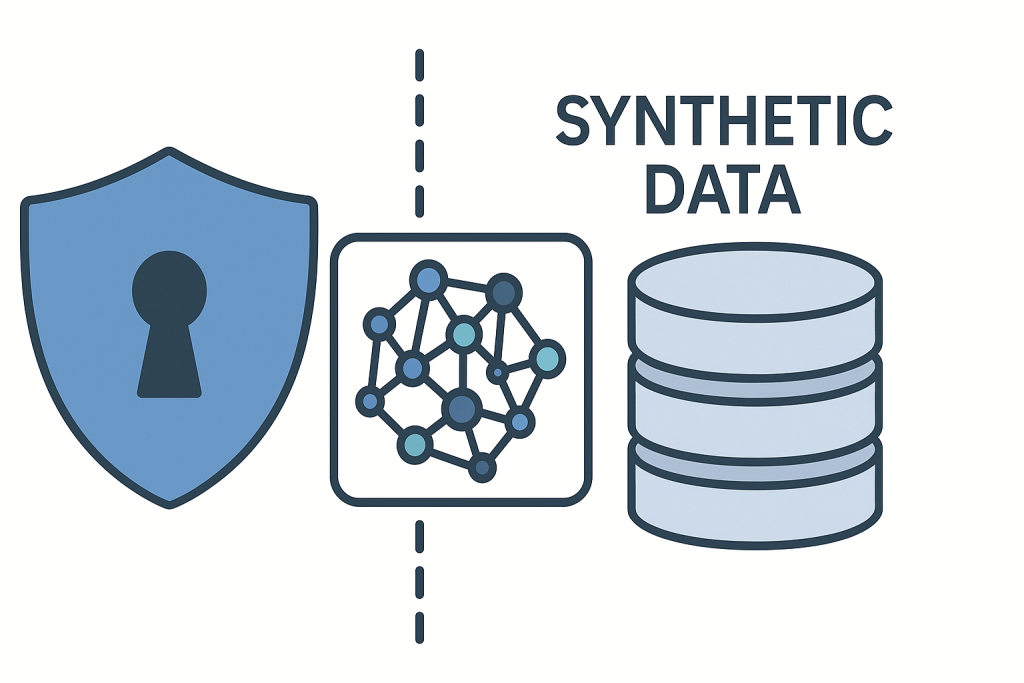
Enterprises are sitting on two kinds of high-value information at once: insight-rich data that could power AI, and proprietary or personal data that must not leak. Synthetic data creates a “data firewall” between those two. By generating synthetic corpora that preserve the patterns AI needs—without reproducing the underlying secrets—organizations can collaborate across teams, vendors, and partners while keeping ownership, privacy, and competitive boundaries intact.
Light italic subheading A simple way to picture it
Instead of shipping raw customer records, product telemetry, or operations logs to every team that wants to build something, enterprises share a synthetic version that behaves like the real thing. The AI learns the environment, not the individuals or trade secrets inside it.
Why This Matters
Most enterprise AI programs stall in the same place: data access. Not because the organization lacks data, but because the risks around that data are real.
Light italic subheading 1) Collaboration is now a core AI bottleneck
AI development is rarely a single-team activity. It spans product teams, data teams, compliance, external vendors, and sometimes ecosystem partners. Every handoff of real data adds friction: legal review, privacy impact assessments, security controls, and often hard “no’s.” Synthetic corpora become a collaboration layer that reduces friction without lowering standards.
Light italic subheading 2) Sensitive data is expanding faster than policies can keep up
Enterprises increasingly hold data that is sensitive by nature (identity, finance, health signals, education records) and sensitive by strategy (pricing models, supply chain patterns, product performance, internal processes). Synthetic data reduces the blast radius if something is mishandled—because the shared dataset doesn’t contain the originals.
Light italic subheading 3) AI iteration needs speed, not perfect access
Most model development cycles require experimentation: feature engineering, baseline training, stress tests, fairness checks. Doing those steps on heavily restricted real data slows teams to a crawl. Synthetic data gives AI builders a realistic sandbox so iteration can happen quickly, while real data is reserved for final calibration and validation.
Here’s How We Think Through This (steps, grounded)
Light italic subheading Step 1: Identify the collaboration goal, not just the dataset
We start by asking what collaboration is trying to enable.
Examples:
- Multiple business units building models with shared customer patterns
- A vendor prototyping a recommendation or forecasting engine
- A partner ecosystem needing consistent training data
The goal determines which patterns must be preserved and which secrets must be protected.
Light italic subheading Step 2: Define the “insight layer” versus the “secret layer”
Enterprises often blur these. We separate them:
- Insight layer: relationships AI must learn (behavioral patterns, demand cycles, anomaly structure, feature correlations).
- Secret layer: anything that enables identity, proprietary inference, or competitive reverse-engineering (unique customer trails, exact product usage fingerprints, pricing rules, rare operational workflows).
Synthetic data should preserve the first and aggressively generalize the second.
Light italic subheading Step 3: Build a minimal, governed seed dataset
Synthetic corpora are learned from real seeds. We ensure:
- Minimality: only variables required for the insight layer
- Tight governance: limited access, clear audit trails
- Representativeness: avoids “default user” bias
A sloppy seed leads to synthetic outputs that look useful but inherit privacy or strategy risks.
Light italic subheading Step 4: Generate synthetic corpora tailored to data type
Different enterprise data needs different generation approaches:
- Tabular corpora: CRM, HR, finance, operations, claims
- Time-series corpora: IoT, app telemetry, supply chain, call volumes
- Text corpora: support tickets, notes, knowledge bases
- Graph corpora: network/fraud patterns, B2B relationships
The method should preserve structure, not just averages.
Light italic subheading Step 5: Validate utility and confidentiality separately
Two gates, always:
Utility validation:
- Do key distributions and correlations hold?
- Do models trained on synthetic data perform comparably on real validation?
- Are rare-but-important cases represented?
Confidentiality validation:
- Are any synthetic records too close to real ones?
- Can proprietary variables be inferred from proxies?
- Would a competitor learn something they shouldn’t?
- Can someone link synthetic records to real people or accounts?
Light italic subheading Step 6: Use synthetic data for collaboration-first workflows
Once validated, enterprises use synthetic corpora as:
- A default dataset for cross-team modeling
- A safe package for vendors and consultants
- A shared benchmark for partners
- A training environment for onboarding new analysts
The real data stays behind the firewall, accessed only when necessary.
Light italic subheading Step 7: Maintain lifecycle controls
Synthetic corpora need versioning and monitoring just like products:
- Regenerate on a clear cadence
- Retest privacy and proprietary risk each release
- Track downstream uses
- Retire corpora that no longer match current reality
This prevents drift and “safe data” becoming stale or risky over time.
What is Often Seen as a Future Trend — Real-World Insight
Light italic subheading Trend people talk about: “Synthetic data is just anonymization 2.0.”
Light italic subheading Reality we see: It’s becoming an enterprise data operating layer.
Here’s the practical shift underway:
Light italic subheading 1) Synthetic corpora are turning into shared internal products
Forward-leaning enterprises now maintain synthetic datasets as reusable assets—like internal APIs. Teams don’t each negotiate with compliance for raw access; they pull from a synthetic “collaboration lake” that’s already validated.
Light italic subheading 2) Vendors are being evaluated on synthetic-first pipelines
Enterprises increasingly want proof that vendors can develop with synthetic data first, then move to tightly scoped real-data validation. This reduces data exposure during early development, when risks and requirements are still evolving.
Light italic subheading 3) Cross-company AI is becoming more realistic
In sectors like banking, retail, logistics, and health-adjacent services, there’s value in models trained across organizations—but real sharing is almost impossible. Synthetic data makes multi-party learning feasible because the shared artifacts are patterns, not secrets.
Light italic subheading The strategic takeaway
Synthetic corpora are not about pretending real data doesn’t exist. They’re about building an enterprise-grade firewall so insights can move freely while secrets don’t. In the next phase of AI adoption, competitive advantage won’t come from who has the most data, but from who can collaborate on it safely and fast.