
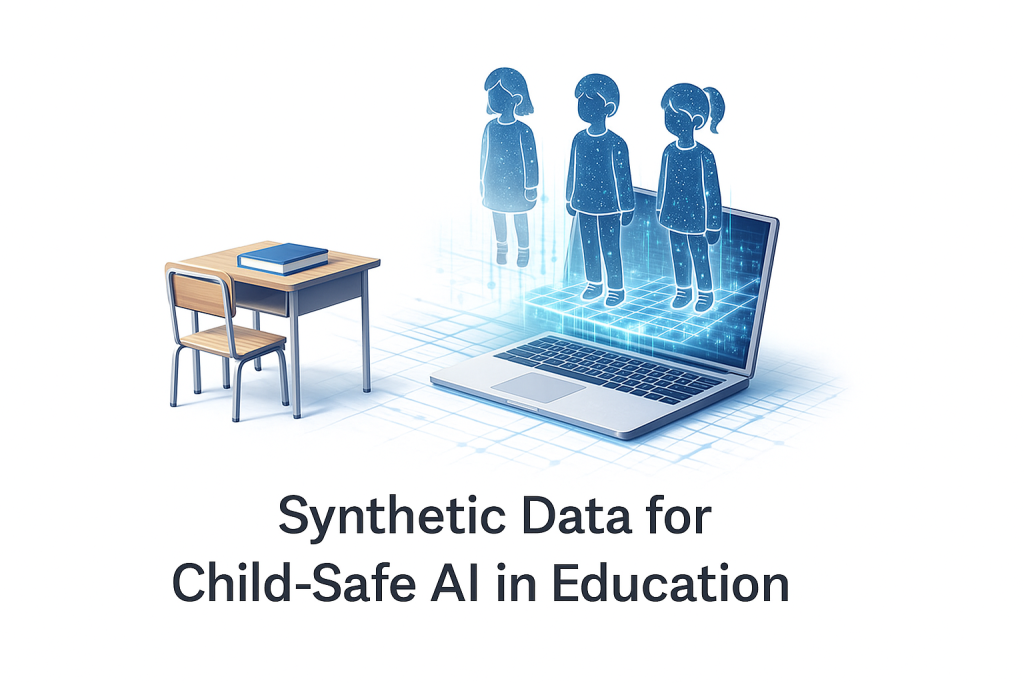
Synthetic data lets us build and test AI learning tools as if we had real student records—without actually using children’s personal data. Instead of collecting, exporting, or repeatedly consenting to real classroom data, we generate realistic “student-like” datasets and classroom simulations that preserve learning patterns but remove individual traceability. The result is safer innovation: better tools for learning support, personalization, and early intervention, with far less risk to kids’ privacy.
Light italic subheading What this means in plain terms
Imagine a flight simulator for education AI. The simulator behaves like a real classroom—students progress at different rates, misunderstand concepts in predictable ways, attendance fluctuates, feedback varies—but no real child is inside it. AI can learn the “rules of learning” without learning about your child.
Why This Matters
Parents and educators are being asked to trust AI in places that matter deeply: reading support, math practice, dyslexia screening, attention tracking, tutoring chatbots, classroom management dashboards. These systems improve when they are trained on rich, real-world data. But children’s data is uniquely sensitive:
- Kids can’t fully understand or consent to long-term data use.
- School performance, behavior, and health signals can follow someone for life if mishandled.
- Data collected for “learning” can be repurposed later for surveillance or marketing.
- Even anonymized student records are sometimes re-identifiable when combined with other information.
Synthetic data changes the default. It makes it possible to explore, prototype, and validate AI tools without turning childhood into a data mining operation.
Light italic subheading For schools
Synthetic student records allow districts to evaluate and improve tools without sending real student datasets to vendors or researchers. This reduces legal risk, reputational risk, and the burden on families to constantly approve data sharing.
Light italic subheading For homes
Edtech apps used at home can be trained and tested on synthetic learning data first, so they don’t need to “learn by watching your child fail.” They can arrive safer and better tuned from day one.
Here’s How We Think Through This (steps, grounded)
Light italic subheading Step 1: Define the educational purpose clearly
We start by naming the decision or support the AI is meant to provide.
Examples:
- Personalizing practice sequences
- Identifying early signs of disengagement
- Supporting neurodiverse learning pathways
- Helping teachers prioritize interventions
If the purpose is fuzzy, synthetic data will only produce fuzzy outcomes.
Light italic subheading Step 2: Determine what patterns matter—and what doesn’t
Synthetic data should preserve learning-relevant relationships, not every detail.
Important patterns include:
- How skills build over time
- Common misconception pathways
- Feedback-response loops
- Attendance and engagement trajectories
Not important (and risky to include) are unnecessary identifiers or sensitive attributes that don’t improve learning outcomes.
Light italic subheading Step 3: Create a small, well-governed real “seed” dataset
Synthetic data isn’t created from nothing. It learns from a real sample first.
We ensure the seed dataset is:
- Minimal: only essential variables
- Secure: tightly controlled access
- Representative: not skewed toward one group
A weak seed creates synthetic “classrooms” that look realistic but don’t behave truthfully.
Light italic subheading Step 4: Generate synthetic student records and classroom simulations
Using established synthetic generation methods, we create:
- Student profiles that mimic population distributions
- Performance time-series that reflect real learning dynamics
- Synthetic classroom environments for testing teacher-facing tools
The goal is realism in behavior, not resemblance to any one child.
Light italic subheading Step 5: Validate two things separately: usefulness and privacy
Usefulness checks:
- Do learning progressions and correlations hold?
- Do models trained on synthetic data perform similarly to those trained on real data?
- Are rare learning needs represented well?
Privacy checks:
- Is any synthetic record too similar to a real child?
- Can someone infer identities through combinations of features?
- Are outliers “too real”?
Only datasets that pass both checks should be used.
Light italic subheading Step 6: Use synthetic data as the default sandbox
Once validated, synthetic data becomes the standard environment for:
- Vendor evaluation
- Tool prototyping
- Bias and fairness testing
- Teacher training with realistic examples
- Safe student-facing experiments
Real data becomes a limited, high-trust resource, used mainly for final calibration and ongoing monitoring.
Light italic subheading Step 7: Keep humans and real-world audits in the loop
Even with synthetic data, AI in education must stay accountable. We recommend:
- Periodic accuracy checks against real outcomes
- Transparent reporting to families
- Opt-out pathways that don’t penalize students
- Clear rules about what the AI may not decide alone
Synthetic data reduces privacy exposure; it doesn’t remove the need for oversight.
What is Often Seen as a Future Trend — Real-World Insight
Light italic subheading Trend people talk about: “Synthetic data will end student data collection.”
Light italic subheading Reality we see: It shifts student data from fuel to compass.
In practice, synthetic data is already enabling safer progress in three areas:
Light italic subheading 1) Child-safe product testing before rollout
Schools often pilot new AI tools with real student data, then discover privacy or bias problems after the fact. With synthetic classrooms, tools can be stress-tested first—across different ages, learning profiles, and classroom conditions—before ever touching real children’s records.
Light italic subheading 2) Faster improvement without wider data sharing
Districts want better tools but must slow down because data-sharing agreements are heavy and sensitive. Synthetic datasets allow iterative improvement with vendors without exporting real student information repeatedly.
Light italic subheading 3) Better coverage of “edge learners”
Real datasets often underrepresent students who are neurodiverse, multilingual, transient, or in low-connectivity settings. Synthetic data can intentionally increase representation for model training, which helps avoid tools that only work well for the “most typical” students.
Light italic subheading The boundary we emphasize
Synthetic data is a privacy advantage, not a truth guarantee. If schools rely on synthetic data alone, models may miss emerging realities—new curricula, shifting student needs, post-pandemic learning gaps, cultural context. Real-world anchoring remains essential, but it can be smaller, safer, and better governed.
Light italic subheading The strategic takeaway for parents and educators
Synthetic data offers a practical path to “no more permission slips” as the default mode. Not by cutting families out, but by reducing how often a child’s real life must be turned into training material. The future of child-safe AI isn’t less innovation—it’s innovation built on better safeguards.