
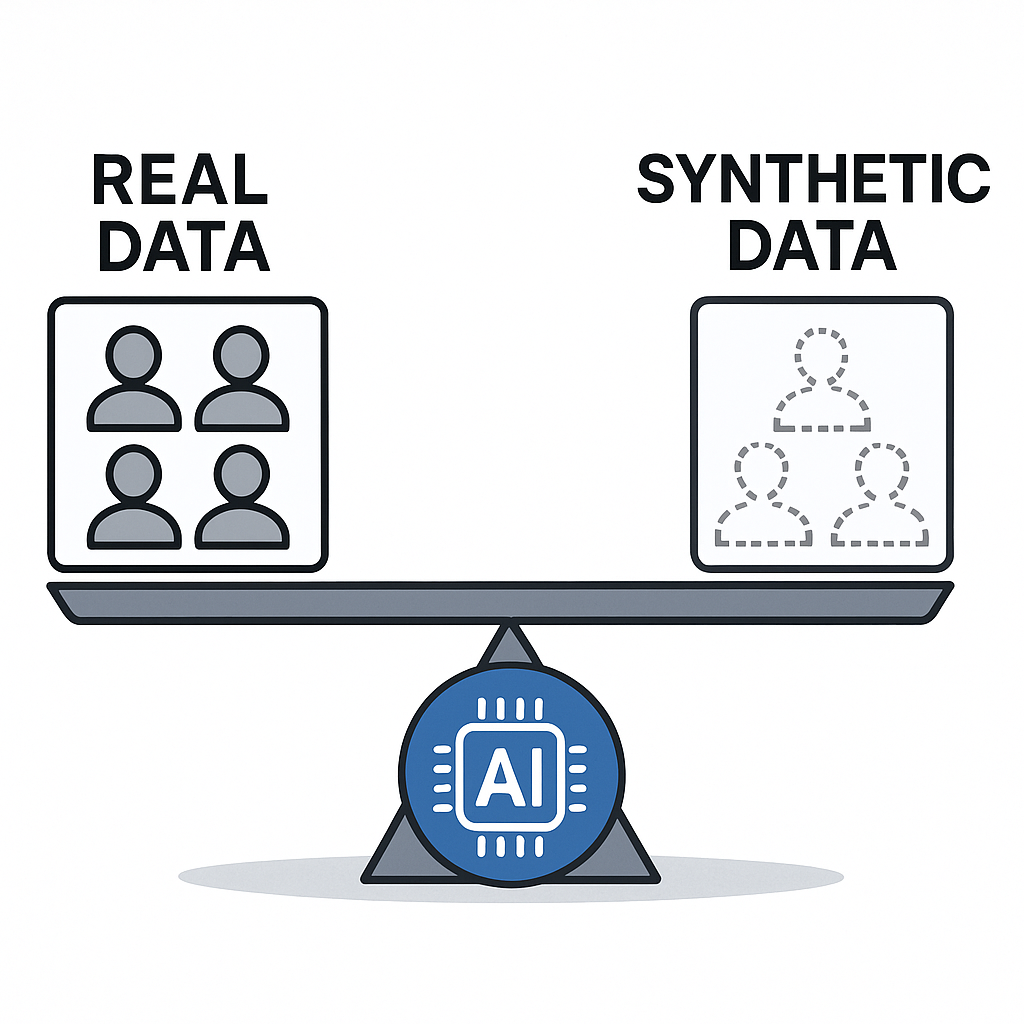
Synthetic data—sometimes casually called “fake data”—is best understood as training on shadows. It can replicate the statistical patterns of real life without copying any one person’s record. That makes it powerful for privacy-safe AI development. But a shadow is not the thing itself. Synthetic data can protect individuals and accelerate innovation, yet it still depends on real-world anchors to remain truthful, fair, and useful.
Light italic subheading A simple way to picture it
Think of real data as direct experience, and synthetic data as a carefully crafted simulation. A simulation can teach you a lot—how traffic flows, how students progress, how patients respond—without revealing who was in the original traffic jam, classroom, or hospital ward. But simulations can drift from reality if not constantly checked against the real world.
Why This Matters
We’re entering an era where AI is expected to support decisions in learning, health, and everyday systems. That expectation runs into a widening constraint: the most valuable data is also the most sensitive. Synthetic data offers a practical way to ease that bottleneck—but only if we’re honest about what it can and can’t do.
Light italic subheading 1) It widens access to learning and experimentation
Organizations often have the knowledge they need locked behind privacy risk. Synthetic data lets schools, hospitals, and companies share workable datasets with internal teams or external partners, enabling faster prototyping and safer collaboration.
Light italic subheading 2) It changes the privacy equation for children and families
For parents and educators, synthetic data can reduce the chance that students’ identities, struggles, or histories become permanent digital artifacts. It makes it more feasible to build AI tutors, support tools, and engagement analytics without exporting raw student records.
Light italic subheading 3) But overconfidence creates new risks
If synthetic data is treated as a full replacement for real data, models can become detached from the messy, changing reality we actually live in. That’s when bias, brittleness, and missed edge cases show up—not because the AI is malicious, but because it was trained in a world that’s too clean.
Here’s How We Think Through This (steps, grounded)
Light italic subheading Step 1: Start with the real decision, not the data
We first ask: What decision will AI support, and whose life will it affect?
Examples:
- “Which students likely need extra support next term?”
- “Where might a patient fall off a treatment plan?”
If the decision shape is vague, synthetic data won’t rescue the outcome.
Light italic subheading Step 2: Identify the “non-negotiable truths” the model must learn
Every domain has core relationships that must be preserved.
In education: trajectories over time, context (home language, access), and teacher inputs.
In health: comorbidities, rare-event patterns, and timing of interventions.
Synthetic generation should prioritize these truths over surface similarity.
Light italic subheading Step 3: Build synthetic data from a governed real “seed”
Synthetic data is only as credible as the real dataset it learns from.
That seed must be:
- Minimal: only what’s necessary
- Protected: strict access controls
- Representative: reflecting the population you serve
Low-quality seeds create convincing but inaccurate shadows.
Light italic subheading Step 4: Validate utility and privacy separately
We run two different checks:
Utility checks:
- Do distributions match key variables?
- Do correlations and causal signals hold?
- Do models trained on synthetic data perform similarly to those trained on real data?
Privacy checks:
- Are any synthetic records too close to real individuals?
- Can someone infer sensitive traits indirectly?
- Do outliers leak resemblance?
Passing one check doesn’t guarantee the other.
Light italic subheading Step 5: Use synthetic data for what it does best
We recommend synthetic data for:
- Early-stage model training
- Sharing data with vendors or researchers
- Creating safe sandboxes for innovation
- Stress-testing AI under simulated scenarios
- Training staff on realistic but non-identifying datasets
Light italic subheading Step 6: Keep real-world anchoring in the loop
Even with excellent synthetic data, real-world testing is essential.
We anchor by:
- Periodic retraining on fresh real data
- Continuous performance monitoring
- Human review in high-stakes contexts
That keeps the shadow aligned with reality.
What is Often Seen as a Future Trend — Real-World Insight
Light italic subheading Trend people talk about: “Soon we won’t need real data at all.”
Light italic subheading Reality we see: Synthetic data reduces exposure, but doesn’t erase dependence.
Here’s where synthetic data gets it right—and where it doesn’t replace reality yet:
Light italic subheading Where synthetic data is genuinely strong
- Privacy-sensitive collaboration
Education districts can evaluate AI vendors without sending student records. Health networks can pool insights without pooling identities. Enterprises can prototype across teams without broad access to personal data. - Scaling rare events safely
Synthetic data can expand small datasets—like rare learning disabilities or uncommon medical conditions—so models learn those patterns without requiring more real records. - Bias probing and controlled experiments
Teams can intentionally vary attributes to test fairness. That’s hard to do with real data because you can’t ethically “edit” people’s lives.
Light italic subheading Where real-world anchors remain essential
- Ground truth for outcomes
If a model predicts dropout risk or treatment success, it still needs real outcomes to confirm accuracy. Synthetic outcomes are guesses unless validated against actual experience. - Capturing the unexpected
Life changes. Policies shift. New diseases emerge. Classroom cultures evolve. Synthetic data reflects the past unless continuously refreshed, so it can miss today’s reality. - Complex human meaning
Some signals aren’t just numerical patterns. Teacher notes, student narratives, caregiver context, and cultural nuance often carry meaning that synthetic approaches can flatten or distort.
Light italic subheading The strategic takeaway
Synthetic data is not a magic substitute. It is a privacy-preserving amplifier. The smart path is a hybrid pipeline: use synthetic data to unlock safe speed and sharing, and use real data as the compass that keeps AI aligned with human reality.