
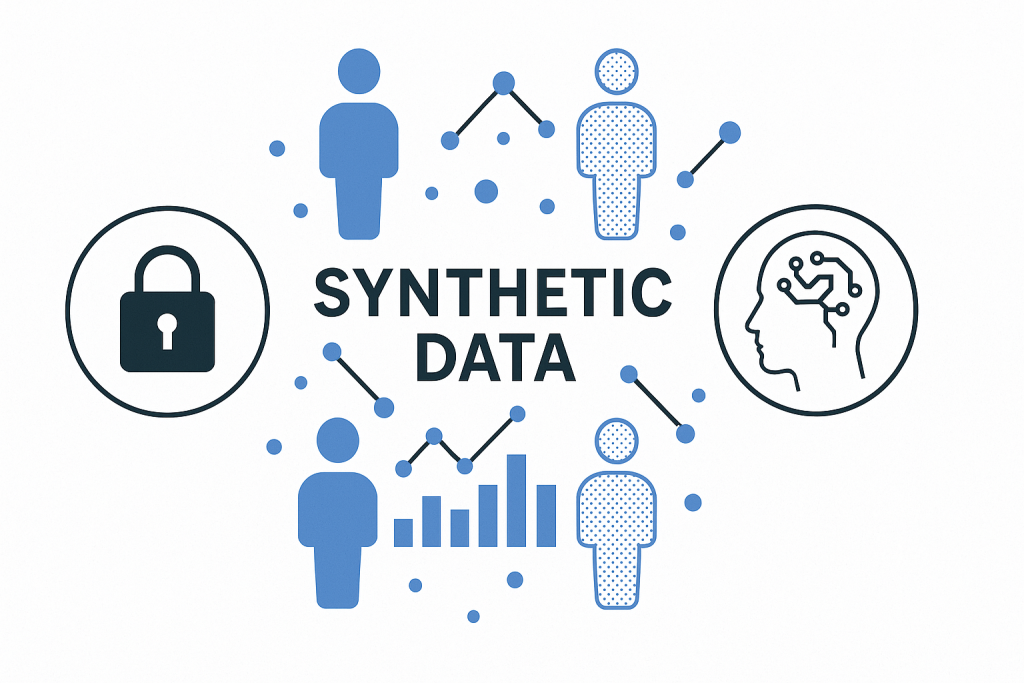
Synthetic data is artificially generated data that mirrors the patterns of real-world datasets without containing information about real people. Done well, it preserves the statistical “shape” that AI needs to learn from while stripping away personal traceability. This creates a “privacy dividend”: organizations can build useful AI systems with far less risk to individuals, because the training data no longer points back to anyone in particular.
What synthetic data is (and isn’t)
Synthetic data is not random noise. It is produced using models that learn the relationships inside a real dataset—such as how attendance correlates with grades, or how symptoms cluster with diagnoses—and then generate new records that follow those same relationships. The result is data that is useful for analysis and AI training, but not a copy of any person’s record.
Why This Matters
AI’s progress has been throttled by a real tension: the best models need rich, human-centered data, but the same data can expose people to harm if leaked, re-identified, or misused. Synthetic data changes this equation in three ways:
1) It lowers privacy risk without killing usefulness
Traditional anonymization often fails because clever re-identification is possible when datasets are cross-referenced. Synthetic data, by contrast, is built so that no record is tied to a specific individual. That means even if a dataset is shared or breached, it cannot be “reverse-engineered” into personal histories in the same way.
2) It expands what data can be shared and combined
Schools, hospitals, and companies frequently sit on high-value data they cannot legally or ethically share. Synthetic versions can be shared across departments, vendors, or research partners, creating collaboration that was previously blocked.
3) It reduces bias blind spots when used responsibly
Because synthetic datasets can be tuned and stress-tested, teams can intentionally correct underrepresentation. For example, a health dataset might be too small for rare diseases; synthetic generation can increase sample size for model training while keeping the rarity’s statistical character intact.
For parents and educators, the practical point is simple: synthetic data makes it easier to build powerful learning and wellbeing tools without turning children’s lives into permanent digital records.
Here’s How We Think Through This (grounded steps)
Step 1: Start with the decision you want AI to support
Before generating anything, define the real question.
Examples:
- “Which students are at risk of disengagement next term?”
- “Which care pathways reduce readmissions for diabetics?”
Synthetic data helps only if the target decision is clear.
Step 2: Identify the minimum real data needed to learn patterns
Synthetic data is derived from reality. You still need a secure, governed “seed dataset.” The rule we use: collect only what is essential to represent true relationships. Extra sensitive attributes that do not improve the model should be excluded early.
Step 3: Generate synthetic data using a method matched to the use case
Different tools work better for different data shapes:
- Tabular data (grades, test scores, health records)
- Time-series data (attendance over months, wearable signals)
- Text or images (feedback comments, diagnostic scans)
The method should preserve the relationships that matter, not just the averages.
Step 4: Validate utility and privacy, separately
We treat these as two different exams.
- Utility tests: Does the synthetic dataset reproduce key correlations, distributions, and edge cases? Does an AI model trained on it perform similarly to one trained on real data?
- Privacy tests: Can any synthetic record be linked back to a real person? Are there outlier duplicates that resemble originals too closely?
If either exam fails, the dataset isn’t ready.
Step 5: Use synthetic data to unlock safe experimentation
Once validated, synthetic data becomes a sandbox. Teams can:
- Prototype models quickly
- Share datasets with vendors without exposing individuals
- Run “what-if” scenarios safely
- Train staff and students on realistic data without risk
Step 6: Keep humans in the loop for high-stakes deployment
Synthetic data reduces privacy risk, but it does not eliminate the need for careful oversight. Any AI system that affects learning paths, healthcare decisions, or employee outcomes must be monitored for drift, hidden bias, and unintended incentives.
What is Often Seen as a Future Trend — Real-World Insight
Trend people talk about: “Synthetic data will replace real data.”
Reality we see: Synthetic data will reshape the pipeline, not erase reality.
Here’s what’s happening on the ground:
Education
Schools are increasingly asked to adopt AI tools for tutoring, assessment, and engagement prediction. But student data is among the most sensitive categories we handle. Synthetic student datasets allow districts to:
- Evaluate vendor tools fairly without exporting real student records
- Test equity impacts before deployment
- Train internal analytics teams safely
The bigger shift is governance: synthetic data is enabling “AI-ready schools” that can innovate without compromising trust.
Health
Hospitals want AI for early risk detection, imaging workflows, and personalized care. Yet compliance and privacy laws make data-sharing hard. Synthetic data is already being used to:
- Support multi-hospital research without moving patient records
- Expand training sets for rare conditions
- Prototype clinical AI faster
The most valuable impact is speed-to-learning in areas where data scarcity has historically slowed progress.
Enterprise AI
Companies want customer intelligence, fraud detection, and operational optimization, but face regulatory pressure and reputational risk. Synthetic data is helping by:
- Allowing cross-team data use without broad access to personal records
- Supporting secure collaborations with partners and vendors
- Enabling stress tests on AI models under simulated extreme conditions
In practice, synthetic data becomes a “privacy-first fuel,” especially in industries like finance, retail, and HR.
The strategic takeaway
Synthetic data is not a magical privacy shield. It’s a disciplined way to keep the insights while dropping the stigma and risk attached to personal traceability. The winners won’t be those who generate the most synthetic data, but those who govern it well and align it to real decisions people care about.