
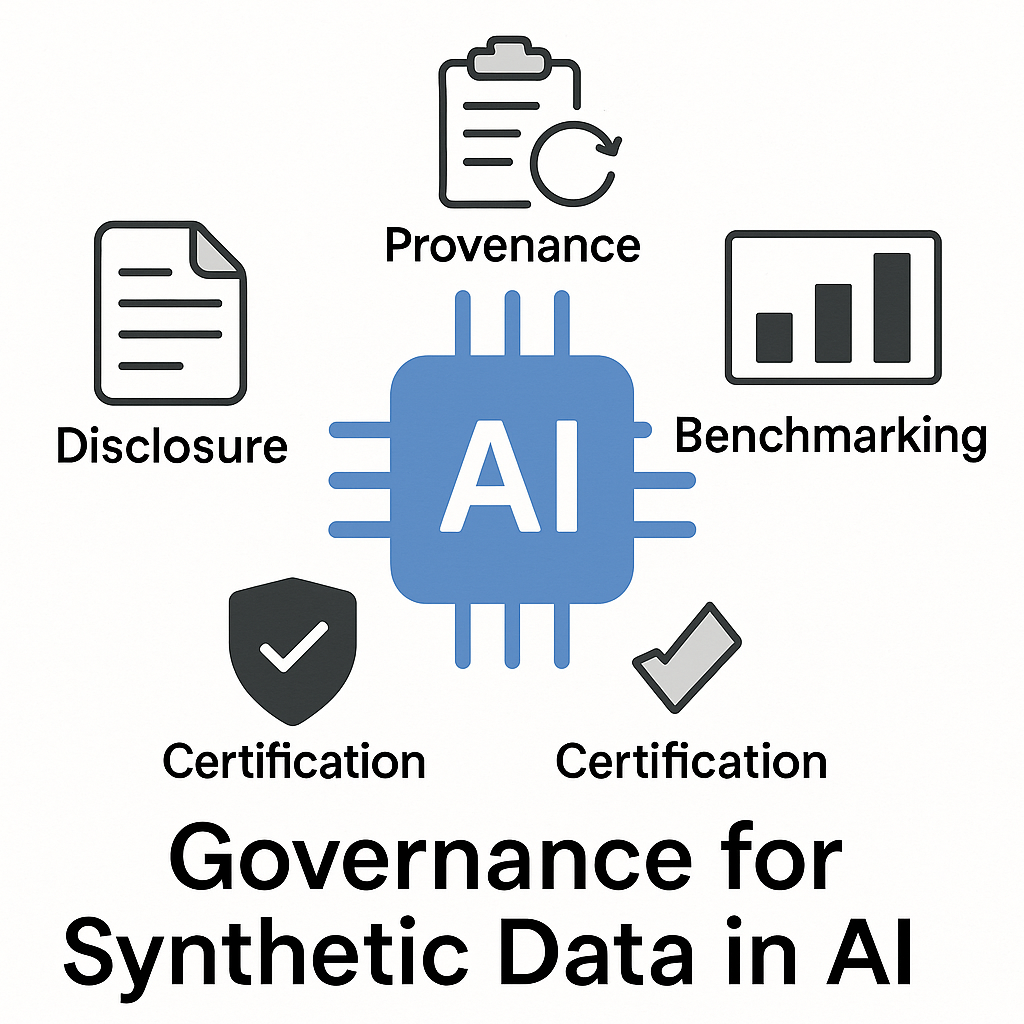
We’re entering a synthetic age where a growing share of “data” used to train AI is generated, not collected. That raises a simple governance question with complex answers: who owns synthetic datasets, who audits them, and on what basis should the public trust them? The emerging direction is clear: synthetic data will need provenance records, clear disclosure, independent testing, and certifiable pipelines—much like food labels or safety standards. Without that, synthetic scale could amplify errors and erode trust just as quickly as it accelerates innovation.
Why This Matters
Synthetic data is often framed as a technical breakthrough. But its long-term impact depends on governance.
1. Synthetic data can be high-utility and high-risk at the same time.
Well-designed synthetic corpora can improve privacy, fill rare-event gaps, and rebalance bias. Poorly designed corpora can do the opposite: distort reality, reinforce stereotypes, or leak signals from sensitive training sources. The World Economic Forum’s 2025 synthetic data report stresses traceability and labeling as essentials because synthetic data can mislead decision-making or be weaponized if unmanaged.
2. Regulation is catching up fast, and synthetic data is in scope.
The EU AI Act now requires strong data governance for training, validation, and testing datasets in high-risk systems, including quality, bias management, and appropriate oversight.
In July 2025, the European Commission published a training-data transparency template for general-purpose AI, explicitly including disclosure of synthetic or AI-generated training data.
That’s a signal: “synthetic” doesn’t exempt you from governance; it increases the need for it.
3. Trust is becoming a competitive factor, especially in child- and family-facing uses.
Parents, educators, and institutions will ask:
- Was this model trained on real student data?
- How was synthetic data produced and checked?
- Who verified it doesn’t introduce new bias or drift?
Governance is the language that answers those questions in a way that’s legible to non-experts.
Here’s How We Think Through This (steps, grounded)
Step 1: Treat synthetic datasets as products with lifecycle accountability.
A synthetic corpus isn’t a throwaway artifact. It’s a training product that needs versioning, changelogs, and retirement criteria. We borrow best practices from data governance and safety engineering: define owners, define acceptable use, define update cadence.
Step 2: Build provenance by design.
Provenance means being able to trace:
- what real sources were used as anchors,
- which generators or simulations produced the synthetic samples,
- what constraints and rules shaped outputs,
- and what post-generation filtering occurred.
Cross-industry provenance standards emphasize auditability and traceable history to support compliance and trust.
In practice, this looks like “datasheets for synthetic datasets,” with machine-readable metadata.
Step 3: Require disclosure that is meaningful, not just legal.
Disclosure is moving toward three layers:
- Internal disclosure: full technical documentation to enable risk teams to audit pipelines.
- Partner disclosure: enough detail for downstream builders to understand limits and obligations.
- Public disclosure: clear summaries that explain whether synthetic data was used and for what purpose.
The EU AI Act transparency regime is shaping the global baseline here.
Step 4: Certify the pipeline, not only the dataset.
Static audits of a single synthetic dataset won’t scale. What scales is certifying the process:
- constraint-based generation,
- privacy testing and “no-copy” checks,
- bias and representativeness evaluation,
- calibration against real gold sets,
- and post-training monitoring.
Recent governance frameworks propose checklists and integrity indices to score synthetic pipelines on fitness, privacy, and ethics.
Step 5: Use independent benchmarking and red-teaming.
Synthetic corpora should pass third-party tests just like models do. We push for:
- robustness benchmarks on real-world tasks,
- fairness suites with counterfactual probes,
- membership-inference and re-identification resistance checks (aligned with privacy guidance such as NIST’s work on de-identification).
Independence matters because a team can’t be the only judge of its own synthetic realism.
Step 6: Assign clear ownership and liability boundaries.
Ownership in a synthetic age usually follows the pipeline:
- the generator owner owns the method and bears responsibility for what it produces,
- the model provider owns the training mixture and must disclose synthetic use,
- the deploying institution owns real-world risk outcomes.
We expect contracts and regulation to harden these boundaries in the next few years.
What is Often Seen as a Future Trend Real-World Insight
A common trend line is: “Synthetic data is neutral and safe because it’s not real.” The real-world insight is the opposite:
Synthetic data is powerful precisely because it can reshape reality at scale—so it must be governed like a critical infrastructure input.
What’s emerging is a layered trust model:
- Provenance for traceability (so we know where synthetic data came from),
- Disclosure for accountability (so users and regulators know synthetic data was used),
- Benchmarking for reliability (so synthetic corpora improve real-world performance),
- Certification for scale (so whole pipelines meet shared standards).
Over time, institutions—schools, hospitals, banks, public agencies—won’t certify datasets one by one. They will certify synthetic training practices the same way they certify labs, exams, or safety procedures. The organizations that lead won’t be those who generate the most data, but those who generate data others can trust.