
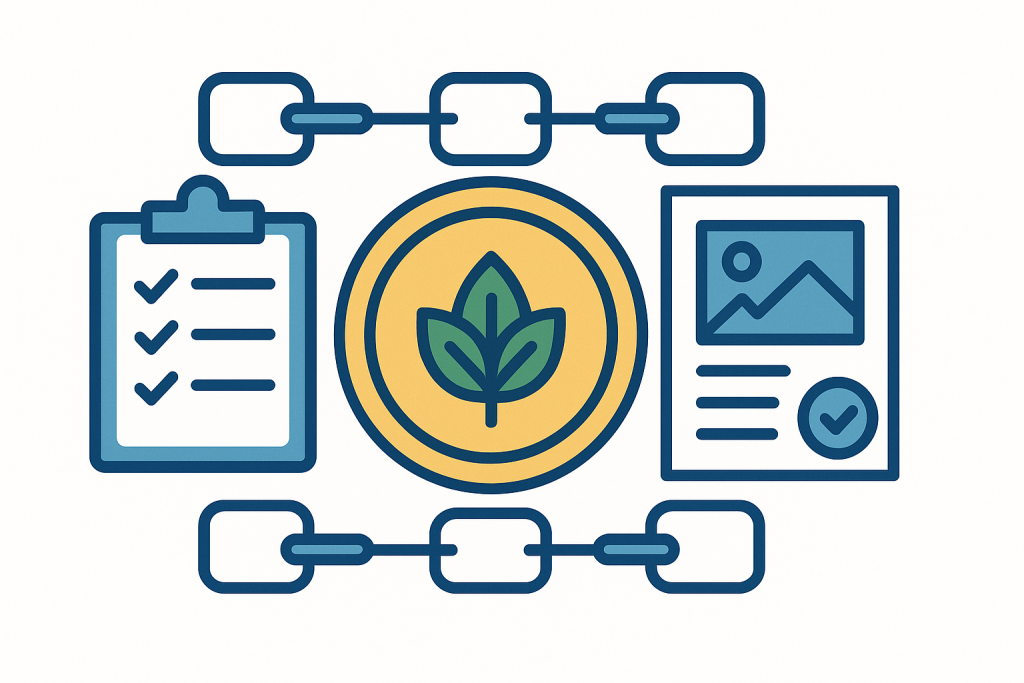
Tokenized climate assets—especially carbon credits—sit at the sharp edge of physical–digital convergence. The promise is straightforward: a credit, a biodiversity unit, or a renewable-energy certificate becomes a digital token that can be tracked, traded, and retired transparently. But the defining issue is credibility. Tokenization does not create environmental value on its own; it only makes value legible and transferable. If measurement, certification, custody, and retirement rules aren’t trustworthy, tokenization simply scales uncertainty faster. In climate markets, verification is the product.
Why This Matters
For future-curious readers, parents, and educators, carbon tokenization is a useful case study because it shows how digital systems can either strengthen or weaken trust in real-world value.
Climate assets are only as real as their evidence.
A carbon credit represents a claim about something physical: emissions avoided or removed. That claim depends on measurement methods, baseline assumptions, and ongoing monitoring. Blockchain can secure the record of the claim, but it can’t validate whether the claim is true. If the evidence is weak, the token is weak.
Families and schools are increasingly exposed to climate claims.
From “carbon neutral” products to school sustainability programs, people face environmental labels every day. Tokenized systems could make these claims more verifiable—if designed well. That means less greenwashing and more real learning about impact.
Markets are shifting from good intentions to auditable outcomes.
Governments, investors, and consumers are demanding proof. Tokenized climate assets can lower the cost of auditing and reporting, and create clearer chains of custody. But only if verification frameworks are consistent and enforceable.
This is where students learn the difference between data and truth.
Educators can use carbon markets to teach that digital records are not automatically reality. The integrity of a system depends on how it measures, certifies, and governs change in the physical world.
Here’s How We Think Through This (steps, grounded)
Step 1: Start with the physical claim.
We ask: what does this climate asset represent in the real world?
Examples:
- a ton of CO₂ avoided through clean energy
- a ton of CO₂ removed through reforestation or direct air capture
- a biodiversity or conservation outcome
Tokenization is downstream. The physical claim is upstream.
Step 2: Examine measurement and baselining.
Verification begins with “What would have happened otherwise?”
We review:
- baseline methodology
- additionality logic (would the benefit occur without incentives?)
- monitoring frequency and tools
- error margins and uncertainty handling
If baselines are overstated or monitoring is thin, tokens amplify a flawed model.
Step 3: Identify the certification authority and accountability.
Who issues and stands behind the credit?
We look for:
- recognized standards bodies
- transparent audit processes
- clear liability pathways if fraud is found
Certification is the trust anchor. Without accountability, issuance becomes a marketing exercise.
Step 4: Design the custody and chain-of-title.
Climate assets often change hands multiple times.
Tokenization helps only if custody rules are explicit:
- who can hold tokens
- how transfers are recorded
- how double-counting is prevented
A clean chain-of-title is essential for credibility.
Step 5: Make retirement rules non-negotiable and auditable.
Retirement is the moment a credit is “used” and cannot be resold.
We require:
- clear retirement triggers
- irreversible retirement states
- public evidence of retirement linked to claims
If retirement is weak, the asset becomes a perpetual “maybe,” not a real offset.
Step 6: Standardize metadata and interoperability.
Climate markets span countries and standards. Without shared schemas, tokens become silos.
We push for consistent metadata around:
- project type and location
- methodology version
- vintage year
- monitoring and audit links
- retirement status
Interoperability reduces the risk of hidden inconsistencies.
Step 7: Stress-test incentives and misuse risks.
We ask: who benefits if verification is loose?
Common risks include:
- overstated baselines
- unverifiable land-use claims
- resale of already-retired credits
- speculative trading detached from impact
Markets improve when the incentive to “game measurement” is minimized.
What is Often Seen as a Future Trend — Real-World Insight
Tokenized carbon is sometimes framed as “blockchain will fix climate markets.” The reality is more precise: blockchain can help fix climate markets, but only where verification is strong.
What we’re seeing in practice:
Verification frameworks are evolving faster than token platforms.
The biggest progress is in better MRV (measurement, reporting, verification): satellites, sensors, improved baselines, and more rigorous audits. Tokenization matters only after those foundations mature.
Markets are converging toward fewer, stricter standards.
As corporate and regulatory scrutiny rises, loose standards lose legitimacy. Tokenization accelerates this filtering: stronger credits trade with more confidence; weaker ones become harder to justify.
Retirement transparency is becoming a competitive differentiator.
Buyers increasingly want proof that a credit was retired and linked to a specific claim. Tokenized retirement logs, if tied to authoritative registries, can reduce fraud and double counting.
Environmental assets beyond carbon will follow the same logic.
Biodiversity credits, water rights, renewable certificates—all face the same test: digital tradability is only valuable if physical verification is credible. Carbon is just the first big classroom.
The takeaway: climate tokenization is not a technology story first. It’s a verification story. The systems that win will be the ones that make measurement, certification, and retirement harder to fake and easier to trust.