
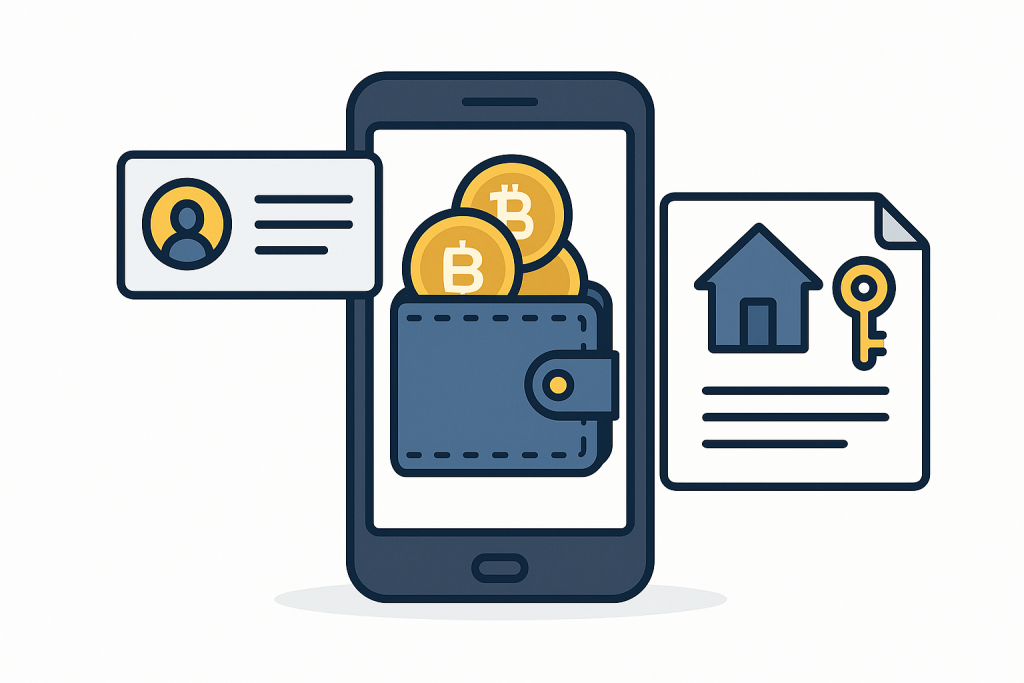
We’re entering a phase where ownership is less about paper documents and platform accounts, and more about a portable “ownership stack” you carry yourself. In this stack, three layers work together: wallets (to hold assets and identity), verifiable credentials (to prove facts about you or your assets), and proof-based property (to show your rights without oversharing data). When tokenized assets meet identity wallets, people can prove they own, can access, or are authorized to do something—without revealing everything about who they are. This is privacy-by-design for ownership.
Why This Matters
For future-curious readers, families, and educators, this shift is important because it changes how trust works in everyday life.
Ownership becomes portable and personal.
Today, rights to things are scattered across institutions: your property deed at a registry, your car title at a transport office, your school credentials in a database, your digital purchases locked inside platform logins. The new ownership stack pulls those rights into a wallet you control, so you can present proof when and where you need it.
Proof replaces exposure.
Most systems today verify a claim by asking for too much data. To prove age, you share your date of birth. To prove residency, you show an entire ID. With verifiable credentials and zero-knowledge style proofs, you can confirm a fact (“I’m over 18,” “I’m licensed,” “I’m the owner”) without exposing unrelated personal details.
Families and communities gain safer ways to share assets.
Think about shared ownership across generations: family property, heirlooms, community-owned equipment, or cooperative solar installations. Credentials can encode roles and rules—who can use what, who can approve sales, how inheritance works—without relying on a single platform to interpret the arrangement.
Education shifts from “digital safety” to “digital rights.”
Students will need to understand not just how to protect their data, but how to use it strategically. Knowing how to present proof without exposure becomes a core life skill—like understanding contracts or credit.
Here’s How We Think Through This (steps, grounded)
Step 1: Identify the rights people need to prove.
We start with real-world scenarios:
- proving ownership of a home or vehicle
- proving access rights to a school lab or club equipment
- proving eligibility for a service or discount
- proving authorship or licensing of digital work
The goal is clarity on what needs proof before thinking about how.
Step 2: Separate identity from credentials.
Identity is who you are. Credentials are claims about you.
A wallet doesn’t need to reveal identity each time; it needs to present the right credential for the moment. We design systems so the credential can stand alone as proof.
Step 3: Choose a trust anchor for credentials.
Credentials are only useful if someone trusted issued them:
- governments for citizenship, permits, land titles
- schools for learning records
- employers for professional certification
- regulated custodians for asset-backed tokens
We ask: who is authoritative and accountable if the claim is disputed?
Step 4: Link assets and credentials cleanly.
Tokenized ownership records “who holds what.” Credentials record “who is allowed to do what.”
We connect them so rights travel with context. Example: a token for a shared property plus credentials for each family member specifying usage and approval rights.
Step 5: Design for selective disclosure by default.
We use proof patterns that minimize data sharing:
- show “over 18” instead of birthdate
- show “resident of district X” instead of full address
- show “licensed electrician” instead of full employment history
Selective disclosure is not an add-on; it’s the main value.
Step 6: Make recovery, guardianship, and inheritance real.
Wallet systems must handle life realities:
- device loss
- family guardianship for minors
- multi-party approvals for major transfers
- inheritance triggers
Without these, the stack won’t fit families or everyday users.
Step 7: Validate against legal and social systems.
A proof is only meaningful if institutions accept it.
We check compatibility with registries, courts, and compliance requirements. The “new ownership stack” succeeds when it integrates with society—not when it bypasses it.
What is Often Seen as a Future Trend — Real-World Insight
This topic is often discussed as a futuristic identity add-on to crypto wallets. In reality, it’s a deeper rebuild of how property and permission work.
Here’s what’s emerging:
Wallets are evolving into “life admin dashboards.”
They won’t just hold tokens; they’ll hold credentials for education, health access, licenses, memberships, and asset rights. The everyday wallet is becoming the interface between people and institutions.
Proof-based property solves a practical privacy problem.
The biggest driver isn’t ideology. It’s lived experience: people are tired of giving away full identities to perform simple transactions. Proof-based systems reduce fraud risk and reduce unnecessary data exposure.
Institutions are approaching this slowly, but directionally.
Governments, universities, and regulated industries are experimenting with verifiable credentials because the benefits are operational: fewer manual checks, better auditability, lower identity theft risk. The shift is gradual, but it’s infrastructure-level.
The long-term impact is cultural, not just technical.
When people carry their own proofs, the power balance changes. Individuals and families gain more agency over access, ownership, and mobility. That creates new expectations about how schools, employers, and public services should work.
The big idea: the future of ownership is not just tokenization. It’s tokenization plus verifiable rights, carried in wallets that let people prove what matters without revealing everything else.