
Quick Insight
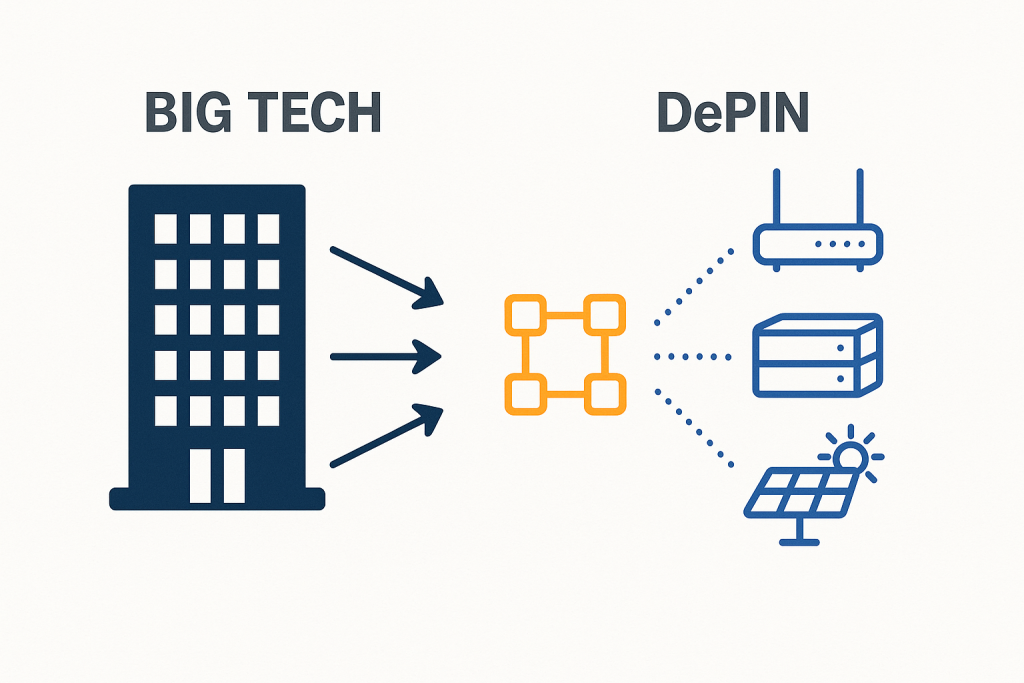
The digital world runs on infrastructure—servers, networks, storage, and power systems built and maintained by massive corporations. For decades, this structure has made Big Tech the gatekeeper of digital access and innovation. But a new model is emerging: Decentralized Physical Infrastructure Networks (DePIN).
DePIN challenges the top-down ownership of cloud and telecom giants by distributing infrastructure creation across thousands—or millions—of independent contributors. Instead of renting access from centralized providers, people can now own and operate parts of the digital infrastructure themselves.
Why This Matters
Big Tech’s infrastructure dominance has been both enabling and limiting. It made global connectivity fast and scalable, but also concentrated power, data, and profit in a few hands. Cloud computing, mobile networks, and data centers have become essential utilities—but they’re also single points of control.
DePIN reimagines this model. By blending blockchain coordination, token-based incentives, and physical hardware participation, DePIN networks transform users into stakeholders. A person can host a node that provides bandwidth, stores data, or contributes energy—and earn rewards for doing so. The network’s value grows with community participation, not corporate expansion.
This shift democratizes infrastructure. It’s not about competing with Big Tech on size, but about redefining ownership and trust. For parents, educators, and future-focused readers, it’s a vital concept: the next generation won’t just use the internet—they’ll help build it.
Here’s How We Think Through This
1. Understand the Centralized Model.
Big Tech operates on scale: massive data centers, proprietary cloud platforms, and top-down control. It optimizes efficiency but limits access to those who can afford entry.
2. Identify What Can Be Decentralized.
DePIN works best for functions that benefit from distributed participation—wireless connectivity (Helium), compute power (Akash Network), storage (Filecoin), and energy coordination (Energy Web). Each transforms a traditional, capital-intensive system into a participatory network.
3. Build Economic Incentives into the System.
Instead of billing users, DePIN rewards contributors. Individuals and small businesses earn tokens or credits for verified contributions, from running a node to providing energy or mobility data. This turns infrastructure into a shared economic ecosystem.
4. Ensure Verifiability and Transparency.
Blockchain technology replaces corporate oversight with cryptographic verification. Every contribution—bandwidth, storage, compute—is transparently tracked and rewarded, creating accountability without a central authority.
5. Align with Real-World Needs.
DePIN isn’t about dismantling existing systems but complementing them. Hybrid models—where decentralized networks interact with traditional cloud or telecom infrastructure—can increase resilience, expand coverage, and reduce costs.
What Is Often Seen as a Future Trend
DePIN is often described as “Web3 infrastructure,” but it’s more than a technology trend—it’s a governance shift. Instead of consumers relying on corporate-scale infrastructure, communities can build and manage networks together.
Real-world examples are already live. Helium’s community-run wireless network operates in over 180 countries. Filecoin has created a global, open marketplace for decentralized storage. Akash Network provides cloud compute through distributed nodes that anyone can operate.
These systems are not replacing Big Tech outright—but they are reframing the relationship. Centralized infrastructure will remain essential, but decentralized participation is becoming the counterbalance. The result is a more equitable, transparent, and resilient architecture for the digital economy.
The insight: infrastructure is no longer just technology. It’s a living, participatory ecosystem. The power shift isn’t just economic—it’s structural. DePIN marks the beginning of a world where owning part of the network is as normal as using it.