
Quick Insight
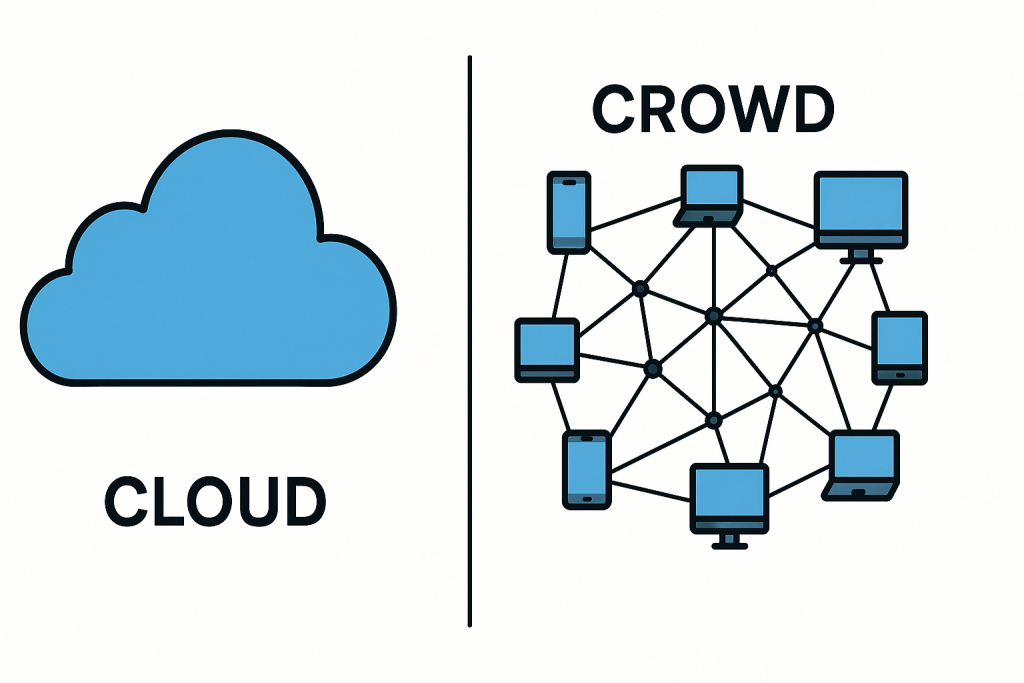
The global internet runs on centralized infrastructure—massive cloud data centers, managed by a few corporations, that store, process, and distribute most of the world’s digital activity. But a shift is emerging. Through Decentralized Physical Infrastructure Networks (DePIN), compute, storage, and network capacity are being distributed across millions of individual-owned devices. This model moves us from the Cloud—a metaphor for distant, corporate-controlled systems—to the Crowd, where infrastructure is built, owned, and operated by the participants themselves.
Why This Matters
Centralized cloud infrastructure has enabled the digital world as we know it—but it comes with tradeoffs. A handful of companies now control much of the internet’s data flow and computational power. This creates single points of failure, data monopolies, and rising costs for smaller innovators.
DePIN challenges that structure by leveraging underused resources at the edges of the network—smartphones, home servers, IoT devices, and personal nodes—to provide compute, bandwidth, and storage in a distributed manner. Blockchain coordination allows these contributions to be tracked, verified, and rewarded automatically.
For educators and parents, this represents a crucial concept to understand: the next generation won’t just use cloud services—they’ll participate in the infrastructure itself. Students could learn about systems where contributing your unused compute or energy is part of how global networks sustain themselves. It’s a new model of digital stewardship, blending economics, technology, and civic engagement.
Here’s How We Think Through This
1. Identify What’s Being Decentralized.
Each DePIN project focuses on a specific layer of infrastructure—compute (e.g., Akash Network), storage (e.g., Filecoin), or bandwidth (e.g., Helium). Understanding the function being decentralized clarifies both the technical challenge and the social opportunity.
2. Map the Contribution Model.
Instead of centralized data centers, capacity is provided by individuals who contribute physical devices. These devices connect to a blockchain protocol that records their participation and ensures fair compensation.
3. Design for Trust and Verification.
The key innovation of DePIN is not just distribution—it’s verifiability. Blockchain enables transparent tracking of uptime, quality, and capacity, ensuring the network remains reliable without centralized oversight.
4. Integrate with Existing Systems.
DePIN doesn’t mean abandoning cloud entirely. The near-term reality is hybrid infrastructure—where decentralized networks complement, not replace, centralized providers. For example, edge computing nodes can reduce latency for real-time apps, while still syncing with traditional cloud systems.
5. Evaluate the Economic Incentives.
Token rewards or usage credits align contributor incentives with network health. These systems need to be carefully designed to prevent speculation and ensure long-term sustainability.
What Is Often Seen as a Future Trend
Many view decentralized infrastructure as an early-stage, idealistic experiment. Yet real-world traction is accelerating. Filecoin stores petabytes of data across globally distributed providers. Akash Network rents decentralized compute capacity for AI workloads. Helium provides wireless connectivity through community-run nodes in over 170 countries.
The deeper insight is this: DePIN is not about replacing cloud—it’s about rebalancing it. By redistributing physical infrastructure among many, we gain resilience, transparency, and community ownership. The “Internet of Infrastructure” is emerging as a human-centered network where the crowd, not the corporation, holds the keys.