
Quick Insight
For decades, intellectual property (IP) law has relied on documents, signatures, and intermediaries to establish ownership and enforce rights. In the emerging digital economy, that framework is shifting toward blockchain-based proof systems—transparent, programmable, and global by design.
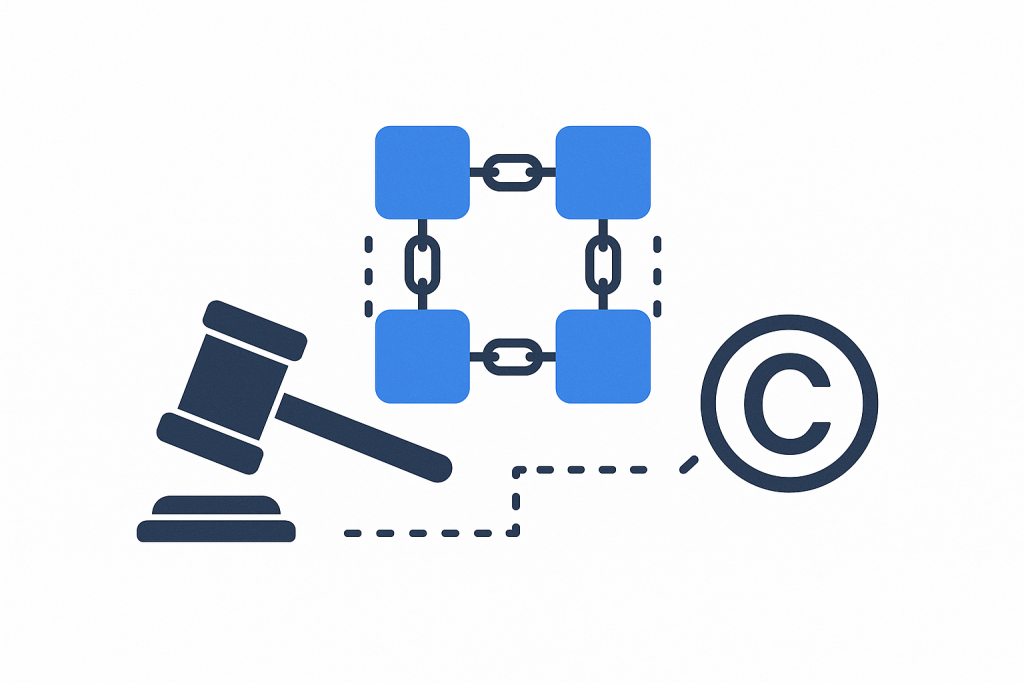
“On-chain IP” uses blockchain to record authorship, licensing terms, and usage history immutably, creating a living ledger of creative rights. This doesn’t replace legal systems; it augments them—transforming how creative ownership is verified, licensed, and litigated.
Why This Matters
Traditional IP law was built for a slower, analog world where contracts were managed through courts and agencies. But creative work now moves at digital speed—across borders, platforms, and AI systems that can remix or replicate content in seconds.
This mismatch between legal frameworks and digital reality creates friction:
- Proof of authorship can be disputed when content spreads or is AI-generated.
- Royalties and licensing are often delayed by outdated or regionally fragmented systems.
- Legal enforcement is expensive and time-consuming, making small-scale creators vulnerable.
Blockchain changes this equation. Every creative act can be timestamped, signed, and verified on a shared ledger. Smart contracts encode licensing conditions automatically—who can use the work, under what terms, and with what payment triggers. Disputes become traceable, data-backed, and globally referenceable, not just jurisdiction-bound.
Here’s How We Think Through This
(A grounded framework for understanding on-chain IP in practice)
- Identify what needs verification.
The key question isn’t “Can we put all IP on-chain?” but “What parts of the IP lifecycle benefit from transparency?” For most creators, proof of authorship and rights transfer are the highest-value use cases. - Establish the chain of custody.
Blockchain creates a continuous, immutable trail from creation to commercialization. Each transaction—license issuance, royalty payment, resale—adds a new data block to that asset’s legal history. This reduces the gray areas that often fuel disputes. - Standardize digital licensing formats.
Emerging frameworks like W3C’s Verifiable Credentials and NFT-based licensing standards allow contracts to be machine-readable. That means future digital platforms—music services, marketplaces, even social media—can automatically respect usage rights. - Integrate with existing law, not against it.
On-chain IP doesn’t eliminate courts; it strengthens evidence. Blockchain records serve as verifiable proof of authorship or agreement, complementing copyright filings and contract law. The key lies in legal recognition, which is already being explored in countries like Singapore, the UK, and the U.S. - Educate the next generation.
For parents and educators, the concept of digital authorship is now foundational. Teaching students how to prove creation and manage rights digitally prepares them for a world where IP is not paperwork—it’s code.
What Is Often Seen as a “Future Trend” (and the Real-World Insight)
Many perceive blockchain IP management as theoretical, but the groundwork is already being laid. Startups and legal tech firms are building on-chain registries that certify authorship, timestamp creative assets, and automate royalties. Major law firms are testing “smart legal contracts” that integrate blockchain data as evidentiary proof.
The real-world insight: The legal system isn’t disappearing—it’s evolving. Lawyers are learning to read ledgers as fluently as contracts. The future of creative law will be hybrid: a mix of legal precedent and digital verification. The next generation of creators will not just protect their rights—they’ll program them.