
Quick Insight
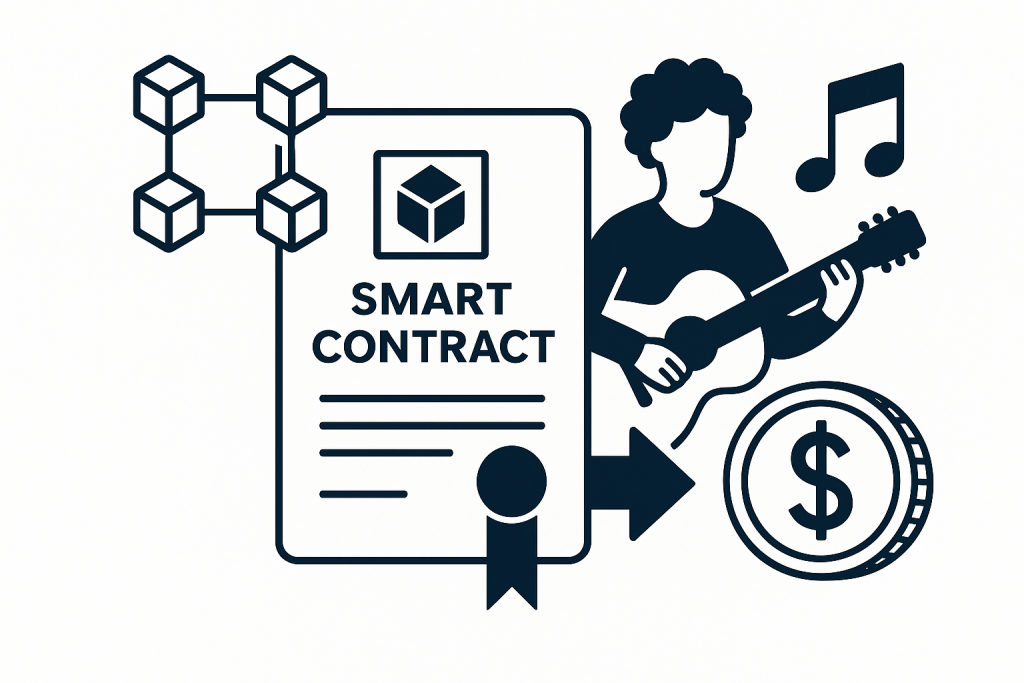
The music industry is quietly being rewritten on the blockchain. Smart contracts now allow musicians to receive payments instantly and transparently—without needing traditional intermediaries such as record labels, publishers, or collection societies. Instead of waiting months for royalty checks, artists can be paid directly when a listener presses play.
Why This Matters
For decades, creative ownership and compensation have been managed by complex systems built around intermediaries. These entities—while offering scale and distribution—often obscure how and when artists get paid. Blockchain and on-chain licensing models upend this by embedding payment rules directly into smart contracts.
This means:
- Fairer distribution: Every participant (artist, producer, songwriter) can be compensated based on pre-agreed percentages stored in the blockchain.
- Radical transparency: Anyone can verify who owns what and how much revenue flows.
- Real-time royalties: Payments occur the moment a track is streamed, downloaded, or synced to a video.
The shift isn’t only about technology; it’s about reclaiming agency in a system that historically favored gatekeepers over creators.
Here’s How We Think Through This
(A grounded, stepwise lens for future-minded strategists)
- Start with the friction points.
Artists’ biggest pain points are delayed royalties, unclear contracts, and lack of transparency. Understanding the inefficiencies in current collection and licensing systems is the first step toward identifying where blockchain can truly add value. - Map out the transaction flows.
Every play, sync, or use of a song generates microtransactions. On-chain smart contracts replace middlemen by embedding royalty logic—“If this track is streamed, then X% goes to Y wallet.” - Design for interoperability.
The future lies in cross-platform collaboration. A blockchain solution that only works on one streaming service misses the opportunity. Think: artist wallets that interact seamlessly with Spotify, Audius, or social platforms. - Focus on data integrity and governance.
Ownership metadata (who wrote, performed, produced) must be accurate before automating payment. Without trustworthy data, automation risks amplifying errors. Establish verification layers before scaling. - Educate and onboard stakeholders.
For parents, educators, and young creators—understanding blockchain isn’t about coding. It’s about trust, creative control, and financial literacy in digital economies. Empowering the next generation to navigate this space responsibly is as critical as the technology itself.
What Is Often Seen as a “Future Trend” (and the Real-World Insight)
Many view blockchain royalties as a futuristic ideal—something years away. Yet, it’s already unfolding. Independent platforms like Audius, Catalog, and Sound.xyz are paying artists directly via smart contracts today. Major labels are experimenting with NFT-based rights management. Even streaming giants are exploring on-chain verification for licensing transparency.
The real-world insight: This isn’t about disruption for disruption’s sake. It’s about evolution—making the value chain more equitable, traceable, and immediate. As education systems and communities prepare young creators for new economic realities, understanding blockchain’s role in creative compensation becomes a core digital literacy skill, not a niche topic.