
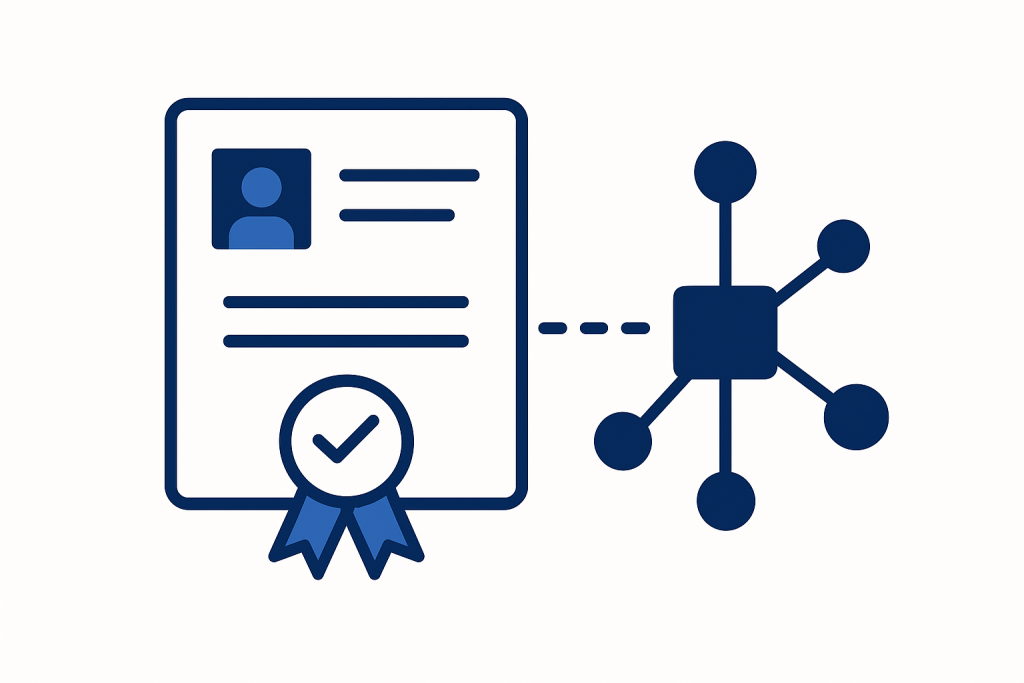
Quick Insight
For centuries, we’ve relied on human intermediaries—lawyers, notaries, auditors—to confirm identity and validate transactions. These professionals form the backbone of trust in commerce and law. But as blockchain technology matures, the mechanisms of verification are shifting from people to protocols.
In a tokenized economy, trust is no longer notarized; it’s programmed. Blockchain-based smart contracts now record, authenticate, and execute agreements automatically. This creates a new layer of verification—one that’s borderless, transparent, and mathematically secure.
Why This Matters
Verification underpins every economy. Whether it’s a land deed, business contract, or diploma, society depends on intermediaries to confirm authenticity. But these systems can be slow, costly, and prone to human error—or even corruption.
Blockchain turns verification into an automated function. By linking digital identity, proof of ownership, and recordkeeping into a single distributed ledger, transactions can be authenticated instantly, without needing a third party to “stamp” legitimacy.
For families, educators, and future leaders, this shift highlights a critical learning frontier: digital trust literacy. Understanding how identity, ownership, and proof operate in decentralized systems will be as essential as understanding signatures or legal documents once were.
Here’s How We Think Through This
- Start with the Problem: The Cost of Manual Verification
Traditional verification systems depend on people to confirm and record trust. This introduces delays and inefficiencies—whether it’s waiting for an escrow to clear, a deed to be notarized, or an audit to be completed. - Understand the Blockchain Advantage
Blockchain’s distributed ledger acts as a global, tamper-proof record of truth. Each transaction or document can be verified by the network itself, using cryptographic consensus rather than institutional authority. This eliminates duplication and reduces reliance on centralized record keepers. - See Smart Contracts as the Automation Layer
Smart contracts extend this capability by embedding rules directly into digital code. For example, instead of hiring a notary to validate a property sale, the contract itself verifies ownership and automatically transfers tokens once payment conditions are met. - Integrate Digital Identity into the Process
Blockchain-based identity systems—often referred to as “self-sovereign identity”—allow individuals to control their own verification credentials. Instead of presenting personal data to multiple third parties, users share cryptographic proofs that confirm facts (like citizenship or creditworthiness) without exposing private details. - Evaluate the Legal Transition
Governments and legal institutions are adapting quickly. Countries like Estonia and Singapore already issue blockchain-verified IDs and certificates. The next decade will see increasing alignment between legal frameworks and digital proofs, bridging the gap between institutional and algorithmic trust.
What Is Often Seen as a Future Trend — Real-World Insight
The “no notary” model is already emerging in practical systems:
- Estonia’s e-Governance System uses blockchain to secure citizen identity, land records, and digital signatures.
- Smart contract platforms like Mattereum and Propy handle property and asset verification without traditional legal intermediaries.
- Educational institutions such as the Massachusetts Institute of Technology (MIT) issue blockchain-based diplomas to prevent fraud and simplify credential verification.
These examples show a clear trajectory toward automated authenticity. Instead of trusting an individual to verify truth, we trust the system itself—one that is transparent, verifiable, and immutable.
As tokenized systems expand, the meaning of verification will evolve from paperwork to codework. The next generation will grow up not waiting for documents to be stamped, but for transactions to be confirmed—instantly, digitally, and globally.