
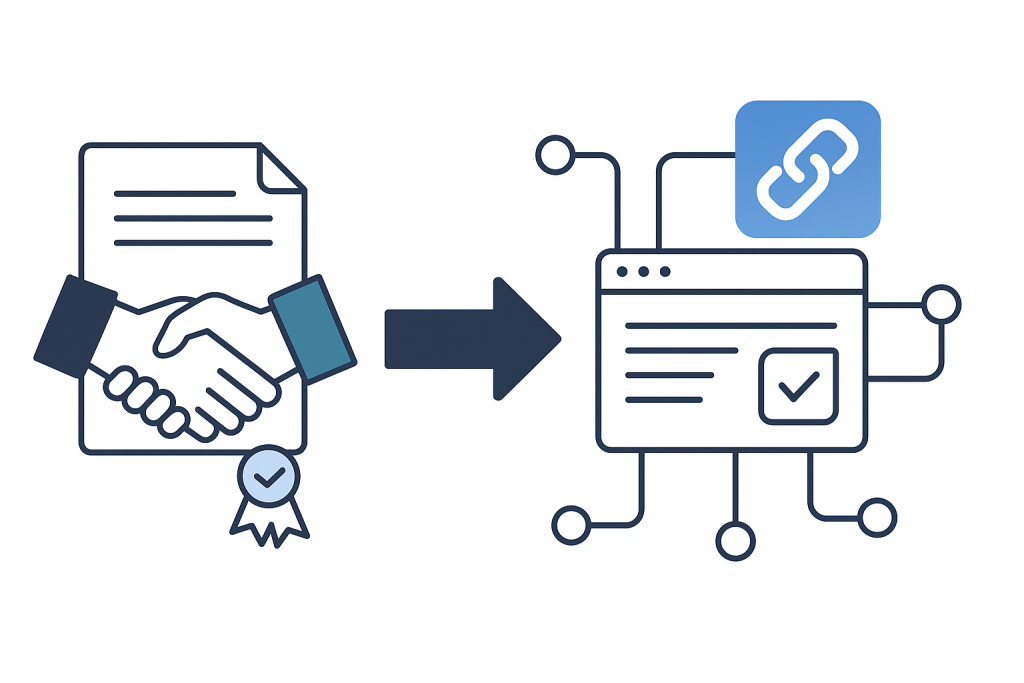
Quick Insight
Financial systems have always depended on trust—trust in institutions, intermediaries, and regulatory oversight to ensure that money and agreements move securely. Smart contracts are changing that foundation. Instead of relying on banks, brokers, or auditors, these blockchain-based programs automatically enforce agreements when predefined conditions are met.
This shift from trust in people to trust in code marks one of the most significant transformations in modern finance. It’s a move toward transparent, programmable systems where integrity isn’t an afterthought—it’s built into the technology itself.
Why This Matters
At its core, finance is about assurance. Whether it’s a mortgage, a trade, or a loan, every transaction depends on verifying that promises will be kept. Traditional intermediaries—banks, clearinghouses, and notaries—exist to manage that risk. But they also slow processes, add costs, and create single points of failure.
Smart contracts replace that manual verification with self-executing logic. They make financial interactions faster, cheaper, and more transparent, while reducing the potential for human error or manipulation.
For families, educators, and future investors, this matters because it signals a deeper societal shift: financial literacy is now merging with digital fluency. Understanding how systems execute rules through code will become as important as understanding how interest rates work.
Here’s How We Think Through This
- Identify the Role of Trust in Financial Systems
Traditional financial trust is layered—institutions verify transactions, regulators enforce fairness, and humans manage compliance. This structure works but creates dependency on multiple intermediaries. - Define Smart Contracts as Programmable Agreements
A smart contract is a piece of code stored on a blockchain that executes automatically when conditions are met. For example, releasing payment only when a shipment is confirmed delivered. Once deployed, it operates autonomously—no delays, no negotiation, no interpretation. - Evaluate the Impact on Transparency and Accountability
Every action a smart contract takes is recorded on a public ledger. This transparency builds auditability directly into the system, meaning anyone can verify what happened and when. In many cases, this could reduce disputes and compliance overhead dramatically. - Consider the Legal and Ethical Layer
Code executes perfectly—but humans still design the rules. Ethical governance, regulation, and oversight will determine whether smart contracts enhance fairness or merely shift control from institutions to technologists.
The future of “trust” will likely involve both: transparent code and accountable human supervision. - Anticipate the Ripple Effect on Financial Education
Tomorrow’s professionals will need to understand not only how to read balance sheets but how to interpret contract logic. The ability to evaluate a code-based agreement will become a new dimension of financial literacy, relevant for students, investors, and civic leaders alike.
What Is Often Seen as a Future Trend — Real-World Insight
This isn’t a distant concept. It’s already being implemented:
- Decentralized Finance (DeFi) platforms like Aave and Uniswap execute billions in transactions daily through smart contracts—no banks involved.
- Trade and logistics industries use blockchain-based contracts to automate payments upon verified delivery.
- Insurance and real estate applications now use smart contracts to manage claims, escrows, and property transfers transparently.
Regulators are adapting too. The European Union, Singapore, and Switzerland have already drafted frameworks for smart contract legality. The goal isn’t to replace law—it’s to align law with logic.
The key takeaway: smart contracts don’t eliminate trust—they re-engineer it. In the new economy, trust is not promised by an institution—it’s proven by design.