
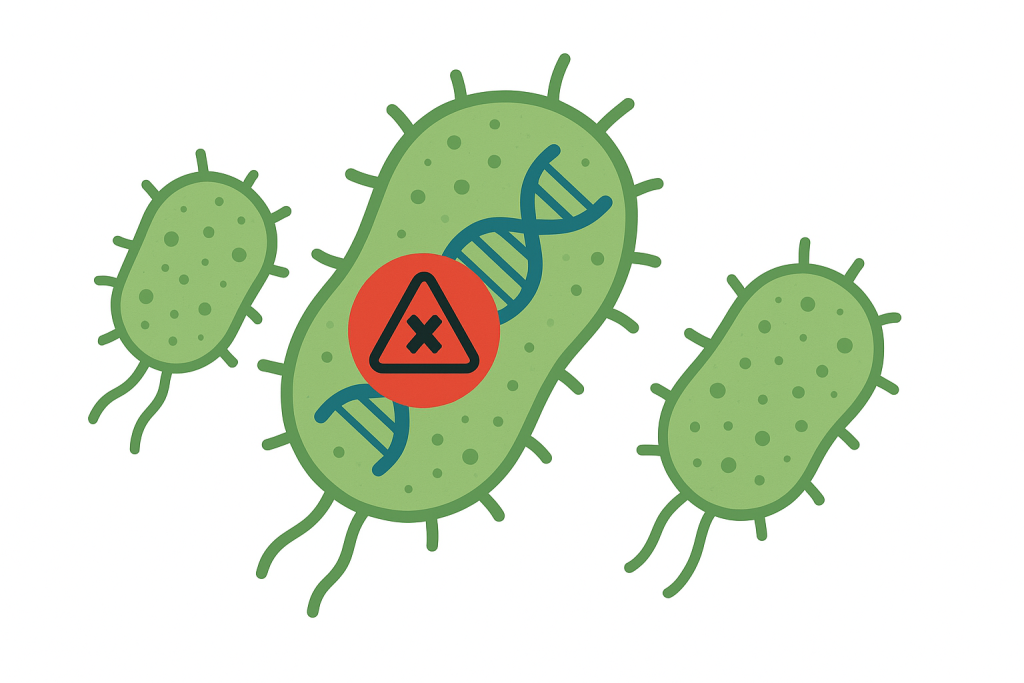
When biology becomes programmable, safety must evolve with it.
The Challenge: Containing Living Technology
Engineered cells don’t stay put.
As biotechnology advances, scientists can reprogram microbes to produce fuels, medicines, and materials. But these same organisms—once released into the wild—can behave unpredictably. A bacterium engineered for one purpose in a lab might mutate, spread, or interact with other species in ways that no one intended.
Traditional lab safety measures—sealed environments and sterilization protocols—work for containment inside facilities. But biological containment must now extend beyond walls and filters. The new frontier is genetic containment: designing life forms that know when to stop existing.
Programmable Containment: The Biological “Off Switch”
Self-destruction can be a feature, not a flaw.
Biologists are developing kill switches—genetic programs embedded within an organism’s DNA that trigger its death under certain conditions. Think of them as biological deadman switches designed to protect the world from accidental or intentional release.
There are several strategies to build this kind of safety directly into biology:
- Environmental dependency: Cells are engineered to rely on a molecule or nutrient that doesn’t exist outside the lab. Once removed from that controlled environment, the organism simply dies.
- Time-controlled suicide genes: After a defined number of cell divisions or hours, a programmed gene activates and degrades essential functions.
- Conditional kill switches: If cells detect unauthorized environmental signals (like temperature or light changes), they initiate self-termination sequences.
Each approach makes containment a property of biology itself—not just the space it inhabits.
Engineering “Safe Failure” into Living Systems
The goal isn’t perfection—it’s predictability.
No containment method is foolproof. Mutations, environmental shifts, and evolutionary pressure can all disable a kill switch over time. To counter that, researchers use layered redundancy—multiple independent safety systems that fail in different ways.
For example, a microbe might depend on a synthetic nutrient and contain a time-triggered self-destruct mechanism. Even if one system fails, the other maintains control.
This concept—safe failure—mirrors cybersecurity and aerospace engineering, where systems are built to handle failure gracefully rather than catastrophically. In biology, it means an escaped cell becomes inert instead of invasive.
The Ethics of Built-In Mortality
Designing life that dies raises new questions about responsibility.
Programmable containment isn’t just a technical innovation; it’s an ethical stance. When humans design organisms, they inherit a duty to manage the consequences. Ensuring that engineered life cannot outcompete natural ecosystems is part of that duty.
Self-destructing cells demonstrate a shift in mindset—from “how do we make it work?” to “how do we make it safe?” This emphasis on controlled impermanence defines the future of ethical biotechnology.
Yet it also raises questions: Should all engineered life be designed to die? Who decides when a biological system’s lifespan ends? These debates will shape not only scientific policy but also public trust in synthetic biology.
Containment Beyond the Lab: Applications in the Real World
The future of containment is everywhere biology goes.
As bioengineered systems move from research labs into agriculture, medicine, and manufacturing, embedded containment will become standard practice.
- In agriculture, engineered microbes can enrich soil or fix nitrogen—then self-terminate after completing their function.
- In medicine, live therapeutic bacteria can deliver drugs inside the body and disassemble once treatment ends.
- In waste management, engineered enzymes could digest pollutants and then deactivate to prevent unintended spread.
This is Containment 2.0: an era where biological systems are programmed not just to perform tasks, but to stop performing them safely.
Building Trust Through Transparent Design
Public acceptance of biotechnology depends on visible safeguards.
Self-destructing cells offer more than technical security—they provide psychological assurance. By embedding safety directly into the genome, scientists make bioengineering more transparent and accountable.
To support that, researchers and regulators are pushing for open reporting standards—public documentation of containment mechanisms, genetic dependencies, and kill switch design logic. This transparency builds confidence that innovation can coexist with responsibility.
Conclusion: The New Logic of Living Systems
Programmable containment marks a turning point in biotechnology. Where once biology was seen as uncontrollable, it’s now being taught restraint through design.
Self-destructing cells reflect a larger principle: safety by design is smarter than safety by restriction. By programming limits into living systems, we don’t just protect the environment—we redefine what responsible creation looks like.
Containment 2.0 is more than a safeguard. It’s a philosophy for an age where biology itself can think, act, and, when necessary, choose to stop.