
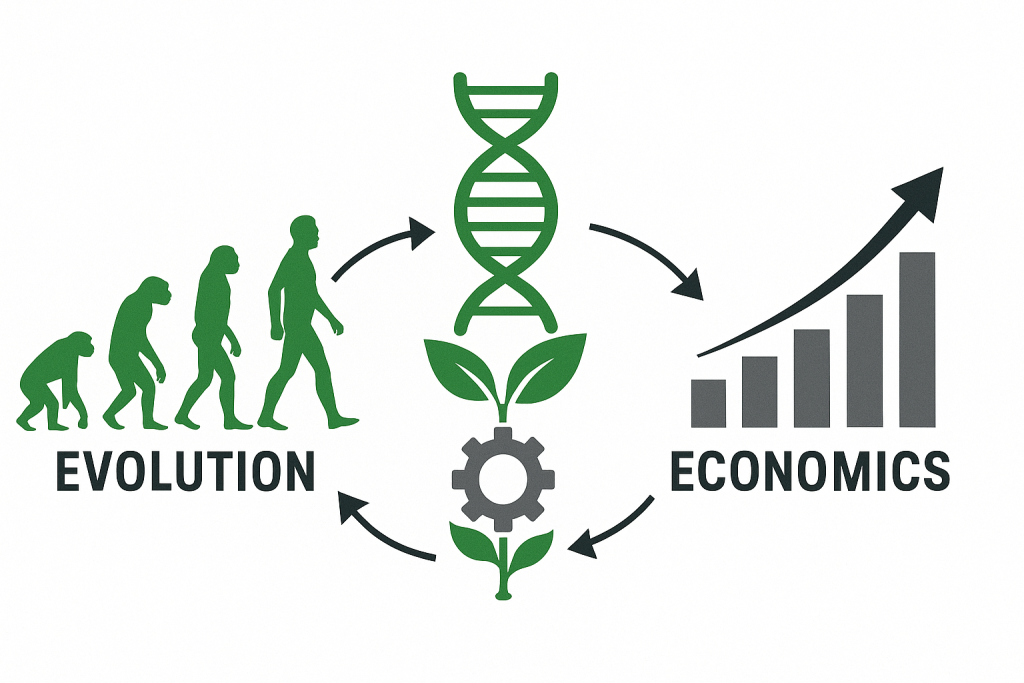
When evolution becomes an economic force, climate strategy transforms from defense to design.
The Problem: Mitigation Has Hit Its Limit
For decades, the global climate agenda has been built around reduction.
Cut carbon. Slow warming. Limit harm. But mitigation—while essential—is a defensive strategy. It assumes that growth and emissions are bound together, and that the best we can do is pollute less.
That framing worked when biology was a spectator to industry. It no longer applies when biology becomes the industry itself.
Programmable biology, the ability to design and direct living systems for production, is redefining economics around regeneration, not restraint.
The Rise of Biofabrication: Manufacturing as Metabolism
Biofabrication turns cells into factories.
Instead of refining metals or cracking hydrocarbons, biologists program organisms—yeast, algae, bacteria—to build materials from renewable inputs like sugars, sunlight, or captured CO₂.
Where traditional manufacturing extracts and emits, biofabrication absorbs and regenerates.
Examples already emerging include:
- Carbon-negative textiles grown from mycelium or algae.
- Biopolymers and packaging produced via microbial fermentation.
- Bio-cement and construction materials that lock carbon into mineral or cellular forms.
Each of these processes uses biology’s natural efficiency—low energy, circular inputs, and self-assembly—to produce economic value while actively reducing atmospheric carbon.
From Mitigation to Regeneration: A New Climate Paradigm
Biological production changes what “impact” means.
Instead of minimizing footprint, programmable biology maximizes restorative throughput—how much carbon or waste it can transform back into useful, stable materials.
This shift in logic reframes global climate policy in three key ways:
- Carbon as currency: CO₂ becomes a feedstock with measurable economic value.
- Growth as restoration: Economic expansion can align with environmental recovery.
- Policy as ecosystem design: Climate strategy becomes about enabling circular bio-industries, not just penalizing emissions.
In short, biology replaces extraction with conversion—and turns climate action into an investment model.
Economic Ripples: Redefining Productivity and Trade
When biology becomes infrastructure, economics evolves.
Biofabrication decentralizes production. Instead of massive industrial centers, small modular bioreactors can operate anywhere biomass or waste is available. That means:
- Local manufacturing replaces global logistics. Reduced transport equals lower emissions.
- Waste becomes an asset. Industrial byproducts feed microbial or algal growth systems.
- Energy demand drops. Biological reactions run at room temperature and atmospheric pressure.
For global trade, this implies a new map of economic power—one defined less by access to oil and more by access to biological intelligence and local feedstock ecosystems.
Climate Policy in the Biofabrication Age
Regulation must evolve as fast as biology does.
To enable regenerative economies, policy must support measurable, verifiable bio-based gains. Key levers include:
- Carbon utilization credits, not just carbon avoidance.
- Lifecycle-based accounting that rewards circular design.
- Open biomanufacturing standards that accelerate safe innovation and knowledge sharing.
Such frameworks align economic incentives with biological logic—rewarding carbon fixation, circular inputs, and regenerative manufacturing at scale.
The Evolutionary Economy: Growth That Heals
Evolution has always optimized for adaptation. Now, economics can too.
Biofabrication marks the convergence of biology and design—where evolution is not a metaphor but a manufacturing strategy.
This new industrial model can transform climate policy from damage control into ecological participation—where industries become co-creators in planetary restoration.
When evolution meets economics, the question isn’t how to emit less, but how to grow better.
Conclusion: Regeneration as Strategy
The BioEconomy reframes climate action from cost to value creation.
Programmable biology shows that the future of growth isn’t extraction—it’s expression. When we learn to program life to heal, production itself becomes a form of restoration.
The next phase of climate economics will be powered not by constraint, but by biological intelligence—evolution, coded for regeneration.