
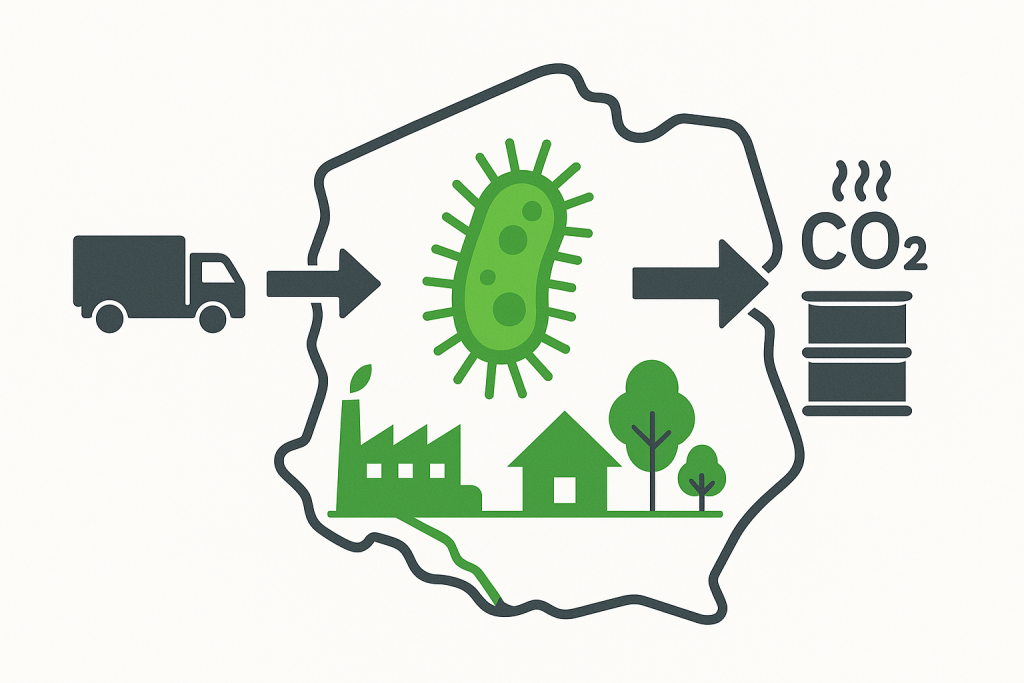
In the next industrial shift, biology meets logistics—and reshapes our carbon footprint.
From Global Supply Chains to Local Bio-Factories
For the past century, efficiency meant scale. Factories grew large, production centralized, and goods traveled thousands of miles before reaching consumers. That model optimized cost per unit but ignored carbon intensity across shipping, storage, and waste.
Bio-local manufacturing—using biological systems to produce materials, food, or goods closer to where they’re needed—flips that equation. It decentralizes production into smaller, adaptable hubs powered by living systems: microbes, plants, or cell cultures. These hubs can make proteins, textiles, or building materials on demand, in the same region—or even the same community—that consumes them.
The Hidden Carbon Cost of “Business as Usual”
Every mile has a footprint.
The global logistics chain is responsible for roughly 10% of worldwide carbon emissions, spanning ocean freight, air transport, and warehousing. Traditional production depends on:
- Long-haul transport between production and consumption zones
- Warehousing to buffer inventory uncertainty
- Overproduction leading to waste and markdowns
These inefficiencies are baked into centralized manufacturing. The result: a hidden layer of emissions that persist even after factories become more energy-efficient.
Biological Production as Living Infrastructure
Biology doesn’t just replace materials—it replaces distance.
A bio-local network relies on microbial fermenters, mycelium growth chambers, or precision fermentation tanks that can operate nearly anywhere. These biological “micro-factories” turn renewable inputs like sugars or agricultural byproducts into finished products with minimal overhead.
Because these systems are modular and compact, they can be embedded near consumption—within cities, campuses, or community zones—reducing both transport emissions and the need for large inventory storage. Production becomes just-in-time, not just-in-case.
The Carbon Equation: Fewer Trucks, Less Waste, Smarter Flow
Let’s break the impact down:
- Reduced long-haul transport: Materials produced locally eliminate global shipping routes.
- Lower storage emissions: Local, on-demand manufacturing cuts warehousing energy use.
- Minimal overproduction: Demand-driven biological systems scale precisely to need, slashing waste.
- Circular inputs: Organic byproducts can loop back into production, closing material cycles.
Each step compounds into what logistics experts call a “distributed advantage”—less carbon per product, less waste per cycle.
Agility Over Scale: A New Measure of Efficiency
The industrial economy prized economies of scale; the biological economy prizes economies of adaptability.
Instead of one factory producing millions of identical units, hundreds of small biomanufacturing sites can flex to meet local demand. The gain isn’t just lower emissions—it’s resilience. When transport grids falter or supply chains fracture, local bio-production keeps communities supplied.
For parents, educators, and policymakers, this reframes sustainability not as sacrifice but as relocalization through innovation—a future where carbon efficiency and community resilience align.
Conclusion: Living Systems, Living Logistics
Bio-local manufacturing isn’t merely greener—it’s smarter logistics through biology.
By replacing dead miles with living production, we move toward a model that values adaptability, locality, and minimal waste. The next carbon breakthrough won’t come from cleaner ships or warehouses—it’ll come from bringing production home.