
The next frontier of climate technology isn’t mechanical—it’s biological.
Why Carbon Needs a New Strategy
The fight against climate change has long focused on reducing emissions and storing carbon underground. But storage alone isn’t enough. The challenge now is to turn carbon dioxide into something valuable—a usable resource, not just a waste gas.
That’s where CRISPR comes in. The gene-editing tool that revolutionized medicine is now being used to redesign life forms that can capture, convert, and reuse carbon dioxide far more efficiently than any industrial process.
From Problem Gas to Feedstock
Carbon dioxide (CO₂) is the main driver of global warming—but it’s also an abundant, untapped source of carbon, the building block of all organic materials. Plants, algae, and microbes already absorb CO₂ naturally through photosynthesis and metabolism. The problem is scale and speed.
CRISPR is allowing scientists to amplify nature’s capacity for carbon fixation. By editing genes in algae, bacteria, and even soil microbes, researchers are creating organisms that:
- Capture CO₂ faster than natural species.
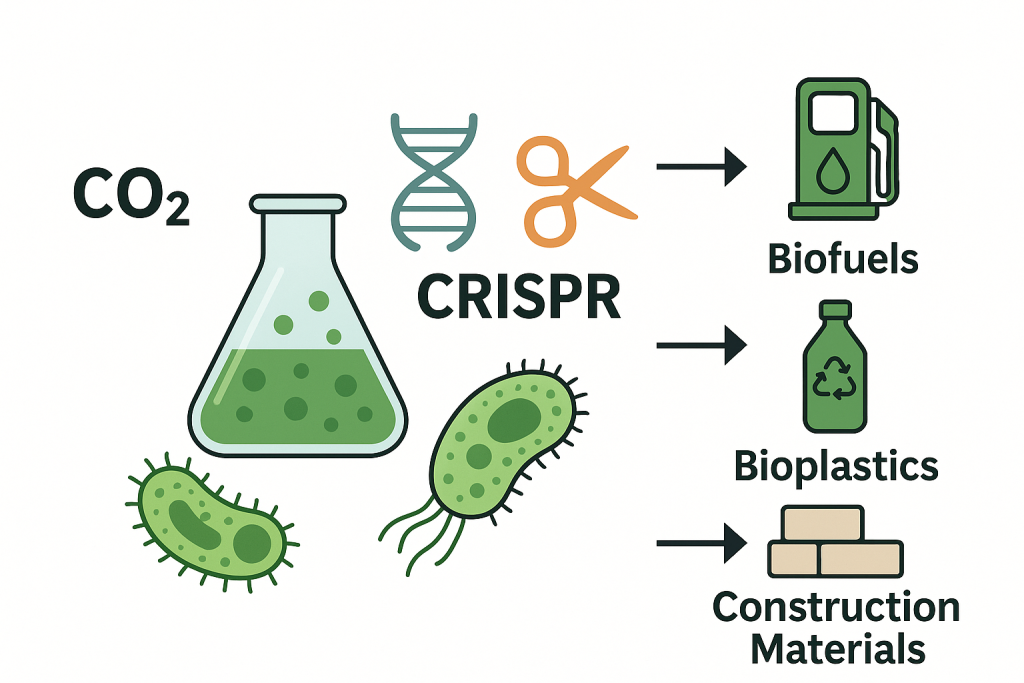
- Convert CO₂ into fuels, bioplastics, or construction materials.
- Store carbon in stable, long-lasting molecular forms.
The goal isn’t just sequestration—it’s transformation.
How CRISPR Enhances Carbon Capture
CRISPR enables scientists to precisely rewire metabolic pathways in microorganisms. In algae, for example, the process of photosynthesis can be made more efficient by editing genes that regulate how the organism absorbs light and processes carbon.
In bacteria, researchers can insert new enzymes that convert CO₂ directly into valuable compounds such as ethanol, methanol, or biodegradable plastics.
Essentially, CRISPR acts as a molecular upgrade kit—turbocharging biology’s ability to eat carbon.
Microbial Factories for a Circular Carbon Economy
Gene-edited microbes are now being developed as miniature biorefineries. Inside specialized bioreactors, these organisms absorb CO₂ from industrial exhaust and convert it into usable materials:
- Biofuels: Algae engineered with CRISPR can produce hydrocarbons similar to jet fuel or diesel.
- Bioplastics: Bacteria modified to secrete polymer precursors offer a renewable alternative to oil-based plastics.
- Cement and Construction Materials: Microbes that mineralize carbon into solid carbonates could help produce carbon-negative bricks or concrete.
This biological approach complements renewable energy by turning emissions into raw materials—closing the loop on carbon.
Why Biology Beats Traditional Technology
Mechanical carbon capture systems rely on chemical filters or high-energy processes to isolate CO₂. Biological systems do it naturally, using solar energy, ambient temperatures, and self-replicating organisms.
The advantages are striking:
- Low Energy Demand: Microbes operate at room temperature and pressure.
- Scalability: Once engineered, they reproduce themselves.
- Adaptability: Genetic tuning allows organisms to thrive in diverse environments—from oceans to industrial smokestacks.
Where traditional systems trap carbon, biology can repurpose it.
Real-World Examples
Several pioneering projects are already translating CRISPR-based carbon capture into industrial practice:
- LanzaTech uses engineered microbes to convert CO₂ from steel mills into ethanol and jet fuel.
- Living Carbon, a startup, is editing trees with enhanced photosynthesis genes to absorb more CO₂ as they grow.
- University of Texas researchers have modified cyanobacteria to transform CO₂ into acetate—a key ingredient for bioplastics and fuels.
These examples mark the start of a new carbon-to-value economy, where waste becomes resource.
Educational and Ethical Implications
For educators and parents, this field represents an ideal case study in STEM integration—combining biology, chemistry, and environmental science to address global challenges. Students exploring synthetic biology or climate innovation can see how gene editing links directly to sustainability and engineering.
However, CRISPR-based carbon capture also raises ethical and ecological questions:
- How do we contain engineered organisms safely?
- Could large-scale biological deployment disrupt ecosystems?
- Who governs the use of genetically modified life for climate control?
Teaching these dimensions alongside the science ensures future innovators consider both impact and responsibility.
Preparing for a Bio-Based Climate Economy
The rise of CRISPR in climate tech suggests a new kind of career landscape—where biology, computing, and environmental policy converge. Future professionals will need to understand how genetic design, AI, and sustainability intersect.
In the same way that coding became a universal skill in the digital age, biocoding—designing genetic systems for specific outcomes—may become foundational in the sustainability age.
The Big Picture: Biology as Infrastructure
Using biology to capture and recycle carbon reframes climate strategy. Instead of fighting nature, we’re learning to partner with it, using tools like CRISPR to enhance its efficiency and precision.
This represents a profound shift: from extraction to regeneration, from emission control to carbon redesign.
In the long view, climate technology may not look like steel towers or mechanical filters—it may look like green algae, engineered forests, and microbial networks humming quietly beneath our feet.
The blueprint for a sustainable planet might already be written in its DNA.