
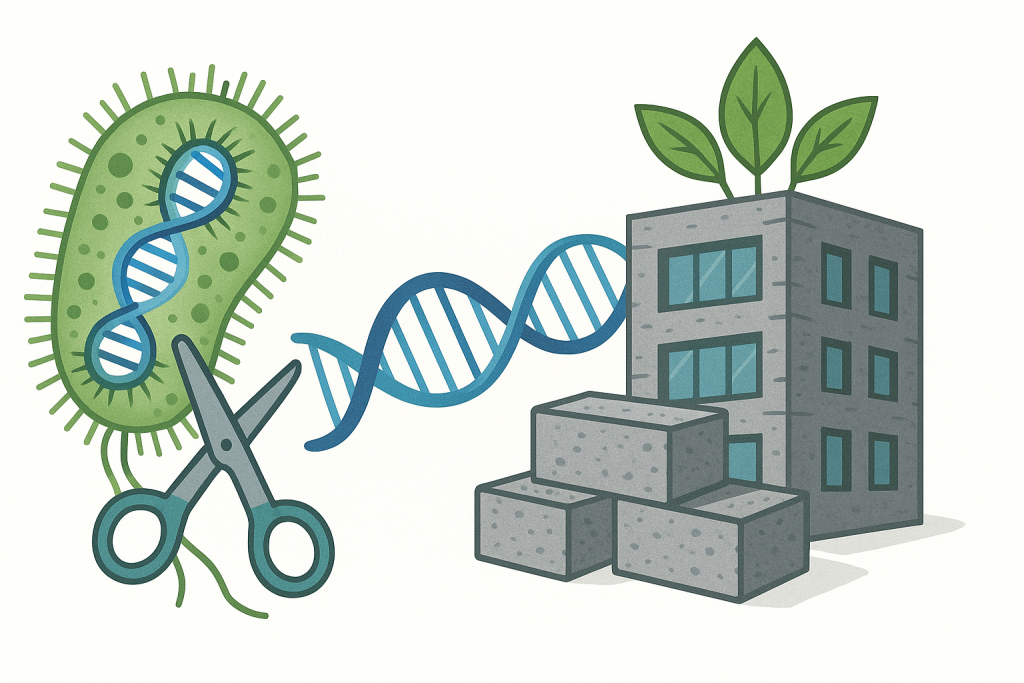
The future of building isn’t just about design—it’s about biology.
Reimagining the Foundations of Construction
Cement and concrete are the most widely used materials on Earth—and some of the most polluting. Traditional cement production accounts for nearly 8% of global carbon emissions, driven by the chemical reaction that turns limestone into clinker.
But a new approach is emerging from the lab bench: using engineered biology to grow, repair, and even improve construction materials. At the center of this shift is CRISPR, the gene-editing tool that allows scientists to precisely reprogram living organisms for specific industrial functions.
Engineering Materials That Build Themselves
Researchers are turning to bacteria as biological builders. Certain species, like Sporosarcina pasteurii, naturally produce calcium carbonate, the same mineral found in limestone. By editing their genes with CRISPR, scientists can amplify this process—essentially programming microbes to grow stone in controlled conditions.
These “living materials” can be cast into bricks, tiles, or structural elements that strengthen over time. Unlike traditional cement, which emits CO₂ during production, these microbial materials can absorb and lock away carbon from the atmosphere.
The Rise of Bio-Bricks and Living Concrete
One of the most promising developments is bio-bricks—blocks grown by engineered bacteria that mineralize sand or recycled aggregates. These bricks are strong, lightweight, and fully biodegradable at end-of-life.
Meanwhile, CRISPR-modified bacteria embedded in concrete can detect cracks and self-heal the material by precipitating new minerals when exposed to water. This reduces the need for maintenance and extends the lifespan of structures, cutting both costs and environmental impact.
In effect, buildings could become self-sustaining ecosystems, capable of repairing themselves as they age.
Carbon-Capturing Construction
Beyond replacing cement, CRISPR is helping turn construction into a carbon sink. By designing microbes that consume CO₂ as part of their metabolism, researchers are creating systems that capture and store greenhouse gases during material formation.
Some prototypes use algae modified to enhance photosynthetic efficiency, producing biopolymers that act as binders in composites. Others use bacteria engineered to convert CO₂ directly into solid carbonates—turning emissions into literal building blocks.
This approach could flip the construction industry’s environmental impact from emitter to absorber.
How CRISPR Makes It Possible
CRISPR provides the precision needed to rewire microbial behavior at the genetic level. Scientists can:
- Boost metabolic pathways for faster mineral production.
- Introduce new genes that help microbes survive in alkaline or high-temperature environments typical of construction sites.
- Program cellular “triggers” to activate repair or carbon capture only when needed.
This flexibility allows researchers to fine-tune biological systems the way engineers design mechanical ones.
A New Toolkit for Sustainable Engineering
For educators and parents, the implications extend beyond construction. CRISPR’s integration into material science shows how future careers will blur the lines between biology, engineering, and architecture.
Students entering these fields will need fluency not just in math and physics, but in genetics and systems thinking—understanding how living systems can be designed to solve material and environmental challenges.
The next generation of engineers won’t only build with biology—they’ll build from it.
Challenges on the Path to Adoption
As promising as biological construction materials are, several challenges remain:
- Scaling up production to meet industrial demand.
- Durability testing over decades, not months.
- Public acceptance of living or gene-edited components in homes and cities.
- Regulatory clarity, as most construction codes were written for inert materials, not living ones.
Overcoming these hurdles will require collaboration between biologists, civil engineers, policymakers, and environmental scientists.
Why This Matters for Climate and Education
CRISPR-enabled construction is part of a larger movement to decarbonize heavy industry. Cement, steel, and chemicals are among the hardest sectors to clean up—and biology offers one of the few viable solutions.
For educators, it’s also a teaching moment: students can see how breakthroughs in gene editing translate directly into real-world sustainability innovations. It’s a living example of applied STEM thinking, where climate solutions come from understanding both life and technology.
The Blueprint for the Future
The construction industry is being redefined from the inside out. As CRISPR continues to expand the toolbox of materials science, our buildings may soon:
- Grow instead of being manufactured.
- Capture carbon instead of emitting it.
- Heal instead of deteriorate.
The story of CRISPR in construction isn’t just about stronger materials—it’s about smarter materials that work in harmony with the planet.
The next generation of architects and engineers won’t just design structures. They’ll design life forms that build them.