
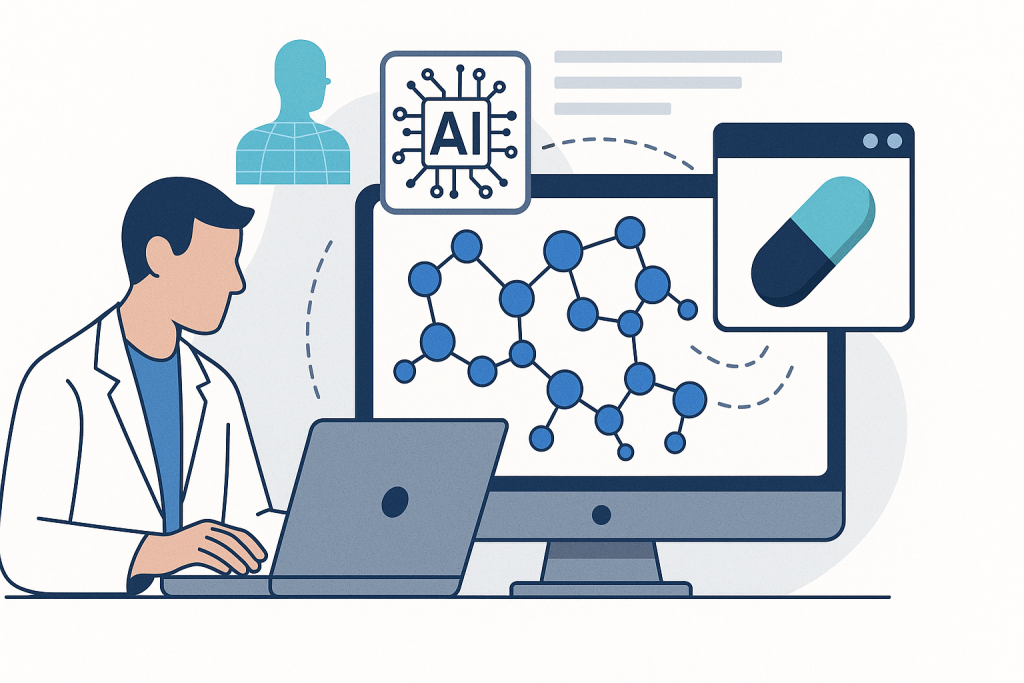
New medicines are now modeled in code before they’re ever mixed in a lab.
The Problem with Traditional Drug Development
Slow, costly, and high-risk
Bringing a new drug to market takes over a decade and billions of dollars. Most compounds fail—often late in the process—because predicting how a drug will behave in the human body is complex and error-prone. Historically, researchers relied on physical lab testing and trial-and-error chemistry, which is expensive and time-consuming.
Now, thanks to AI and digital modeling, that paradigm is changing.
The New Model: Simulate Before You Synthesize
Software-first drug design is accelerating discovery
Today’s biotech innovators are using AI-driven tools and digital twins to model how drugs interact with biology—virtually. This lets scientists:
- Predict how a molecule will bind to a target protein
- Simulate how it behaves in different tissue environments
- Spot toxicity or side effects before making a single physical sample
These tools dramatically reduce the number of failed experiments and speed up the time to human trials.
What Are Digital Twins in Drug Discovery?
A digital twin is a simulated model of a biological system
Digital twins aren’t just for machines. In pharma, they represent systems like cells, organs, or even full-body metabolism. By integrating data from genomics, imaging, and past trials, researchers can simulate how a drug behaves inside a virtual human.
This makes it possible to:
- Run millions of simulations in parallel
- Tailor drug candidates to specific disease profiles
- Explore “what-if” scenarios without harming a patient
Digital twins are essentially virtual test subjects, enabling smarter iteration before human testing.
The Role of AI in Molecular Design
Generative models are designing new molecules like language
AI systems are now being trained on massive libraries of chemical structures and biological responses. With this knowledge, they can:
- Propose entirely new compounds that haven’t been synthesized
- Optimize molecules for specific traits like solubility or efficacy
- Identify drug repurposing opportunities based on predicted behavior
This makes drug design more like engineering than exploration. Researchers describe what they want, and AI proposes blueprints.
Real-World Impact: Faster, Safer, Cheaper
Software-first drug development is already saving lives
This approach is already proving its value. AI-designed drug candidates have entered clinical trials in record time. Some biotech firms now go from idea to in vivo testing in under 18 months—previously unheard of.
More importantly, the ability to fail fast in simulation means safer, more targeted treatments reach patients sooner, with fewer side effects and lower costs.
What This Means for Future Careers
Biotech is merging with data science
For students and educators, the message is clear: future pharma careers will combine biology, computation, and systems thinking. Skills in:
- Computational modeling
- AI/ML for molecular prediction
- Bioinformatics and data integration
- Digital twin development
will be core to the next generation of scientists and engineers.
The Takeaway
Drug development is no longer confined to labs and petri dishes. It’s moving into the realm of code, where AI and simulation are accelerating discovery and reducing risk. From digital twins to generative chemistry, the future of medicine will be designed first in software—and validated second in the lab.